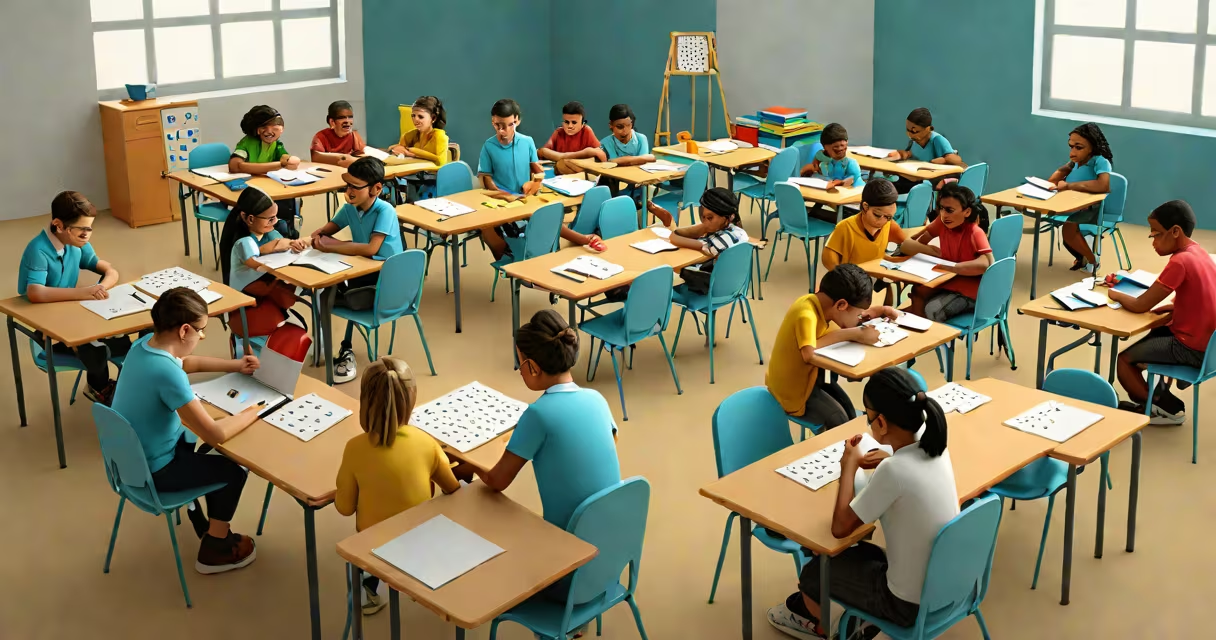
Illustrative Math is a K-12 mathematics curriculum developed by nonprofit organizations and educators to promote deep conceptual understanding, procedural fluency, and mathematical reasoning through coherent, research-backed lesson design. It emphasizes student thinking, collaborative learning, and real-world application over rote memorization.
The curriculum was created by the nonprofit organization Illustrative Mathematics, founded by mathematicians and educators including Bill McCallum, who served as lead author and director. It aligns with the Common Core State Standards for Mathematics (CCSSM), but goes beyond standards compliance by embedding instructional routines that support diverse learners. The program is available free under a Creative Commons license for public schools and districts.
Each grade level includes units focused on specific mathematical domains-number sense, algebra, geometry, statistics-and each unit contains daily lessons structured around a central mathematical idea. Lessons begin with a warm-up to activate prior knowledge, proceed through a main task requiring reasoning and discussion, and conclude with a synthesis and reflection. This structure ensures consistent cognitive demand and supports long-term retention.
Illustrative Math uses a deliberate sequence of tasks and discussions to guide students toward mastery. Each lesson centers on a single, rich problem that requires students to engage with multiple representations-visual models, equations, verbal explanations, and real-life contexts. For example, in Grade 6 Unit 1 on area, students explore how to decompose irregular shapes into rectangles and triangles, then calculate total area using formulas they've derived through hands-on work.
Teachers receive detailed lesson plans with anticipated student responses, formative assessment strategies, and differentiation suggestions. These resources reduce planning time and ensure consistency across classrooms. A key feature is the "Mathematical Practices" embedded throughout-students are explicitly taught to reason abstractly, construct viable arguments, model with mathematics, and attend to precision.
Classroom discourse is central. Instead of teacher-led lectures, students present their solutions, compare approaches, and critique reasoning. Research from the University of Michigan's Center for the Study of Teaching and Learning shows that classrooms using Illustrative Math report higher levels of student engagement and improved performance on standardized assessments compared to control groups using traditional curricula.
The curriculum is organized into units, each lasting 3-6 weeks depending on grade level. Units follow a predictable format:
Each unit ends with a summative assessment aligned to the unit's learning goals. Formative assessments are integrated into daily activities through observation prompts and exit tickets.
For example, in Grade 8 Unit 4 on linear equations, students analyze patterns in tables and graphs to predict future values. They compare different methods-such as using slope-intercept form versus iterative substitution-and justify which approach is most efficient in various scenarios. This builds both computational skill and conceptual clarity.
Illustrative Math offers distinct versions tailored to different educational settings:
| Version | Grade Range | Use Case | Key Features |
|---|---|---|---|
| Illustrative Mathematics K-12 | K-12 | Public school districts, charter networks | Free, open-source, aligned with CCSSM, includes teacher guides and digital tools |
| IM K-5 | K-5 | Elementary schools | Focus on number sense, place value, early algebraic thinking; includes manipulative-based lessons |
| IM Algebra 1, Geometry, Algebra 2 | 9-12 | High school courses | Integrated approach; combines algebra, geometry, and statistics within each course |
A common misconception is that Illustrative Math is only for advanced learners. In reality, it includes scaffolding for struggling students and extension tasks for those ready to go further. For instance, in Grade 4 Unit 2 on fractions, students use fraction strips and number lines to compare sizes. Teachers can assign additional challenges-like finding equivalent fractions between two given ones-to push high achievers without leaving others behind.
Many educators assume Illustrative Math is purely inquiry-based or unstructured. This is incorrect. While it encourages exploration, every lesson follows a tightly designed sequence. The curriculum specifies timing, pacing, and expected outcomes. Teachers do not improvise-they implement a carefully vetted structure.
Another misunderstanding is that it eliminates practice. On the contrary, it integrates practice into every lesson. Students solve problems repeatedly, but always within context. For example, in Grade 7 Unit 5 on rational numbers, students apply addition and subtraction of negative numbers to temperature changes, bank account balances, and elevation shifts. Practice is contextualized, not isolated.
Some confuse it with other open-access curricula like Open Up Resources. While both are free and CC-licensed, Illustrative Math has stronger alignment with national standards and more extensive professional development support. According to a 2022 study by the RAND Corporation, schools adopting Illustrative Math saw statistically significant gains in math achievement, especially among historically underserved populations.
In a middle school in Oakland, California, a teacher used Grade 7 Unit 3 on proportional relationships. Students were asked to determine whether a recipe scaled proportionally when doubling ingredients. They collected data, graphed ratios, and discussed why some recipes failed when scaled incorrectly due to ingredient interactions.
After five days of structured tasks, students presented findings. One group discovered that doubling cinnamon in a spice blend altered flavor balance, even though the ratio stayed constant. This insight led to a class conversation about real-world limitations of proportionality. The teacher reported that 92% of students met or exceeded proficiency benchmarks on the unit assessment, compared to 67% in the previous year using a traditional textbook.
I observed a sixth-grade class in Denver using Illustrative Math during a unit on ratios. Students worked in small groups to design a school garden using a 3:2 ratio of flower beds to vegetable plots. They drew scale diagrams, calculated area, and debated layout options based on sunlight and water access. The teacher circulated, asking probing questions like "Why did you choose that ratio?" and "How would changing one dimension affect the whole plan?"
What stood out was the depth of student reasoning. One student explained, "If we make the flower bed twice as wide, the vegetables won't get enough sun." She had applied proportional reasoning to a physical constraint-a level of abstraction rarely seen in traditional math classes.
Illustrative Math addresses systemic inequities in math education by ensuring all students, regardless of background, have access to rigorous, engaging content. Its focus on language, representation, and collaboration makes math accessible to English learners and students with disabilities. The curriculum includes explicit supports such as sentence frames, visual aids, and multilingual glossaries.
Research from the National Council of Teachers of Mathematics (NCTM) confirms that teaching math as a process of sense-making-rather than a set of procedures-leads to better long-term outcomes. Illustrative Math embodies this principle. It doesn't just teach students how to solve problems-it teaches them how to think like mathematicians.
For educators seeking a structured yet flexible alternative to traditional textbooks, Illustrative Math provides a research-driven foundation that supports both student growth and teacher effectiveness. It's not a quick fix, but a sustainable model for building mathematical literacy across grades and communities.
Understanding what is illustrative math reveals a shift from passive learning to active reasoning. It's not about getting the right answer-it's about understanding why the answer makes sense. This approach prepares students not just for tests, but for life.