The Stamp Act of 1765 required colonists in British North America to pay a tax on every piece of printed paper they used, including legal documents, newspapers, licenses, and playing cards. This was the first direct tax Parliament imposed on the colonies, and it sparked immediate backlash.
The law mandated that all such items carry a revenue stamp purchased from the Crown. The cost varied by document type-legal papers were more expensive than newspapers-but the principle was consistent: colonists had to pay for the right to communicate officially or commercially. The tax applied to all thirteen colonies and was enforced through customs officials and fines for non-compliance.
Colonists argued that since they had no representation in Parliament, taxing them violated their rights as British subjects. The slogan "No taxation without representation" became central to colonial resistance. The act was repealed in 1766 after months of protests, boycotts, and violence against tax collectors.
Parliament passed the Stamp Act on March 22, 1765, and it took effect on November 1, 1765. The tax applied to many paper-based transactions. For example, a marriage license cost six shillings, a newspaper six pence, and a legal document one pound. These amounts were significant for artisans, merchants, and lawyers who relied on frequent documentation.
Revenue stamps were issued by the British government and sold through authorized agents. Colonists had to purchase them and affix them to documents before using them. Failure to comply resulted in fines or confiscation. Officials in Boston, New York, and Charleston reported enforcement challenges due to public defiance.
A key feature was the centralized collection of funds. Unlike indirect taxes on imports, which were collected at ports, the Stamp Act required every transaction involving paper to be documented and taxed at the point of use. This created a visible, daily reminder of imperial control.
The act targeted specific categories of printed material. The following list shows the most common items subject to the tax:
| Document Type | Tax Amount (in shillings) | Example Use |
|---|---|---|
| Legal documents (deeds, wills) | 10s | Transferring land ownership |
| Newspapers and pamphlets | 6d | Weekly publication in Philadelphia |
| Licenses (for trades, gambling) | 1s-5s | Operating a tavern or running a lottery |
| Playing cards and dice | 1s | Entertainment in taverns |
| Insurance policies | 1s | Shipping cargo across the Atlantic |
These rates were standardized across colonies, though local enforcement varied. In some areas, printers refused to publish until the tax was lifted. In others, people used blank paper and forged stamps.
The British government enacted the Stamp Act to help cover the costs of maintaining troops in North America after the Seven Years' War. The war had left Britain with a national debt of £133 million, and military expenses in the colonies remained high. Prime Minister George Grenville argued that the colonies should contribute to their own defense.
However, the act failed to achieve its financial goals. Revenue from the tax totaled only £16,000 in the first year-far below estimates. More, it triggered a political crisis. Colonial assemblies passed resolutions condemning the act as unconstitutional. The Virginia House of Burgesses, led by Patrick Henry, passed five resolutions declaring that only colonial legislatures could tax colonists.
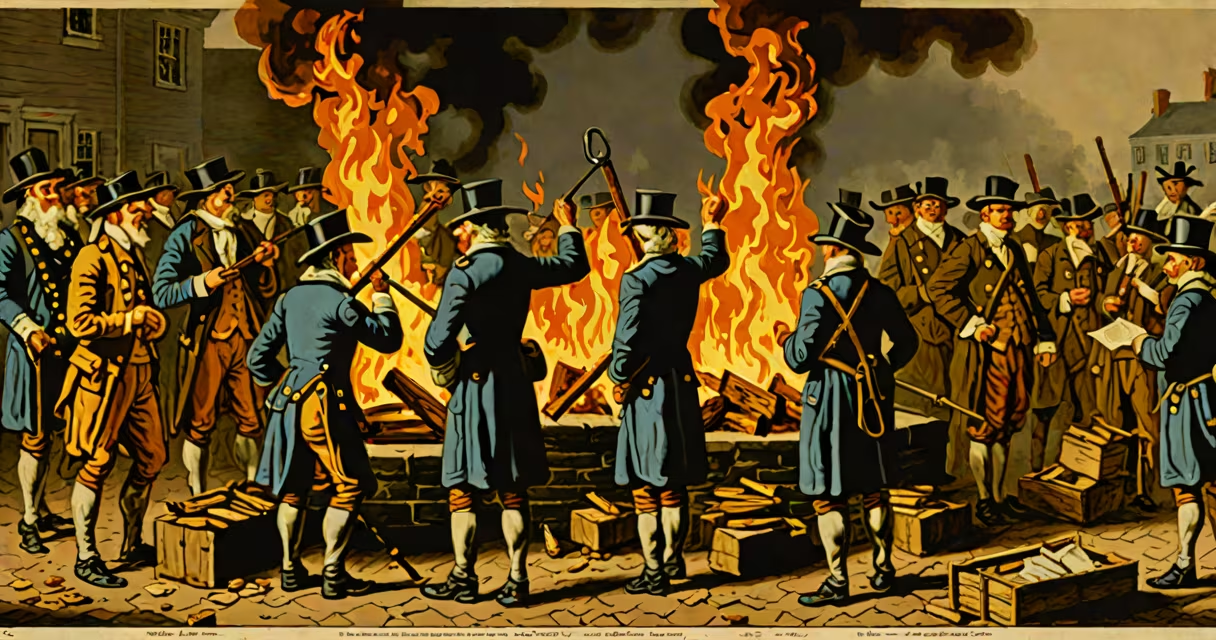
Protests escalated quickly. Sons of Liberty groups formed in major cities. In New York, protesters burned a governor's effigy. In Boston, crowds attacked the home of Lieutenant Governor Thomas Hutchinson. One notable incident involved a mob destroying the house of Andrew Oliver, the colony's stamp distributor, who resigned under pressure.
Many assume the Stamp Act was a minor tax or a one-off policy. In reality, it was part of a broader effort to assert parliamentary authority over the colonies. The act was not repealed because it was ineffective-it was repealed because it caused unrest that threatened imperial stability.
Another misconception is that the colonies united instantly. They did not. Some merchants in New York and Philadelphia continued trading despite the tax. Only after coordinated resistance through the Stamp Act Congress in October 1765 did unified action emerge. Thirteen colonies sent delegates to New York City to draft a Declaration of Rights and Grievances.
A lesser-known fact: the act's enforcement relied heavily on local officials who often lacked loyalty to London. Many customs agents were bribed or intimidated. In South Carolina, the governor reported that no stamps were ever used in practice due to local refusal.
In August 1765, a crowd gathered in Boston Common to burn a copy of the Stamp Act. They paraded a dummy representing the tax collector, Andrew Oliver, through the streets. When Oliver's house was reached, the mob broke windows and set fire to his property. The event was widely reported in colonial newspapers, including the Boston Gazette.
Local leaders later admitted that the protest was orchestrated by the Sons of Liberty, a group formed specifically to resist the act. Their tactics included public demonstrations, threats against tax agents, and organizing boycotts of British goods. These actions helped build momentum for future resistance.
The repeal of the Stamp Act in 1766 did not resolve tensions. Parliament passed the Declaratory Act the same year, asserting its right to legislate for the colonies "in all cases whatsoever." This declaration laid the groundwork for future conflicts.
Historians like Edmund Morgan, in Benjamin Franklin: An American, note that the Stamp Act marked the first time colonial leaders formally challenged Parliament's authority. The resistance demonstrated that coordinated action across colonies was possible-a foundation for later unity during the Revolutionary War.
Modern scholars, including those at the Library of Congress, emphasize that the act's failure was not economic but political. It revealed that colonial consent-whether expressed through elected bodies or public opinion-was essential to effective governance. As the National Archives notes, "The Stamp Act crisis showed that taxation without representation could not be sustained in a society that valued liberty."
Today, the principles raised by the Stamp Act influence debates about federal power, state autonomy, and citizen rights. The idea that laws affecting people must involve their input remains central to democratic systems.
Understanding what the Stamp Act did reveals more than a historical tax-it exposes the roots of American political identity. The act didn't just raise money; it forced a reckoning over who governs whom.