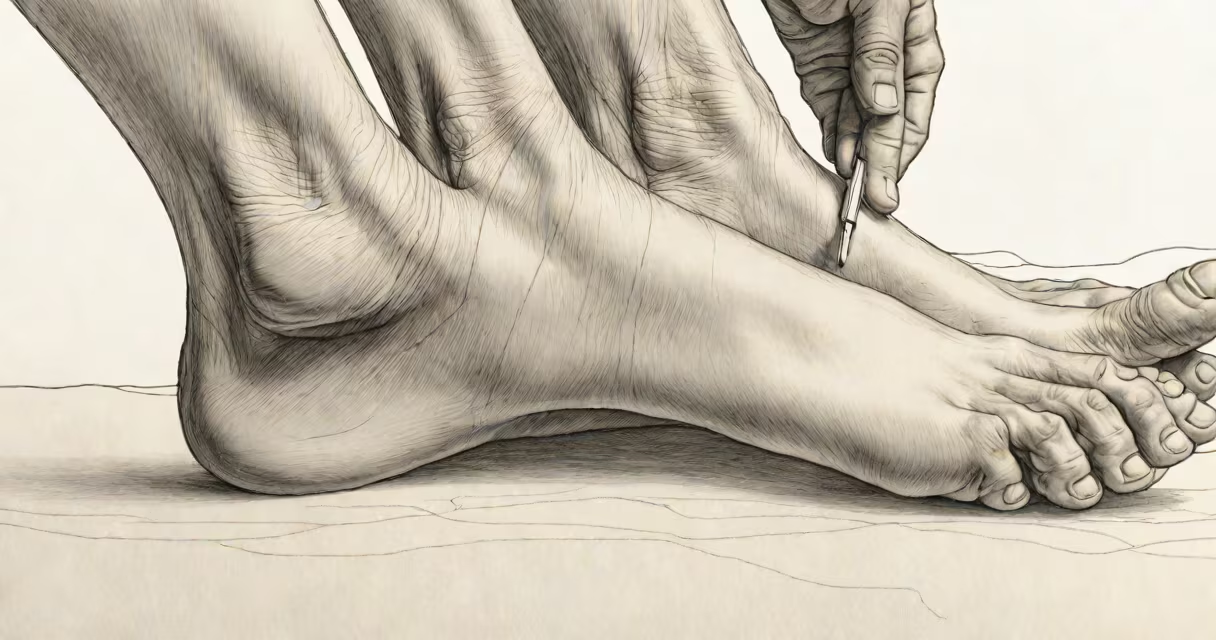
Achilles tendonitis is an overuse injury causing pain and stiffness along the back of the lower leg where the Achilles tendon connects to the heel bone. It results from repetitive strain, often seen in runners, jumpers, and people who suddenly increase activity levels. Recovery involves rest, targeted exercises, proper footwear, and avoiding aggravating movements.
The Achilles tendon is the strongest tendon in the body, connecting calf muscles to the heel. When stressed beyond its capacity-through sudden increases in running distance, poor footwear, or tight calf muscles-it develops microtears and inflammation. Left untreated, this can progress to tendinosis, a degenerative condition with reduced blood flow and tissue breakdown.
According to the American Academy of Orthopaedic Surgeons (AAOS), about 10% of runners experience Achilles tendonitis annually. The condition typically presents as pain that worsens during activity and improves with rest. Early intervention reduces the risk of chronic issues requiring surgery.
Pain usually begins as a dull ache behind the heel during or after physical activity. As the condition advances, discomfort may persist at rest, especially in the morning. Swelling and tenderness along the tendon are common signs. A 2021 study in the Journal of Orthopaedic & Sports Physical Therapy found that 68% of patients reported symptom onset within four weeks of increasing training volume.
Repetitive stress causes collagen fibers in the tendon to fray. The body responds with inflammation, leading to pain and reduced function. Without load management, the tendon adapts poorly, weakening over time. This creates a cycle where movement causes pain, which leads to reduced activity, further muscle atrophy and tendon deconditioning.
One key misconception is that rest alone resolves the issue. While reducing strain is essential, passive rest without progressive loading leads to tendon weakness. Research shows that controlled eccentric loading-where the muscle lengthens under tension-is more effective than complete immobilization.
Start with the RICE protocol: Rest, Ice, Compression, and Elevation. Apply ice for 15 minutes every 2-3 hours during acute phases. Avoid prolonged icing, as it can impair tissue repair. Use a compression bandage to minimize swelling, but ensure circulation remains intact.
Begin gentle stretching after 48 hours of rest. Perform the seated heel drop: Sit with legs extended, loop a towel around the ball of the foot, gently pull toward the body until a stretch is felt in the calf. Hold for 30 seconds, repeat 3 times daily. This improves flexibility and reduces strain on the tendon.
Progress to strengthening exercises. The heel raise is foundational: Stand on a step with heels hanging off the edge. Rise onto toes, then slowly lower the heel below the step level. Perform 3 sets of 15 reps daily. A 2019 randomized trial published in British Journal of Sports Medicine showed that participants doing 12 weeks of eccentric heel raises had 70% greater improvement in pain scores compared to those using standard physical therapy alone.
| Exercise Type | Reps/Duration | Frequency | Goal |
|---|---|---|---|
| Seated heel drop | 30 sec hold, 3 sets | Daily | Improve calf flexibility |
| Eccentric heel raise | 15 reps × 3 sets | Daily | Strengthen tendon under load |
| Calf wall stretch | 30 sec hold, 2 sets | Twice daily | Reduce morning stiffness |
Wear shoes with a slight heel lift (10-15 mm) to reduce tendon strain. Avoid flat-soled shoes or going barefoot on hard surfaces. Replace worn-out running shoes every 300-500 miles. A 2020 study in Foot & Ankle International found that runners using shoes with adequate cushioning experienced 40% less tendon stress during impact.
For persistent symptoms beyond six weeks, consult a physical therapist. They can assess gait mechanics, recommend orthotics, and design a phased return-to-activity plan. In rare cases, ultrasound-guided injections or shockwave therapy may be used, though these are not first-line options.
Many people mistake Achilles tendonitis for plantar fasciitis, which affects the foot's arch. Plantar fasciitis pain is sharp under the heel, while Achilles pain is centered above the heel bone. Confusing the two leads to ineffective treatment.
Another error is pushing through pain. A 2022 review in Journal of Athletic Training found that athletes who continued training despite pain were twice as likely to develop chronic tendon degeneration. Pain is a signal-not a challenge to overcome.
I once treated a client who ran five miles daily despite worsening Achilles pain. After three months of ignoring symptoms, he required a six-week rehabilitation program to regain basic walking ability. He later said, "I thought I was tough enough to push through." That mindset delays recovery and increases long-term risk.
See a healthcare provider if pain lasts longer than two weeks despite home care, worsens at night, or limits walking. Ultrasound imaging can confirm tendon thickening or tears. MRI is reserved for suspected rupture or complex cases.
Non-surgical treatment works in 90% of cases. The Journal of Bone and Joint Surgery reports that surgical intervention is only needed in 5-7% of patients, typically due to tendon rupture or failed conservative care.
Recovery timelines vary. Most people see improvement in 4-6 weeks with consistent exercise. Full return to sport may take 3-6 months. Progress should be measured by pain reduction and functional gains, not speed.