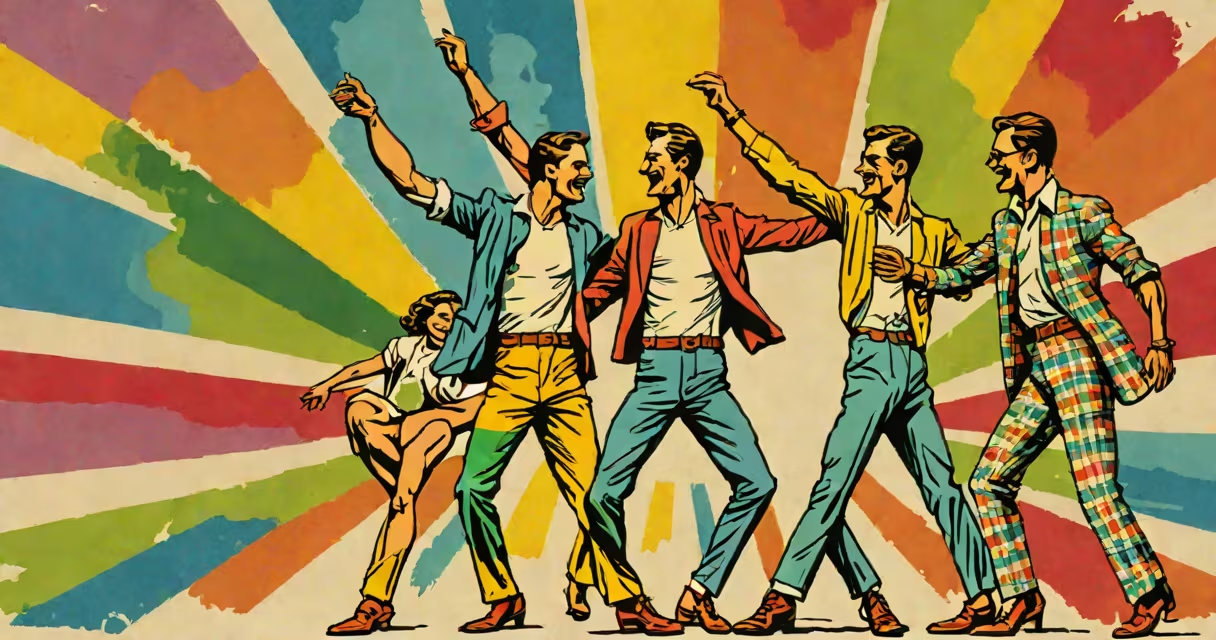
The word "gay" originally meant cheerful or carefree, but since the mid-20th century, it has primarily referred to a person who is attracted to others of the same sex. This shift in meaning reflects both linguistic evolution and social change.
Historically, "gay" appeared in English as early as the 1500s, describing someone lively or frivolous. By the 1800s, it was used in phrases like "gay old time" to describe fun or festive occasions. The Oxford English Dictionary documents this usage through literary examples, including Shakespearean references to "gay apparel."
By the 1920s and 1930s, "gay" began appearing in American slang to describe men who were openly homosexual. This usage became widespread in urban gay communities, particularly in cities like New York and San Francisco. The shift was not abrupt-it developed gradually through coded language in literature, music, and underground networks.
The transformation from "joyful" to "homosexual" occurred during a period of intense social scrutiny. As homosexuality was criminalized in many countries, coded language helped people identify one another safely. "Gay" became a euphemism within these circles, allowing discreet communication.
By the 1960s, the term had entered mainstream discourse. The Stonewall Riots of 1969 marked a turning point in LGBTQ+ visibility. Activists adopted "gay" as a political identity, reclaiming it from stigma. The term gained public recognition through media, protests, and advocacy groups like the National Gay Task Force.
Today, "gay" is widely accepted as a descriptor for same-sex attraction. According to the American Psychological Association, using accurate terminology supports mental health and reduces discrimination. The term applies to both men and women, though "gay man" and "gay woman" are common pairings.
Many assume "gay" only describes men. This is incorrect. While historically used more frequently for men, the term includes women in modern usage. A woman attracted to other women is correctly described as gay.
Another misconception is that "gay" implies promiscuity or lifestyle choices. This is false. Sexual orientation is about internal attraction, not behavior. The term does not describe frequency of relationships or sexual activity.
A less obvious point: "gay" is not interchangeable with "queer." While both refer to non-heterosexual identities, "queer" is broader and sometimes used as an umbrella term. "Gay" specifically denotes same-sex attraction. Using them interchangeably can erase nuance.
There are three primary contexts in which "gay" appears:
| Context | Meaning | Example |
|---|---|---|
| Historical/Archaic | Happy, lighthearted | "They had a gay time at the party." |
| Modern/LGBTQ+ | Same-sex attraction | "She's proud to be a gay woman." |
| Cultural/Slang | Informal, often playful | "That outfit is so gay!" (used ironically) |
When used in modern LGBTQ+ contexts, "gay" is respectful and self-identifying. In casual speech, however, it can be misused as an insult. Saying "that's so gay" to mock something perpetuates stigma. The American Dialect Society notes that such usage contributes to anti-LGBTQ+ bias.
Using "gay" in a derogatory way is not just offensive-it's harmful. Research from the Human Rights Campaign shows that youth exposed to homophobic language are more likely to experience depression and suicidal ideation. Language shapes perception, and misuse of terms like "gay" reinforces marginalization.
In 2019, the film *The Half of It* portrayed a high school student going through friendship and romantic feelings for a girl. The protagonist, Ellie, uses the term "gay" to describe her own identity. Her mother, initially unfamiliar with the term, asks, "Are you saying you're gay?" The scene captures generational shifts in understanding.
This moment reflects a broader trend. In 2020, Pew Research Center found that 61% of Americans aged 18-29 identified as supportive of LGBTQ+ rights. Among younger adults, the term "gay" is widely recognized and accepted as a valid identity label. In contrast, older generations may still associate it with outdated or negative connotations.
Language evolves with society. The shift from "gay" meaning "lively" to "same-sex attraction" demonstrates how words gain new layers of meaning over time. The process is not arbitrary-it results from lived experience, community activism, and cultural change.
I once taught a high school English class where students debated whether "gay" could be used to describe a joyful event. One student argued, "It's not about sexuality-it's about happiness." I asked how they'd feel if someone called their identity "just a mood." The silence that followed revealed the disconnect between historical usage and modern identity.
That moment underscored a key principle: words carry weight beyond dictionary definitions. When a term becomes central to someone's identity, its usage must reflect respect, not reduction.
Understanding "gay" requires distinguishing it from similar terms:
While "gay" is specific, "queer" is expansive. Using either term appropriately depends on context and personal preference. Always follow the individual's lead when asking about identity.
The meaning of "gay" today centers on identity, inclusion, and self-expression. It is not merely a synonym for "happy"-it is a declaration of belonging. When used accurately, it affirms dignity. When misused, it harms. Language matters. So do the people behind the words.