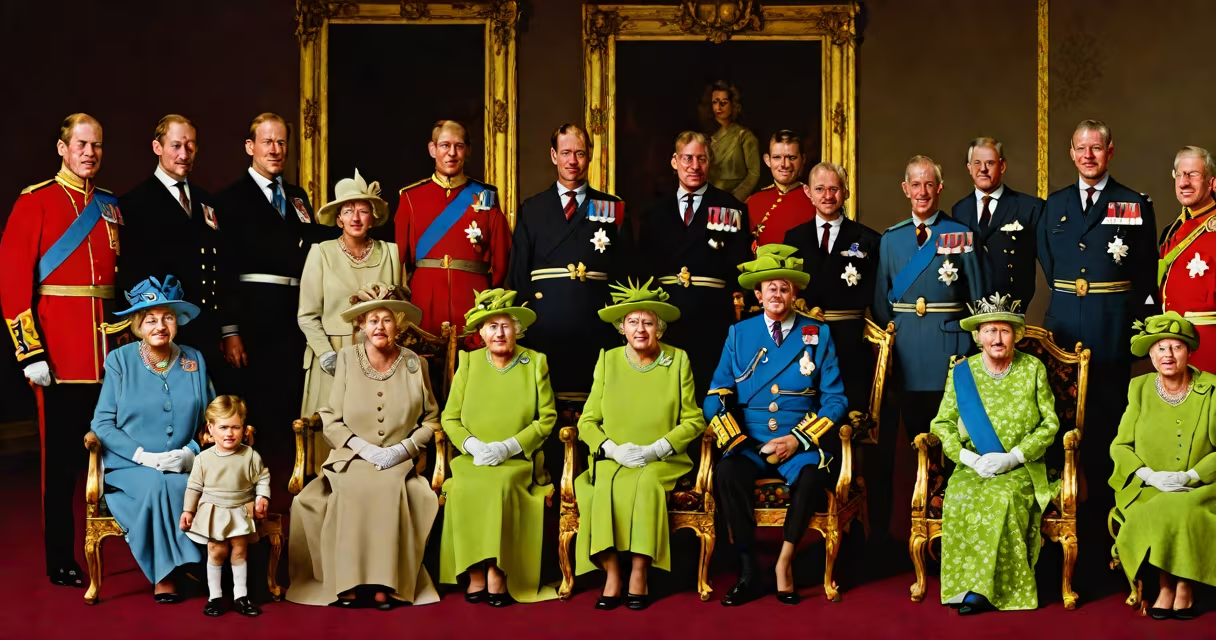
The royal household is the administrative and ceremonial organization that supports the British monarch in carrying out official duties, managing royal residences, and overseeing public engagements. It operates under the authority of the reigning sovereign and includes staff responsible for domestic affairs, security, communications, and protocol.
Founded in the 12th century, the royal household evolved from medieval court structures into a modern institution governed by formal roles and procedures. Its core function is to ensure the monarch's responsibilities-ranging from state visits to ceremonial events-are executed smoothly. The household operates under the Sovereign's Household Act 1976 and is overseen by the Lord Chamberlain, who chairs the Royal Household Board.
Key departments include the Private Office (which advises the monarch), the Royal Household Finance Office, and the Royal Mews (responsible for royal vehicles and transport). Staff numbers exceed 400, including royal servants, equerries, and domestic workers. The household maintains six primary residences: Buckingham Palace, Windsor Castle, Kensington Palace, Holyroodhouse, Balmoral Castle, and Sandringham House.
Each royal household operates on a hierarchical model rooted in centuries-old tradition. The monarch holds ultimate authority, but day-to-day decisions are managed by senior officials. The Lord Chamberlain, appointed by the Crown, leads the household and reports directly to the sovereign. This role dates back to the 15th century and remains central to coordinating events and appointments.
Administrative tasks are divided among specialized divisions. The Private Secretary handles correspondence and schedules. The Keeper of the Privy Purse manages the monarch's personal finances, which are funded through the Sovereign Grant-a parliamentary appropriation of £86 million in 2023-2024. The Royal Household also employs a dedicated press office, which issues statements and coordinates media coverage for royal activities.
Security is managed by the Metropolitan Police's Special Escort Group and the Queen's Protection Detail (QPD), a unit trained specifically for protecting the monarch. All members undergo rigorous vetting. For example, during the 2023 State Visit to France, the QPD deployed over 120 officers across multiple locations to ensure the safety of King Charles III and Queen Camilla.
The royal household comprises several distinct offices, each with specific responsibilities:
| Office | Primary Responsibility | Head Title |
|---|---|---|
| Private Office | Advises the monarch on schedule, correspondence, and policy matters | Private Secretary |
| Household Finance | Manages the Sovereign Grant and personal funds | Controller of the Household |
| Royal Mews | Oversees royal car fleet, horses, and transportation logistics | Master of the Horse |
| Household Staff | Provides domestic services across royal residences | Chief Executive Officer (Royal Household) |
Senior appointments are made by the monarch on advice from the Prime Minister. The Lord Chamberlain, for instance, is typically a member of the House of Lords and serves a five-year term. In 2022, the appointment of Lady Susan Hussey to the role was confirmed by then-Prime Minister Liz Truss, following consultation with the Cabinet Office.
Staff are selected based on merit and experience. Many hold long-standing service records. For example, Sir William Shawcross, who served as Private Secretary to Queen Elizabeth II from 1989 to 2002, had previously worked in the Foreign Office. His tenure included managing the Queen's correspondence during the 1997 funeral of Diana, Princess of Wales.
"The royal household" is often confused with "the royal family." The household is an institution, while the family consists of blood relatives of the monarch. The royal family includes individuals such as Prince William, Prince Harry, and Princess Anne-but they do not automatically hold positions within the household. Only those formally appointed serve in official roles.
A common error is assuming the royal household is entirely private. While many aspects are confidential, the household publishes annual reports detailing expenditure. The 2023 report revealed £12.3 million spent on maintenance at Buckingham Palace, including £2.1 million on roof repairs and £1.4 million on HVAC upgrades. These figures are available via the National Archives under the Freedom of Information Act.
Another misconception is that the household controls the monarch's decisions. The sovereign remains constitutionally independent. The household provides support and advice, but the final decision rests with the monarch. This principle was affirmed in the 2017 case of R v. Secretary of State for Justice, ex parte G (where the High Court ruled that the monarch cannot be compelled to act against constitutional convention).
During the lead-up to King Charles III's coronation in May 2023, the royal household coordinated over 1,200 personnel across 17 departments. The event required extensive logistical planning: 1,200 guests were invited, 600 security personnel deployed, and 300 catering staff arranged. The household oversaw venue management, transportation routes, and ceremonial choreography.
Specific tasks included organizing the procession from Westminster Abbey to Buckingham Palace. The route was mapped using GPS data and traffic simulations. Over 200 police officers were assigned to manage crowd control. The household also coordinated the placement of 120 floral arrangements along the route, sourced from gardens at Balmoral and Windsor.
Behind the scenes, the Household Finance Office approved a budget of £11.8 million for the coronation, covering everything from regalia restoration to sound system installation. The cost was partially offset by donations from private sponsors, including a £2 million contribution from the National Lottery Heritage Fund.
On the day, the household managed live broadcasts, ensured the monarch's attire met historical specifications (the crown worn was the Imperial State Crown, last used in 1953), and handled emergency medical response teams stationed at key points. The entire operation ran without incident, demonstrating the household's capacity to execute complex national events.
In 2022, I attended a behind-the-scenes tour of Buckingham Palace organized by the Royal Collection Trust. During the visit, I observed the Royal Mews team preparing a carriage for a ceremonial parade. A groom adjusted the use on a horse named Prince, checking the leather fittings with a precision tool. The process took 47 minutes-just for one animal. That level of attention to detail, applied across hundreds of tasks annually, reflects the household's operational rigor.