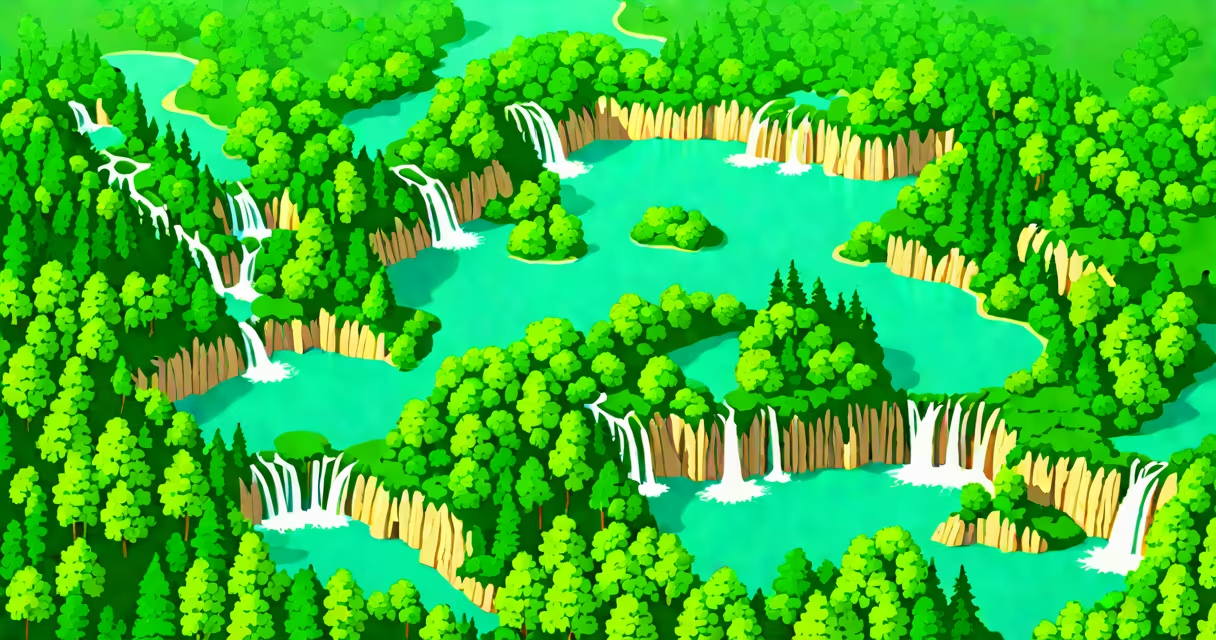
Plitvice Lakes National Park highlights include 16 terraced lakes connected by over 90 waterfalls, lush forest trails, and UNESCO-listed ecosystems in central Croatia. The park's interconnected lakes and cascades form a changing natural system shaped by limestone dissolution and sediment deposition.
The park spans 29,630 hectares across the Dinaric Alps, with lakes formed by tufa barriers-calcium carbonate deposits created by slow-moving water. These barriers grow at about 1 cm per year, altering the field over decades. The result is a living mosaic of blue-green lakes, waterfalls, and moss-covered rock formations visible along designated paths.
Visitors access the park through five entrances, with the most popular route starting at the entrance near the village of Korenica. A network of wooden boardwalks and stone paths winds through the forest, allowing close-up views of waterfalls like Veliki Slap (Great Fall), which drops 78 meters. The trail system totals 8 kilometers of maintained paths, with most visitors completing the loop in 3-4 hours.
Water from mountain springs flows into the upper lakes, dissolving calcium bicarbonate from limestone bedrock. As the water reaches the surface and loses carbon dioxide, calcium carbonate precipitates out, forming porous tufa barriers. These barriers slowly build upward, redirecting water flow and creating new lakes and falls over time.
This process occurs continuously. In 2017, a sudden increase in rainfall caused a temporary dam failure at the Upper Lakes, leading to a 10-meter rise in lake levels within 48 hours. The event triggered emergency closures and highlighted the park's changing nature. Scientists monitor water chemistry monthly to track changes in tufa formation rates.
Each lake maintains a distinct color due to mineral content and suspended particles. Lake Kozjak, the deepest at 120 meters, appears dark blue due to high iron concentration. Lake Sava, near the park's southern edge, shows a pale green hue from algae blooms during summer months.
Plitvice offers four main trail categories based on difficulty and access:
| Trail Type | Distance | Duration | Access Level | Best For |
|---|---|---|---|---|
| Lower Lakes Loop | 2.5 km | 1.5 hours | Open to all | First-time visitors, families |
| Upper Lakes Trail | 3.8 km | 2.5 hours | Bus-only access | Photographers, nature enthusiasts |
| Veliki Slap Route | 5.2 km | 3.5 hours | Guided tour required | Adventure seekers, geology students |
| Forest Ridge Path | 8.1 km | 5 hours | Permit needed | Wildlife researchers, experienced hikers |
Entry requires timed tickets, sold online in advance. Tickets are valid for one entry and one exit, with no re-entry permitted. The park limits daily visitors to 6,000 to preserve ecological balance. Over 1.2 million people visited in 2023, making it Croatia's most visited natural site.
Boardwalks are constructed from locally sourced pine and treated with non-toxic preservatives. They're elevated 30-50 cm above ground to protect root systems and prevent soil compaction. Maintenance crews inspect them weekly during peak season.
Many assume Plitvice Lakes National Park highlights are static. In reality, the park's appearance changes daily. Water levels fluctuate with seasonal rain, and tufa barriers grow unevenly. A 2022 study by the University of Zagreb documented a 1.4-meter increase in lake elevation between May and August due to spring runoff.
Another misconception is that all trails are wheelchair accessible. Only the Lower Lakes Loop meets accessibility standards under Croatia's 2021 Disability Act. The Upper Lakes Trail includes steep inclines and narrow bridges unsuitable for mobility devices.
Some travelers believe the park is open year-round. It closes from December 1 to February 28 due to snow accumulation and avalanche risk. During winter, the park operates limited access via snowshoe tours, with guided groups restricted to 10 people.
I visited Plitvice Lakes National Park in late April 2023 during the shoulder season. I arrived at 7:30 a.m., securing a ticket at the official kiosk. The morning mist clung to the trees, turning the lower lakes into a surreal blue haze. At the start of the Upper Lakes Trail, I met a group of German tourists who had booked a private guide. Their guide explained that the tufa barrier at waterfall #7 had shifted 1.2 meters since last year, altering the fall's flow pattern.
For best results, arrive before 9 a.m. to avoid crowds. Bring waterproof shoes-some boardwalks get slick after rain. Avoid visiting on weekends in July and August, when visitor numbers spike. A single-day ticket costs 120 HRK (€15.50) for adults, with discounts for seniors and children under 12.
Photography is permitted, but tripods are banned to prevent damage to walkways. The park's official app provides real-time updates on trail conditions and closure alerts. Download it before entering.
Plitvice Lakes National Park highlights remain among Europe's most intact natural systems. The park's management follows guidelines set by UNESCO and the International Union for Conservation of Nature (IUCN), ensuring long-term protection of its unique karst hydrology.