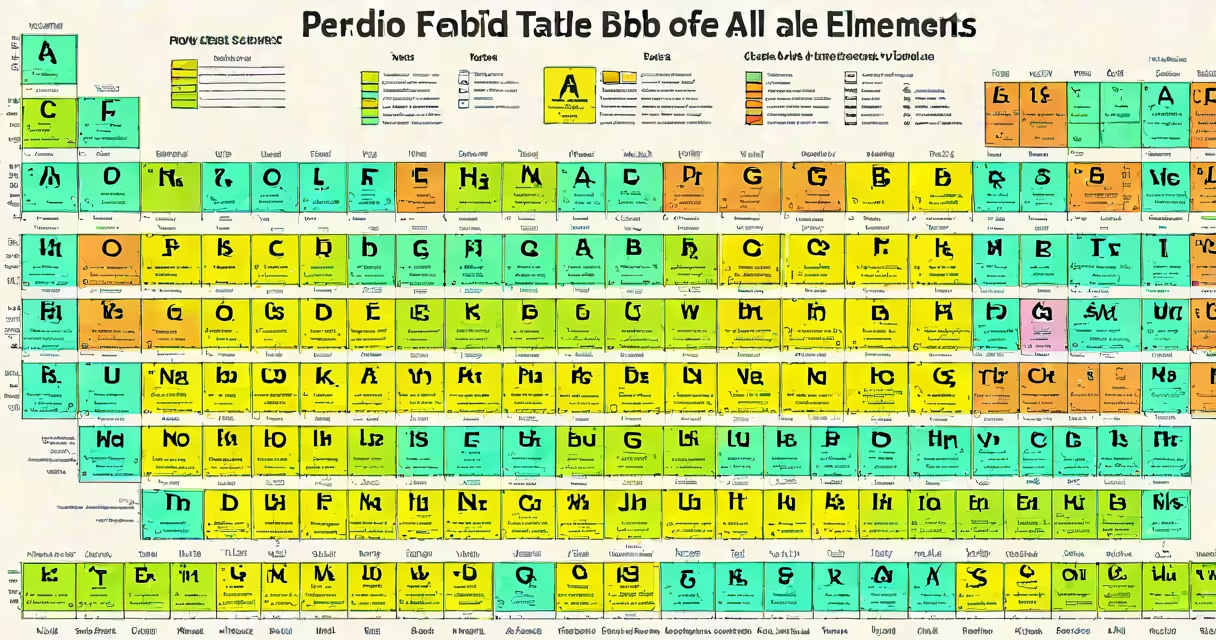
The periodic table of all elements with names is a structured arrangement of the 118 known chemical elements, ordered by increasing atomic number, grouped by recurring chemical properties, and labeled with their standard names and symbols.
This table organizes elements based on electron configuration and periodic trends. Each element appears in a specific position determined by its atomic number-the number of protons in its nucleus. The layout reveals patterns in reactivity, electronegativity, ionization energy, and atomic radius across periods (rows) and groups (columns).
Elements are categorized into metals, metalloids, and nonmetals. Metals dominate the left side and center; nonmetals occupy the upper right; metalloids form a staircase between them. The table includes naturally occurring elements (up to uranium, atomic number 92) and synthetic elements created in labs beyond uranium.
Elements are arranged in rows (periods) and columns (groups). There are seven periods and 18 groups. Each period corresponds to a new principal energy level being filled with electrons. Groups contain elements with similar valence electron counts and thus similar chemical behavior.
For example, Group 1 (alkali metals) includes lithium (Li), sodium (Na), and potassium (K). These elements all have one electron in their outermost shell and react vigorously with water. Group 17 (halogens) includes fluorine (F), chlorine (Cl), and bromine (Br)-elements that gain one electron to achieve stability.
Elements are placed in order of increasing atomic number. Hydrogen (atomic number 1) starts the table. Oganesson (Og, atomic number 118) is the last confirmed element. The placement reflects electron shell filling: s-block (Groups 1-2), p-block (Groups 13-18), d-block (transition metals, Groups 3-12), and f-block (lanthanides and actinides).
The periodic table divides elements into distinct categories based on physical and chemical traits:
| Category | Examples | Key Traits |
|---|---|---|
| Metallic elements | Copper (Cu), Iron (Fe), Gold (Au) | Shiny, conductive, malleable, lose electrons easily |
| Nonmetals | Oxygen (O), Nitrogen (N), Sulfur (S) | Dull, poor conductors, gain electrons in reactions |
| Metals (transition) | Iron (Fe), Nickel (Ni), Zinc (Zn) | Variable oxidation states, colored compounds, catalytic activity |
| Alkaline earth metals | Magnesium (Mg), Calcium (Ca) | Two valence electrons, reactive with water |
| Noble gases | Helium (He), Neon (Ne), Argon (Ar) | Full valence shells, extremely unreactive |
Some elements exist only briefly in laboratory settings. For example, tennessine (Ts, atomic number 117) was synthesized in 2010 and decays within milliseconds. Its existence is confirmed through decay chains, not isolation.
A key distinction often missed: not all elements are stable. Of the 118 known elements, only 88 occur naturally in measurable quantities. The remaining 30 are synthetic and must be produced via nuclear fusion in accelerators.
The periodic table is foundational in chemistry, materials science, medicine, and engineering. It predicts compound formation, guides drug design, and informs semiconductor development.
In pharmaceutical research, knowing an element's position helps estimate toxicity and metabolic pathways. For example, selenium (Se, atomic number 34) is essential in trace amounts but toxic in excess. Its placement in Group 16 explains its biological role and reactivity.
Engineers use the table to select materials for high-temperature environments. Tungsten (W, atomic number 74) has the highest melting point of all elements (3,422°C), making it ideal for light bulb filaments and rocket nozzles.
One non-obvious fact: the table's structure influenced the discovery of missing elements. Mendeleev left gaps for elements not yet found-like gallium (Ga) and germanium (Ge)-and predicted their properties with notable accuracy. His predictions were validated decades later, proving the table's predictive power.
Many assume the periodic table is complete. It is not. New elements are still being synthesized. Elements 119 and 120 are under investigation at facilities like the Joint Institute for Nuclear Research in Dubna, Russia.
Another myth: all elements are visible. Only about 30 appear in pure form under normal conditions. Most are unstable or reactive. Francium (Fr, atomic number 87) has a half-life of 22 minutes and exists in trace amounts in uranium ores.
Some confuse the periodic table with the periodic law. The law states that elemental properties recur periodically when arranged by atomic number. The table is the visual representation of that law.
I once observed a classroom demonstration where students tried to identify unknown samples using only their appearance. A piece of aluminum foil looked like silver, but its density and reaction with acid revealed it was aluminum (Al), not silver (Ag). This illustrates how the periodic table enables identification beyond surface traits.
The complete periodic table of all elements with names is available in print and digital formats. Online resources provide interactive versions with clickable entries for detailed data.
Each entry includes the element's name, symbol, atomic number, atomic mass, group, period, and classification. Data is sourced from the International Union of Pure and Applied Chemistry (IUPAC) and the National Institute of Standards and Technology (NIST).
Understanding the periodic table of all elements with names is essential for anyone studying science. It is not just a chart-it is a map of matter itself.