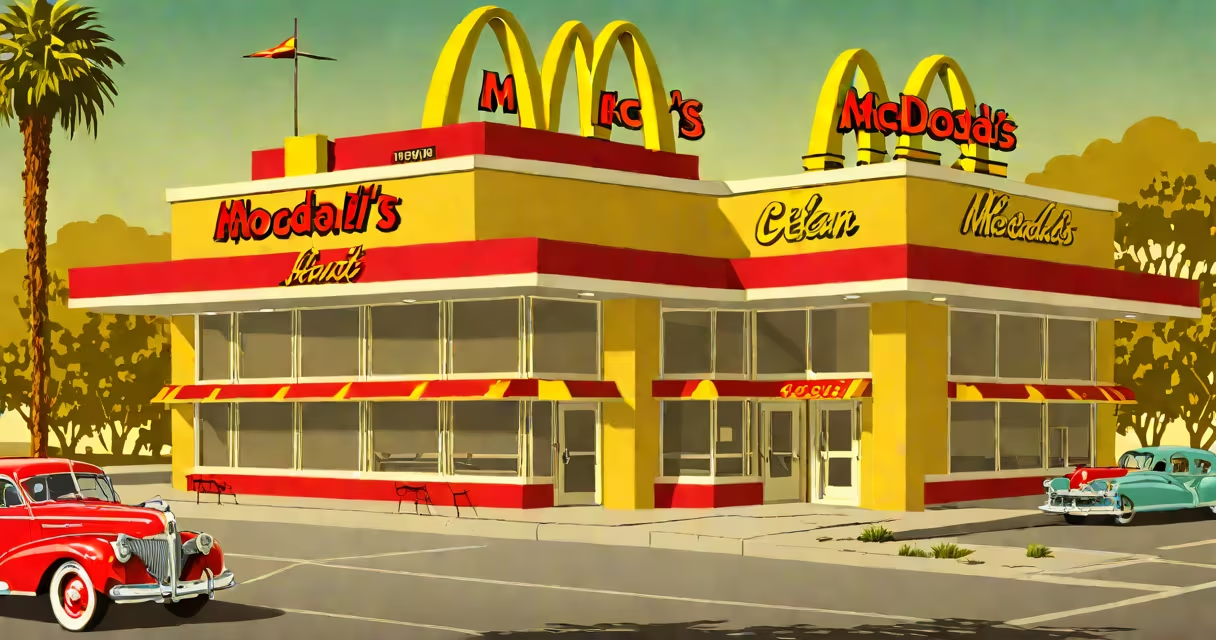
McDonald's was founded in 1940 by brothers Richard and Maurice McDonald in San Bernardino, California, as a barbecue drive-in. The company evolved into a global fast-food brand under Ray Kroc, who joined in 1955 and opened the first franchised location.
The original McDonald's opened as a hamburger stand serving $0.15 cheeseburgers and fries. The brothers operated it successfully until 1954, when they sold the rights to franchise the business model. Ray Kroc, a struggling salesman of milkshake mixers, saw potential in their system and bought the licensing rights.
Kroc's vision transformed the concept into a standardized, scalable operation. He opened his first franchised McDonald's in Des Plaines, Illinois, on April 15, 1955. That location became the blueprint for the 14,000+ stores operating globally today.
McDonald's operates on a franchise model. The company owns the brand, trademarks, and core systems-like the kitchen layout, ingredient sourcing, and customer service protocols-but individual franchisees pay for and run local locations.
Each franchisee signs a contract agreeing to follow strict operational standards. This includes using specific suppliers for ingredients like beef patties, buns, and fries. The company controls quality through centralized procurement and regular audits.
For example, McDonald's uses frozen beef patties made from 100% USDA-inspected beef. These are cooked to a precise temperature and time across all U.S. locations. This consistency ensures customers get the same product whether in New York or Tokyo.
McDonald's operates under several ownership structures. The most common are:
| Type | Ownership | Global Reach | Example |
|---|---|---|---|
| Company-Owned | McDonald's Corporation | ~16% of U.S. locations | Headquarters in Oak Brook, IL |
| Franchisee-Owned | Independent operators | ~84% of U.S. locations | Local business owners in cities like Chicago |
| Joint Venture | Partnership with local firms | Asia-Pacific, Middle East | McDonald's Japan, operated with local partners |
Franchisees pay an initial fee-$45,000 to $50,000 in the U.S.-and ongoing royalties of 4% to 5% of sales. Company-owned locations report directly to corporate and handle higher capital investment.
McDonald's does not license its name or logo to independent restaurants. Any restaurant using the McDonald's name must be officially licensed and meet audit standards. Unauthorized use results in legal action.
Many people believe Ray Kroc founded McDonald's. He did not. Kroc acquired the rights to expand the business in 1955, but the original concept came from the McDonald brothers in 1940.
Another misconception is that McDonald's began as a burger-only chain. The original menu included barbecue chicken, hot dogs, and even a breakfast sandwich called the "Big Breakfast" in 1940. The current menu evolved over decades.
A lesser-known fact: the original McDonald's restaurant in San Bernardino still stands. It was restored in 1997 and now serves as a museum. Visitors can see the original grill, cash register, and 1940s signage. The site is listed on the National Register of Historic Places.
Ray Kroc's first franchised McDonald's opened on April 15, 1955, in Des Plaines, Illinois. The building was a single-story structure with a red-and-yellow roof and a large golden arch sign.
At opening, the menu had 15 items: Big Mac (not yet invented), Quarter Pounder, fries, milkshakes, and a limited breakfast selection. Prices ranged from $0.15 for a cheeseburger to $0.25 for a combo meal.
By 1960, the Des Plaines location had served over 1 million customers. Today, it remains operational as a training center for new franchisees. The original sign is preserved in the corporate archives.
Knowing when McDonald's was founded clarifies its evolution from a regional drive-in to a global brand. The 1940 date marks the start of the business model. The 1955 date marks the beginning of mass expansion.
According to the U.S. Census Bureau, McDonald's generated $23 billion in revenue in 2023. Over 90% of its U.S. locations are franchises. The company operates in 120 countries, with over 40,000 restaurants worldwide.
McDonald's history reflects changes in American culture-from postwar suburbanization to globalization. The company's success stems from standardization, supply chain control, and consistent branding. These elements were established early and refined over decades.
My first visit to a McDonald's was in 1987, at a location near my childhood home. I remember the smell of frying potatoes and the sound of the grill. The uniformity of the experience-same food, same price, same layout-was striking. That consistency, rooted in the 1955 model, is what made the brand recognizable across borders.
Understanding when McDonald's was founded helps explain its dominance. The 1940 foundation created a functional system. The 1955 launch scaled it. Together, they built a brand that now serves over 69 million customers daily.
McDonald's was founded in 1940 by the McDonald brothers. Ray Kroc expanded it nationally in 1955. The company's growth is tied to both the original concept and its later execution. Knowing the correct founding date separates myth from history.