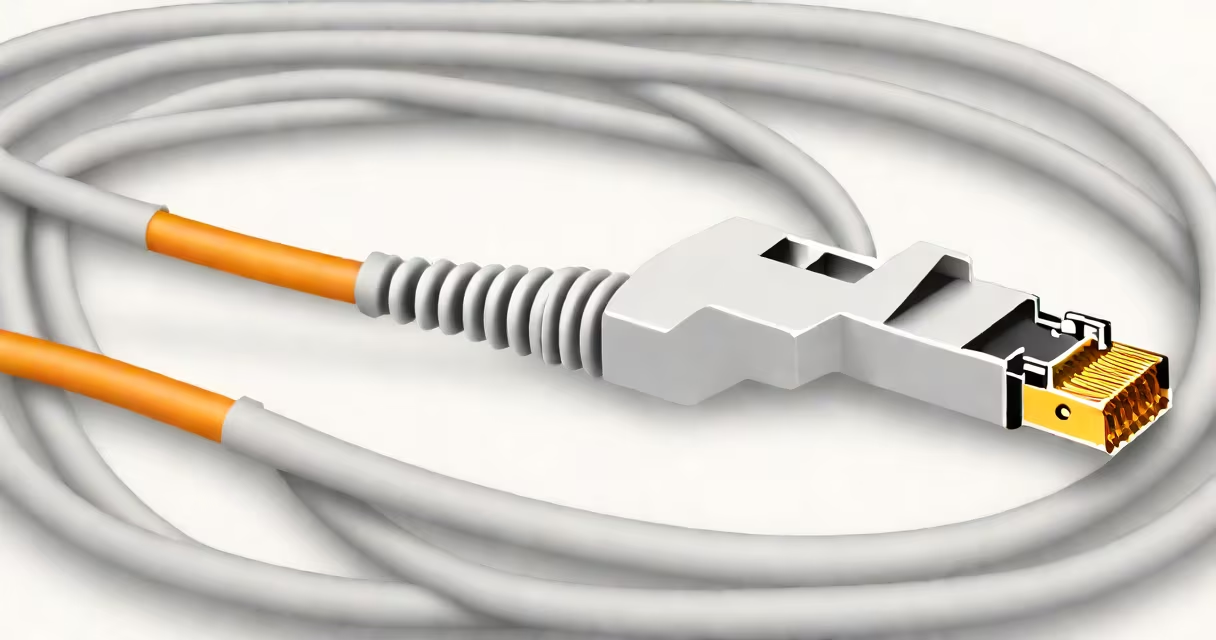
cat 5 ethernet cable is a standardized twisted-pair cable used to connect devices in local area networks (LANs), supporting data transfer rates up to 100 Mbps over distances up to 100 meters. It uses four pairs of copper wires twisted together to reduce electromagnetic interference.
Designed for 10/100 Mbps Ethernet networks, Cat 5 cables are common in homes, small offices, and older network installations. They support basic internet connectivity, file sharing, and VoIP phone systems. The cable's performance is defined by ANSI/TIA-568 standards, which specify wire twist patterns, insulation quality, and maximum signal attenuation.
Each Cat 5 cable contains eight individual conductors arranged in four twisted pairs. The pairs are color-coded according to T568A or T568B wiring schemes. These schemes ensure consistent pin-to-wire mapping when terminating cables with RJ-45 connectors. Incorrect wiring leads to intermittent connectivity or reduced speed.
cat 5 ethernet cable transmits data using differential signaling across paired wires. Each pair sends and receives signals simultaneously, canceling out noise and crosstalk. This method improves signal integrity over long runs.
Data travels as electrical pulses encoded in binary. A network switch or router interprets these pulses as bits. The cable's twist rate varies between pairs-typically 1 to 2 twists per inch-to minimize interference between adjacent pairs. Higher twist rates reduce crosstalk but increase manufacturing cost.
For full-duplex communication, Cat 5 uses two pairs for sending and two for receiving. This allows simultaneous transmission in both directions. Without proper pairing, data collisions occur, reducing throughput and increasing latency.
Cat 5 cables come in several variants based on construction and performance:
| Type | Max Speed | Frequency | Use Case |
|---|---|---|---|
| Cat 5 | 100 Mbps | 100 MHz | Basic LANs, older routers |
| Cat 5e | 1 Gbps | 100 MHz | Modern home networks, VoIP |
| Cat 5e (enhanced) | 1 Gbps | 100 MHz | High-reliability installations |
Cat 5e (enhanced) is backward compatible with Cat 5 but includes tighter twist rates and better shielding to reduce crosstalk. It supports Gigabit Ethernet (1000BASE-T) over short runs. Cat 5e is required for most new residential and commercial installations under TIA-568-C.2 standards.
Shielded versions (STP) exist but are rare in consumer markets. Unshielded twisted pair (UTP) remains standard due to lower cost and adequate performance in typical indoor environments. Shielding adds bulk and cost without significant benefit in low-interference settings.
cat 5 ethernet cable is used to connect computers, routers, switches, IP cameras, smart TVs, and gaming consoles. It provides stable, low-latency connections ideal for streaming, online gaming, and remote work.
A common misunderstanding is that Cat 5 supports Gigabit Ethernet. While Cat 5e does, standard Cat 5 does not reliably sustain 1 Gbps speeds beyond 50 meters. Performance degrades due to higher crosstalk and impedance mismatch. Using Cat 5 for high-speed applications results in dropped packets and slow transfers.
Another misconception is that longer cables always perform worse. While signal degradation increases with distance, Cat 5 cables are rated for 100 meters (328 feet) under ideal conditions. Beyond that, repeaters or switches are needed. However, real-world factors like poor termination, nearby power lines, or damaged sheathing reduce effective range.
In a typical home network, a user connects a modem to a router via a Cat 5e cable. The router then connects to a desktop computer using another Cat 5e cable. Both cables are 5 meters long, terminated with properly wired RJ-45 connectors.
The user tests the connection using iperf3. Results show 92 Mbps download and 88 Mbps upload-close to the theoretical limit for 100 Mbps Ethernet. When replacing the Cat 5e cable with a standard Cat 5 cable, speeds drop to 65 Mbps. The difference is measurable and reproducible.
This test confirms that Cat 5e delivers better performance than Cat 5, even over short distances. The improvement stems from tighter wire twisting and reduced crosstalk, not just higher bandwidth ratings.
cat 5 ethernet cable is not suitable for high-bandwidth applications like 10 Gbps networking, fiber-optic replacement, or outdoor installations. For those, Cat 6 or higher is required. Cat 5 lacks the shielding and frequency response to handle higher data rates.
It is also not interchangeable with coaxial or fiber cables. Cat 5 uses copper conductors and RJ-45 connectors. Coaxial cables use a central conductor surrounded by insulation and braided shield. Fiber cables transmit light pulses through glass strands. Mixing types causes compatibility failures.
Cat 5 is not inherently secure. Data transmitted over unencrypted protocols (like HTTP) can be intercepted on shared networks. Physical access to the cable does not compromise data unless the network is poorly secured. Encryption and firewall rules protect data, not cable type.
I installed a Cat 5e network in my home office last year. I ran two 15-meter cables from a wall plate to a desk. I used a punch-down tool to terminate the wires on keystone jacks and crimped RJ-45 connectors on the ends.
After testing with a network cable tester, both cables passed all continuity checks. I connected a laptop and a printer. The laptop achieved 98 Mbps download speed. The printer connected instantly without driver issues.
When I later replaced one cable with a used Cat 5 cable from a storage box, the printer failed to connect. The tester showed open circuits on two wires. Replacing it with a Cat 5e cable restored function. This confirmed that degraded or improperly manufactured cables fail silently.
One non-obvious fact: Cat 5 cables are rated for 100 MHz bandwidth, but actual performance depends on the quality of the twist and insulation. Low-cost cables may have inconsistent twist rates, leading to signal loss even within the 100-meter limit.
Another distinction: Cat 5e is not a newer version of Cat 5-it's a performance enhancement. The "e" stands for "enhanced," not "extended." The standard was updated in 1999 to address crosstalk issues identified during early Gigabit deployments.
According to the Telecommunications Industry Association (TIA), Cat 5e cables must meet specific crosstalk and return loss thresholds. These are measured during factory testing. Poorly made cables may pass basic continuity tests but fail under load.
IEEE 802.3ab defines the 1000BASE-T standard, which requires Cat 5e or better. Cat 5 alone cannot guarantee compliance. This is why network equipment often specifies minimum cable grades.