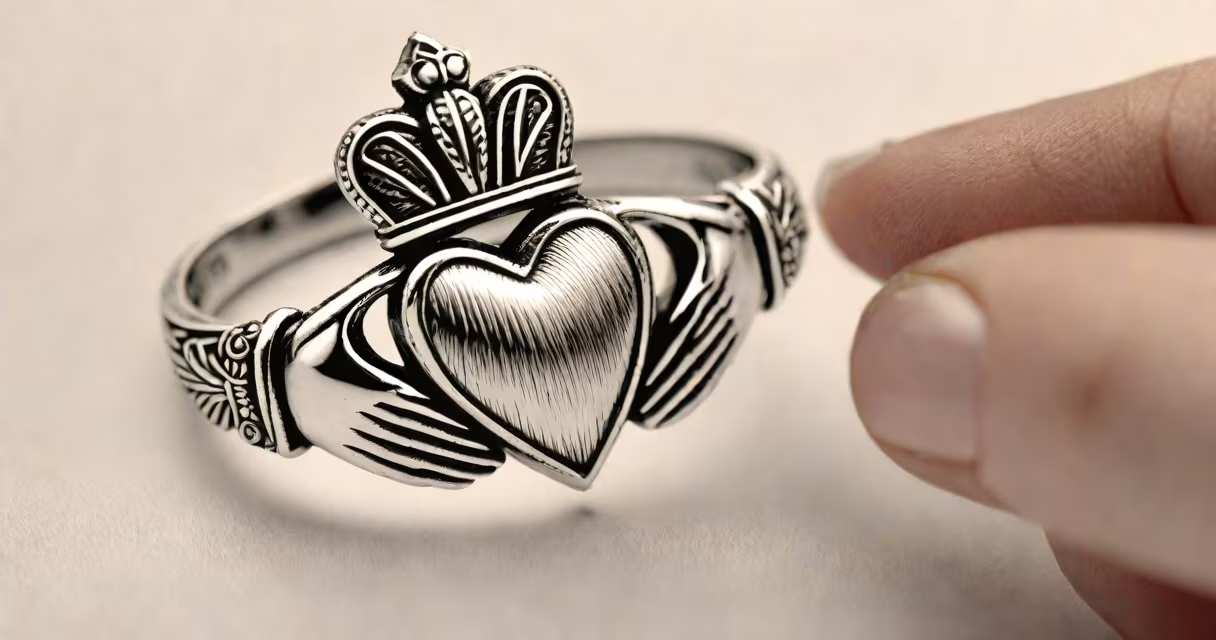
The claddagh ring is traditionally worn on the right hand with the heart facing outward to indicate you're single, or on the left hand with the heart pointing inward to show you're engaged or married. This placement reflects emotional status through symbolic orientation.
Originating in Galway, Ireland, the claddagh ring features two hands holding a heart, topped with a crown. The design represents love (heart), loyalty (hands), and friendship (crown). Its meaning is rooted in centuries-old Irish culture, where the ring was passed down through families and given as a token of affection.
Wearing the ring on the right hand with the heart facing outward signals openness to love. When worn on the left hand with the heart pointing toward the wrist, it indicates commitment-either engagement or marriage. This custom is still widely observed in Ireland and among Irish communities worldwide.
The orientation of the ring determines its message. The heart, positioned between two hands and crowned, rotates based on how the wearer places it. When the heart faces outward, it shows the wearer is available. When it faces inward, it signals that the person is taken.
This symbolism is not arbitrary. Historically, the ring was given by a suitor to his beloved. If she accepted it, she wore it on her right hand with the heart outward-showing she was open to courtship. Once she agreed to marry, she moved it to her left hand, turning the heart inward to signify her promise.
Modern couples often follow this tradition during engagements. Some partners exchange claddagh rings as betrothal gifts, then move them to the left hand when they marry. The act of switching hands becomes a quiet ritual marking a shift in relationship status.
Claddagh rings come in various metals: sterling silver, gold (yellow, white, or rose), and platinum. Sterling silver is most common due to affordability and traditional authenticity. Gold versions are often chosen for wedding bands.
Some rings feature engraved details like Celtic knots or initials. Others have gemstone accents-typically a small diamond or emerald set in the crown. These variations don't change the symbolic meaning but allow personalization.
| Type | Material | Typical Use | Symbolic Meaning |
|---|---|---|---|
| Classic | Sterling silver | Gifts, daily wear | Love, loyalty, friendship |
| Wedding Band | Gold or platinum | Marriage, anniversary | Enduring commitment |
| Engraved | Any metal | Personalized gifts | Unique identity |
One non-obvious fact: the ring's direction matters more than which hand it's on. A ring worn on the right hand with the heart inward may confuse observers. The correct signal depends entirely on orientation, not location.
Claddagh rings are most frequently worn in Ireland, especially in County Galway. They're also popular in the United States, Canada, and parts of Europe among people of Irish descent. Many Irish-Americans wear them during St. Patrick's Day celebrations or family gatherings.
Beyond cultural identity, the ring serves as a conversation starter. Its design prompts questions about heritage, relationships, and tradition. It's often gifted during weddings, anniversaries, or as a symbol of enduring friendship.
A real-world example: During a 2022 wedding in Dublin, the bride wore a classic silver claddagh ring on her left hand with the heart facing inward. Her groom had worn the same ring on his right hand, heart outward, since their engagement six months prior. Both followed the traditional placement.
Many assume the claddagh ring must be worn on the ring finger. That's incorrect. While the ring fits best on the ring finger, it can be worn on any finger. The key is the orientation, not the digit.
Another mistake: thinking the crown always points upward. In fact, the crown's position changes depending on how the ring is turned. When worn on the left hand with the heart facing inward, the crown points toward the elbow. On the right hand, it faces outward.
Some believe the ring must be passed down through generations. While this is a cherished practice, it's not required. Modern couples buy new rings for engagement or marriage, and that's perfectly valid.
I once attended a family gathering in County Kerry where my cousin wore a claddagh ring on her middle finger. She explained she liked the look and didn't want to risk losing it during work. The ring still conveyed its intended meaning because the heart faced outward-she was single, and everyone understood.
Unlike a wedding band, which only marks marital status, the claddagh ring communicates emotional state through design and placement. A wedding band is typically worn on the left hand regardless of relationship stage.
Compared to a promise ring, which often signifies a vow to remain faithful, the claddagh ring includes three distinct symbols: love, loyalty, and friendship. It's not just about romance-it's about connection in all forms.
Even among other Celtic jewelry, such as the Trinity knot or the spiral, the claddagh stands out for its narrative function. It tells a story through how it's worn.
If you're considering wearing a claddagh ring, choose the right hand with the heart outward to show you're single. Move it to your left hand with the heart pointing inward when you're engaged or married. This follows centuries-old Irish custom and ensures your ring speaks.
Understanding what finger to wear claddagh ring ensures respect for its heritage and clarity in communication. expressing your current relationship status, the ring's design offers both beauty and purpose.