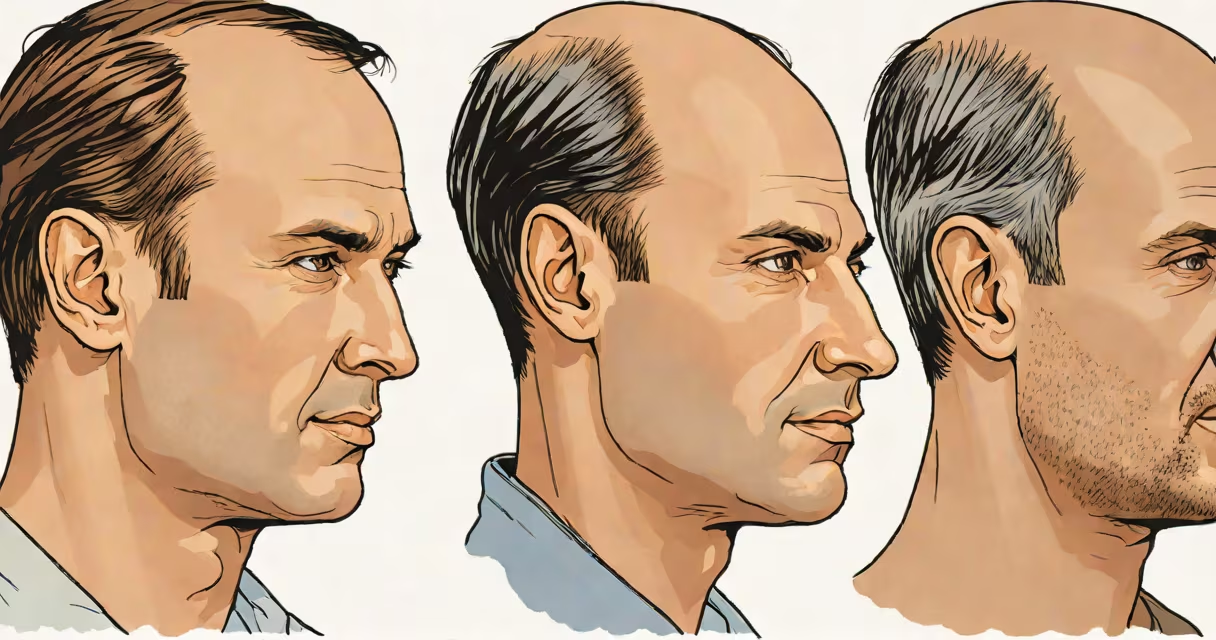
A normal hairline sits at the center of the forehead, typically forming a soft, slightly curved shape between the temples. A receding male hairline begins to retreat from the temples, creating a distinct "M" shape over time. This shift is often the earliest sign of male pattern baldness.
Male pattern baldness affects about 50% of men by age 50, according to the American Academy of Dermatology. The process usually starts subtly-around age 20-and progresses slowly. A receding hairline is not just a cosmetic issue; it's a biological response to dihydrotestosterone (DHT), a hormone derived from testosterone. DHT binds to receptors in hair follicles, shrinking them over time and shortening the growth phase of hair.
Normal hairlines are genetically determined and stable throughout adulthood. They sit roughly 2.5 inches above the eyebrows and form a gentle arc. Receding hairlines begin at the temples and move backward, often leaving a noticeable gap between the forehead and the hairline. The progression varies by individual, but most men see changes over 5-10 years.
Hair growth cycles consist of three phases: anagen (growth), catagen (transition), and telogen (rest). In healthy follicles, the anagen phase lasts 2-6 years. With male pattern baldness, this phase shortens due to DHT sensitivity. Over time, follicles shrink, produce thinner hairs, and eventually stop growing altogether.
Genetic predisposition plays a major role. Men with a family history of early hair loss are more likely to develop a receding hairline. The AR gene on the X chromosome influences DHT sensitivity. Since men inherit their X chromosome from their mother, maternal family history is a stronger predictor than paternal.
Environmental factors contribute too. Stress, poor diet, smoking, and certain medications can accelerate hair thinning. However, they don't cause the initial recession. A study published in JAMA Dermatology found that 78% of men with receding hairlines had a positive family history, confirming genetics as the primary driver.
Receding male hairlines follow predictable patterns. The Norwood scale classifies male pattern baldness into seven stages. Stage 1 shows no recession. Stage 2 marks the beginning of temple retreat. By Stage 4, the hairline forms a pronounced "M," and the crown begins to thin. Stage 7 represents advanced baldness with only a horseshoe-shaped band of hair remaining.
| Pattern | Characteristics | Typical Age of Onset |
|---|---|---|
| Stage 2-3 (early recession) | Subtle temple retreat, slight thinning at front | 20s-30s |
| Stage 4-5 (M-shape dominant) | Distinct "M" shape, visible gap between temples | 30s-40s |
| Stage 6-7 (crown involvement) | Front and crown areas merge into a larger bald patch | 40s-50s |
Some men develop a "widow's peak" shape, which is natural and not a sign of balding. This occurs when the hairline curves upward at the center. A widow's peak is inherited independently of male pattern baldness and doesn't progress into recession.
Many assume a receding hairline always leads to complete baldness. That's incorrect. Not all men progress beyond Stage 4. Some stabilize at a moderate recession. Others maintain a full head of hair despite early signs.
Another myth is that frequent shampooing or scalp massage causes recession. The American Hair Loss Association states there's no evidence linking washing frequency to hairline loss. Daily washing does not remove follicles or trigger DHT production.
One overlooked fact: receding hairlines can appear earlier in men with darker skin tones. A 2021 study in Clinical and Experimental Dermatology found Black men were 23% more likely to show early signs of recession compared to White men, possibly due to higher baseline DHT levels and differences in scalp anatomy.
Consider James, a 34-year-old man with a family history of baldness. His father began receding in his late 20s. At 28, James noticed a small dip at his left temple. He took photos every six months using consistent lighting and camera angles. By age 32, both temples had retreated 1 inch from their original position. His hairline now formed a clear "M." He consulted a dermatologist who confirmed early-stage Norwood 3.
James started using minoxidil 5% solution twice daily. After 12 months, he saw a 15% increase in hair density in the frontal area. His hairline did not reverse completely, but further recession halted. He continues monitoring monthly.
If you notice your hairline retreating faster than expected, or if it's accompanied by excessive shedding (more than 100 strands per day), consult a board-certified dermatologist. Early intervention improves outcomes. Treatments like finasteride (which reduces DHT) and low-level laser therapy have shown effectiveness in clinical trials.
For those unsure whether their hairline is changing, compare current photos to ones taken 1-2 years ago. Look for symmetry. A true receding hairline affects both sides equally. Asymmetry may indicate traction alopecia or scarring from tight hairstyles.
Understanding the difference between a normal hairline and a receding male pattern is essential for informed decisions. Knowing your genetic risk, tracking changes visually, and acting early can preserve hair volume and confidence. Recognizing the signs early prevents unnecessary anxiety and supports timely care.