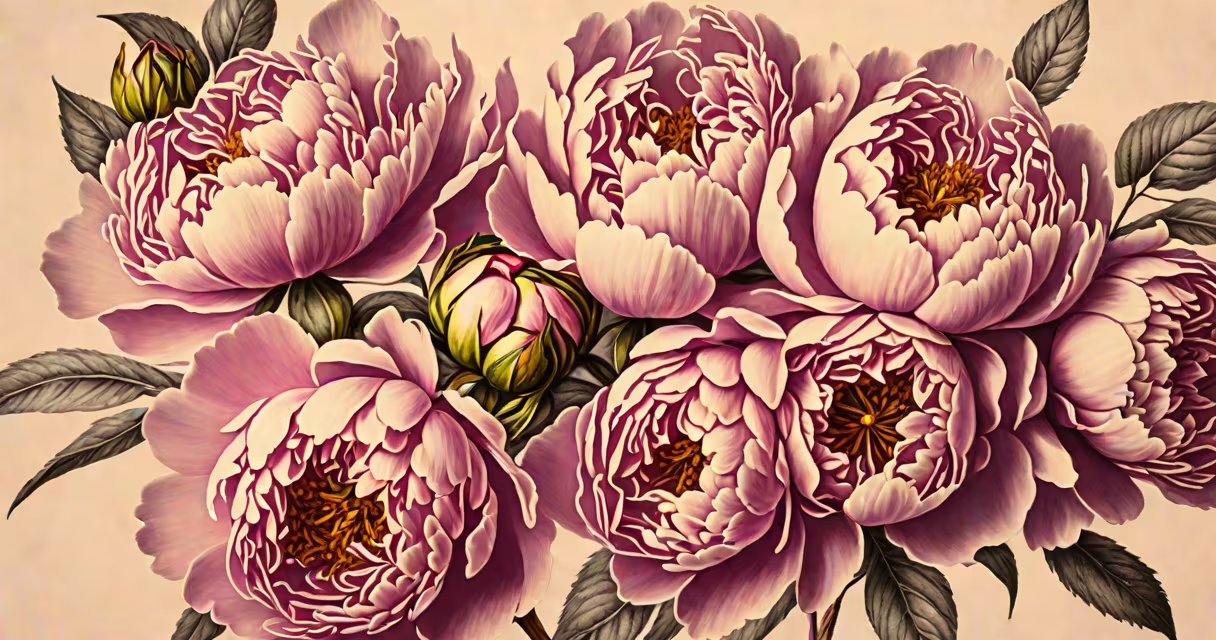
Peonies symbolize romance, prosperity, and good fortune in many cultures, especially in East Asia and Western floral traditions. Their lush blooms carry layered meanings tied to love, honor, and renewal.
Peonies belong to the genus Paeonia, with over 30 species native to temperate regions of Europe, Asia, and North America. The most common garden varieties are herbaceous peonies (Paeonia lactiflora) and tree peonies (Paeonia suffruticosa). These plants grow slowly, often taking five years to bloom fully, but once established, they live for decades.
In Chinese culture, peonies are known as the "king of flowers" and represent wealth, honor, and romantic love. They appear in imperial art and poetry from the Tang Dynasty onward. In Japan, peonies are associated with bravery and are often seen in samurai-era paintings. In Western traditions, particularly Victorian England, peonies were linked to bashfulness and a happy marriage, though their meaning evolved into celebration and abundance.
Flower meanings arise from long-standing associations between plants and human experiences. For peonies, these connections stem from appearance, seasonal timing, and historical usage. Their large, fragrant blooms resemble a cluster of satin petals, making them visually striking in gardens and bouquets.
During the Song Dynasty in China, peonies were cultivated in royal gardens and featured in court rituals. Emperors commissioned artists to paint them during spring festivals. The flower's association with the imperial court elevated its status beyond decoration-it became a signifier of power and dignity. This legacy persists today: in modern Chinese weddings, peonies are used to wish couples prosperity and lasting harmony.
In contrast, Victorian England assigned peonies a more personal meaning. While not part of the original language of flowers, they gained popularity in the 1860s and were interpreted as symbols of bashful affection and a desire for happiness. A bouquet containing peonies was seen as a quiet declaration of love, especially when paired with roses or lilies.
Different peony types carry distinct visual and symbolic traits. The table below outlines key varieties and their traditional meanings:
| Type | Appearance | Primary Cultural Meaning |
|---|---|---|
| Herbaceous peony (P. lactiflora) | Soft, feathery leaves; large, double blooms in pink, white, or red | Love, prosperity, healing (China); modesty, joy (West) |
| Tree peony (P. suffruticosa) | Woody stems; showy, single or semi-double flowers | Imperial favor, elegance (China); resilience, strength (Japan) |
| Intersectional peony (Itoh hybrids) | Combines woody and herbaceous traits; bold colors | Renewal, new beginnings (global) |
Tree peonies, which can live over 100 years, are especially revered in China. A single plant may be passed down through generations, symbolizing family continuity. In Japanese gardens, tree peonies are often planted near temples, where their presence is believed to ward off negative energy.
Many assume peonies are universally symbols of romance. That's only partly true. While they're popular in wedding bouquets, especially in the U.S., their deeper significance varies widely by region and context.
A common error is equating peonies with purity or innocence. That meaning belongs to white lilies or violets. Peonies are too rich in color and form to be seen as pure-they're associated with abundance, not restraint. In fact, in some ancient Greek texts, peonies were linked to healing and protection, not love.
Another misconception: peonies are easy to grow. They're not. Herbaceous peonies require well-drained soil, full sun, and patience. Many fail to bloom because they're planted too deeply or in shaded areas. A 2021 study by the Royal Horticultural Society found that 43% of home-grown peonies failed to flower in the first three years due to improper planting depth.
Consider a 2023 wedding in Kyoto, Japan, where the bride wore a kimono embroidered with tree peonies. The groom carried a single white peony in his sash. This wasn't decorative-it was intentional. Tree peonies in Japanese tradition symbolize courage and resilience, reflecting the couple's shared values of endurance and mutual respect.
Meanwhile, in a New York City ceremony, a bride chose a bouquet of pastel herbaceous peonies. Her florist explained that the soft pink hues were selected to convey tenderness and a hopeful future. The choice reflected Western symbolism, where peonies represent a joyful, abundant marriage.
These two events show how the same flower carries different meanings based on cultural context. The meaning of peonies isn't fixed-it's shaped by place, history, and intent.
This experience reshaped my view of peony symbolism. It's not just about beauty or luck. It's about patience, legacy, and the quiet joy of seeing something grow slowly over years.
The meaning of peonies is not synonymous with "femininity" or "romance" in all contexts. While they appear frequently in women's fashion and bridal wear, this is a modern trend, not a universal truth. In rural China, peonies are still used in folk medicine to treat inflammation. In some parts of Central Asia, dried peony roots are brewed into tea for digestive health.
Also, peonies are not always positive symbols. In medieval European folklore, they were sometimes linked to jealousy or unrequited love. A 13th-century manuscript from the University of Bologna describes a scene where a woman weeps over a peony, believing it represents her lost lover. This shows that even positive flowers can carry complex emotional weight.
Peonies endure as symbols because they embody contradictions: delicate yet strong, fleeting yet long-lived, personal yet communal. Their meaning shifts with culture, season, and intention. Whether given as a gift, painted in a scroll, or grown in a backyard, the meaning of peonies is not fixed-it's alive.
Understanding this allows us to use them more thoughtfully. A bouquet of peonies isn't just a pretty gesture. It's a message-about love, luck, or legacy-that speaks differently to each person who receives it.