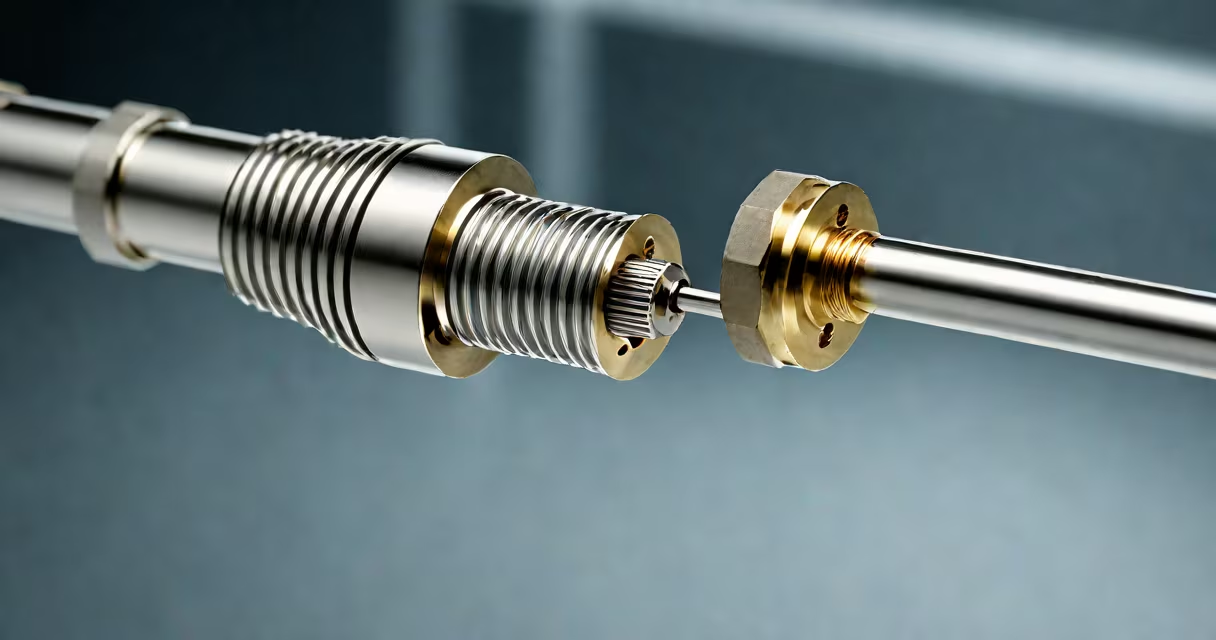
Static pressure probes are precision instruments that measure the static pressure of a fluid-air or liquid-without disrupting the flow. They are essential in aerodynamics, HVAC systems, and industrial flow monitoring. These devices provide baseline pressure readings critical for calculating flow speed using established fluid dynamics principles.
Static pressure is the force exerted by a fluid at rest, perpendicular to the surface it contacts. Unlike changing pressure-which increases with flow velocity-static pressure remains constant across a uniform flow field. A properly designed static pressure probe captures this value accurately by aligning small holes along its surface with the direction of flow, minimizing turbulence and flow distortion.
These probes are typically cylindrical or tapered, with multiple small ports (usually 6-12) evenly spaced around the circumference. The ports connect to a central tube that leads to a pressure sensor. When the probe is inserted into a flow stream, the average pressure measured through these ports reflects the local static pressure. This design reduces errors caused by flow angle deviations or localized vortices.
When a fluid moves past a solid boundary, such as a wing or pipe wall, it exerts pressure on that surface. Static pressure is the component of that force acting normal to the surface, independent of motion. In steady, incompressible flow, static pressure is related to velocity through Bernoulli's equation:
P_static + ½ρv² = P_totalWhere:
To determine flow speed, engineers subtract the static pressure from the total pressure and solve for velocity. For air at standard conditions (ρ ≈ 1.225 kg/m³), a 100 Pa difference between total and static pressure corresponds to approximately 12.8 m/s (29 mph).
Probes must be calibrated in controlled environments-like wind tunnels-to ensure accuracy. Even minor misalignment or port blockage can introduce significant error. The National Institute of Standards and Technology (NIST) provides calibration standards for pressure sensors used in such applications.
Several probe designs exist, each optimized for specific environments and accuracy requirements.
| Type | Use Case | Accuracy | Key Feature |
|---|---|---|---|
| Flush-mounted | Aircraft fuselage, wind tunnel walls | High | Ports flush with surface; minimizes flow disruption |
| Probe-mounted | Wind tunnel test sections, engine intake | Medium-High | Extends into flow; easier to install and replace |
| Multi-hole | High-speed flows, unsteady conditions | Very High | Measures pressure at multiple angles; enables flow direction reconstruction |
Multi-hole probes-such as the five-hole probe-are used in research settings where flow direction and velocity magnitude must be determined simultaneously. These are common in supersonic wind tunnels and jet engine testing.
For low-speed applications, such as HVAC ductwork, single-port flush probes are sufficient. Their simplicity reduces cost and maintenance while maintaining acceptable accuracy for most building systems.
Static pressure probes are integral to aircraft instrumentation. In commercial aviation, they form part of the pitot-static system, which feeds data to altimeters, airspeed indicators, and vertical speed indicators. The Federal Aviation Administration (FAA) mandates strict calibration intervals for these systems to prevent errors that could lead to loss of control.
In wind tunnel testing, researchers use arrays of static pressure probes to map pressure distribution across wings and bodies. For example, during the development of the Boeing 787 Dreamliner, over 1,000 static pressure taps were installed on the model's surface. Data from these probes helped refine the wing's shape to reduce drag and improve fuel efficiency.
Industrial applications include monitoring flow in pipelines and ventilation systems. In a 2021 study published in the Journal of Fluid Mechanics, researchers used static pressure probes to detect early-stage blockages in HVAC ducts by identifying abnormal pressure gradients. A 15% drop in static pressure over a 1-meter segment triggered an alert, enabling preventative maintenance.
They are not the same as pitot tubes. Pitot tubes measure total pressure-the sum of static and changing pressure. Confusing the two leads to incorrect velocity estimates. A pitot tube has a forward-facing opening that captures stagnation pressure, while a static probe has side ports aligned with flow.
Another misconception is that static pressure probes can measure flow rate directly. They cannot. Flow rate requires integration of velocity across a cross-sectional area. Static pressure readings must be combined with other measurements-such as velocity profiles from hot-wire anemometry or computational models-to estimate volumetric flow.
Even within their function, static pressure probes are not immune to error. Misalignment of just 5 degrees from the flow direction can cause a 2% underestimation of static pressure. This is why probe installation is carefully specified in engineering drawings and verified during testing.
I once observed a wind tunnel test where a single static pressure probe was misaligned by 8 degrees due to a loose mounting bracket. The resulting data showed a consistent 3% deviation in pressure readings across the entire test run. After correcting the alignment, the values converged with theoretical expectations. This highlighted how sensitive these tools are to physical setup-even small mechanical errors propagate into measurable inaccuracies.
Understanding the difference between static and changing pressure is important. Changing pressure increases with flow speed and is proportional to the square of velocity. Static pressure remains constant in a uniform flow field but changes when flow accelerates or decelerates.
For example, in a converging nozzle, static pressure drops as flow speeds up. A static pressure probe placed at the throat of such a nozzle will show lower values than at the inlet. This behavior is governed by conservation of mass and energy in fluid systems.
Engineers use this principle to infer flow characteristics. In a jet engine intake, static pressure probes monitor pressure recovery-how well the inlet converts kinetic energy into pressure. Low recovery indicates inefficiency or flow separation, both of which degrade performance.
Static pressure probes remain indispensable in engineering. Their ability to capture undisturbed fluid pressure enables precise analysis of airflow, fluid transport, and system performance. Whether in flight, lab, or factory, they deliver the baseline data needed to understand and control complex systems.