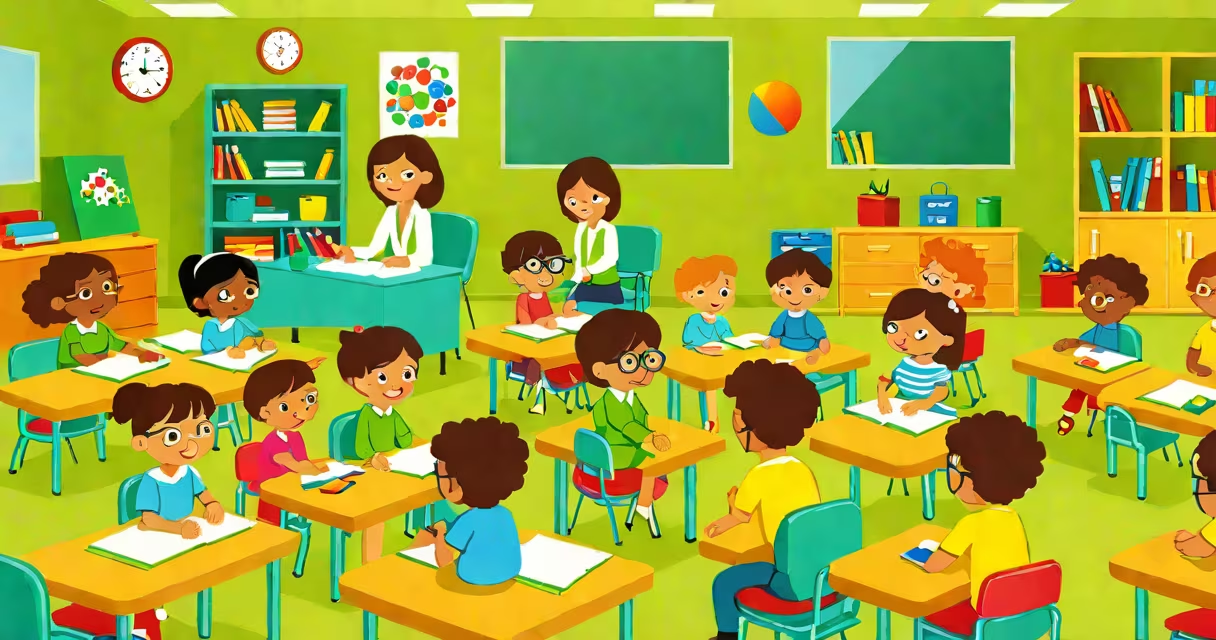
Preschool classroom management is the intentional design of routines, spaces, and responses that guide young children's behavior, promote engagement, and create a safe, consistent environment for learning. It focuses on prevention, clear expectations, and positive reinforcement rather than punishment.
Children ages 3 to 5 learn through exploration, imitation, and repetition. Without structure, their natural curiosity and emotional expression can lead to chaos. Effective management prevents disruptions by setting daily rhythms-meals, transitions, free play, circle time-and teaching behavioral norms through modeling and clear language.
Research from the National Association for the Education of Young Children (NAEYC) confirms that consistent routines reduce anxiety and increase attention span in preschoolers. A study published in Early Childhood Research Quarterly found that classrooms with structured schedules had 40% fewer behavioral incidents than those without.
Management begins before the first child arrives. Teachers plan the physical layout, define roles, and establish predictable sequences. For example, a morning routine might start with a greeting song, followed by choosing an activity center, then group time.
Transitions between activities are high-risk moments. A child may resist leaving blocks to join circle time. Instead of demanding compliance, a skilled teacher uses a visual timer and says, "When the sand runs out, we'll clean up." This gives the child agency and reduces power struggles.
Every interaction reinforces expectations. When a child grabs a toy, the teacher doesn't yell. She says, "I see you want the red car. We take turns. Your turn comes after Emily finishes." This teaches sharing without shaming.
Preschool classroom management rests on four pillars: physical space, emotional climate, verbal communication, and response systems. Each supports the others.
| Element | Description | Example |
|---|---|---|
| Physical Environment | Arranged to minimize clutter, maximize visibility, and support independence. | Low shelves with labeled bins for toys, a small rug for circle time, and a quiet corner with books. |
| Emotional Climate | Warm, respectful interactions that validate feelings while setting limits. | A teacher kneels to eye level and says, "You're sad because your friend took the crayon. That's okay. Let's find another one." |
| Verbal Communication | Clear, concise language using positive phrasing and simple instructions. | "Please walk to the art table. Hands are for drawing, not throwing." |
| Response System | Consistent consequences tied to behavior, not emotion. | If a child hits, they sit quietly for one minute and discuss what happened. No yelling, no isolation. |
Some programs use tiered systems. Level 1 is redirection and natural consequences. Level 2 involves brief time-ins (calm-down time with adult presence). Level 3 requires collaboration with families and specialists. These levels prevent escalation and avoid labeling children.
Many assume preschool classroom management means strict control or constant discipline. In reality, it's about creating conditions where children feel secure enough to explore, make mistakes, and grow.
One mistake is confusing "quiet" with "productive." A silent room doesn't mean learning is happening. A well-managed classroom often sounds busy-children talking, laughing, negotiating-but within agreed-upon boundaries.
Another error is expecting preschoolers to self-regulate instantly. They lack the brain development for sustained focus. The prefrontal cortex isn't mature until age 7. Teachers must scaffold attention through movement breaks, sensory tools, and short tasks.
A non-obvious fact: children imitate adult emotional regulation more than rules. If a teacher stays calm during a meltdown, children learn to regulate too. A 2021 study in Child Development found that children in emotionally regulated classrooms showed 30% higher social competence scores over six months.
At Willow Creek Preschool, a boy named Mateo pushes another child away from the block center. The teacher, Ms. Lin, doesn't intervene immediately. She waits until the conflict escalates, then gently says, "I see you both want to build the bridge. Let's find a way together."
She offers two solutions: "You can take turns building, or we can make two bridges." Mateo chooses the second. The teacher adds, "Great idea. You're being fair."
Later, during reflection time, she asks, "What helped us share the blocks?" Children respond: "We talked," "We used two bridges." This builds metacognition-the ability to think about thinking.
This moment wasn't about stopping misbehavior. It was about teaching negotiation, empathy, and problem-solving-all core outcomes of effective preschool classroom management.
Children who experience consistent, nurturing management in preschool are more likely to succeed academically and socially later. A longitudinal study by the University of Minnesota tracked 1,200 children from age 3 to 12. Those in high-quality preschools with strong classroom management scored 15% higher on reading and math assessments by third grade.
Classroom management isn't about controlling kids. It's about creating a culture where every child feels seen, heard, and capable. When routines are predictable, children spend less energy on fear and more on discovery.
For teachers, managing a classroom effectively reduces burnout. A 2022 report from the American Psychological Association found that educators using proactive strategies reported 35% lower stress levels than those relying on reactive discipline.
Preschool classroom management is not a single tactic. It's a living system of choices, patterns, and responses that evolve with each child. The goal isn't perfection. It's progress-one shared block, one calm breath, one moment of connection at a time.