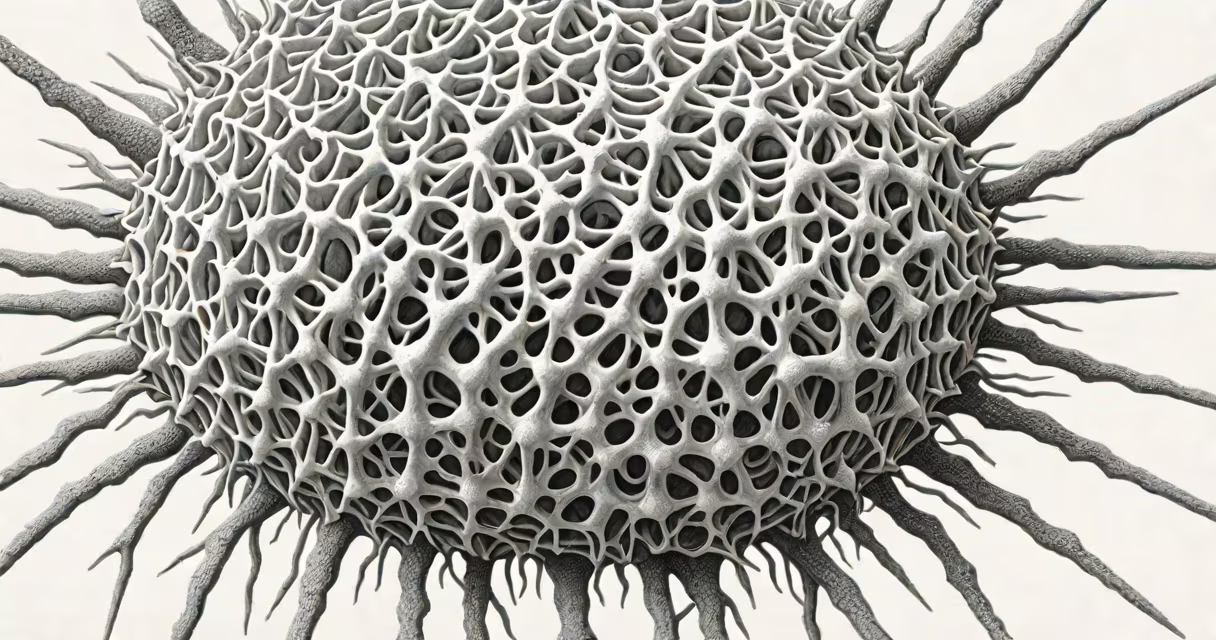
A virus is a microscopic infectious agent that can only replicate inside the living cells of a host organism. It consists of genetic material-either DNA or RNA-surrounded by a protein coat called a capsid. Viruses cause diseases in plants, animals, and humans by hijacking cellular machinery to produce more viral particles.
Viruses are not alive in the traditional sense. They lack the ability to carry out metabolic processes independently and cannot reproduce without a host cell. This dependence on host cells defines their behavior and limits their classification as life forms. The term "virus" comes from Latin, meaning "poison," reflecting early perceptions of their harmful nature.
Viruses infect all domains of life. In humans, they cause conditions ranging from the common cold to Ebola and HIV. The influenza virus mutates rapidly, which is why annual flu vaccines are needed. The SARS-CoV-2 virus, responsible for the global COVID-19 pandemic, spreads through respiratory droplets and can survive on surfaces for hours to days depending on material and environment.
When a virus enters a host, it attaches to specific receptors on the surface of a cell. For example, the human immunodeficiency virus (HIV) binds to CD4 receptors on immune system cells. Once attached, the virus injects its genetic material into the host cell's cytoplasm or nucleus.
The host cell's machinery then begins producing viral proteins and copying the viral genome. New virus particles assemble and burst out of the cell, often destroying it in the process. This release allows the infection to spread to neighboring cells. A single infected cell can generate thousands of new viruses within hours.
Some viruses integrate their genetic material into the host's DNA and remain dormant for long periods. Herpes simplex virus, for instance, lies inactive in nerve cells and can reactivate during stress or illness, causing recurrent outbreaks.
Viruses are categorized based on their genetic material, structure, and mode of replication. The following table outlines major types:
| Type | Genetic Material | Structure | Examples |
|---|---|---|---|
| DNA viruses | Double-stranded or single-stranded DNA | Often enveloped or non-enveloped | Herpesviruses, adenoviruses |
| RNA viruses | Single-stranded or double-stranded RNA | Many have lipid envelopes | Influenza, SARS-CoV-2, hepatitis C |
| Retroviruses | Single-stranded RNA | Enveloped with reverse transcriptase enzyme | HIV, HTLV |
| Bacteriophages | DNA or RNA | Complex tail structures | T4 phage, lambda phage |
RNA viruses tend to mutate faster than DNA viruses because RNA polymerase lacks proofreading ability. This high mutation rate complicates vaccine development, as seen with seasonal flu strains and SARS-CoV-2 variants.
People often confuse viruses with bacteria. Bacteria are free-living single-celled organisms that can grow independently and are treated with antibiotics. Viruses, however, require host cells and do not respond to antibiotics. Misusing antibiotics for viral infections contributes to antibiotic resistance.
Another misconception is that all viruses cause severe disease. Many viruses exist in a state of balance with their hosts. Human herpesviruses, such as Epstein-Barr virus (EBV), persist lifelong in most people without symptoms. Only when immunity weakens do they reactivate and cause illness.
Viruses are not inherently malicious. Some play roles in evolution by transferring genes between species. Endogenous retroviruses-viral sequences embedded in human DNA-make up about 8% of the human genome. These sequences were once active viruses that infected germ cells millions of years ago and became part of our inherited genetic material.
The 1918 H1N1 influenza virus killed an estimated 50 million people worldwide. Scientists reconstructed the virus's genome from preserved tissue samples taken from victims buried in permafrost. The reconstruction revealed that the virus had a combination of avian and human influenza genes, allowing it to spread efficiently among humans.
Unlike modern flu strains, the 1918 virus caused a cytokine storm-an overreaction of the immune system that led to rapid lung failure. This explains why young adults, whose immune systems were strongest, suffered higher mortality rates than older individuals who had partial immunity from prior exposure.
This event underscores how a single viral mutation can alter transmission dynamics and severity. It also highlights the importance of surveillance and rapid response in preventing pandemics.
Knowing how viruses work informs public health strategies. Vaccines train the immune system to recognize viral antigens without causing disease. The measles vaccine, for example, uses a weakened version of the virus to stimulate protective antibodies. Since 2000, global vaccination efforts have prevented over 50 million deaths from measles alone, according to the World Health Organization.
Antiviral drugs differ from antibiotics. They target specific stages of viral replication. For instance, oseltamivir (Tamiflu) inhibits neuraminidase, an enzyme that helps influenza viruses exit infected cells. When taken within 48 hours of symptom onset, it reduces illness duration by about one day.
Understanding viruses also aids in biotechnology. Modified viruses serve as vectors in gene therapy. Adeno-associated viruses (AAVs), for example, deliver functional genes to treat inherited disorders like spinal muscular atrophy. Clinical trials show sustained improvement in motor function after treatment.
During a lab experiment in 2017, I observed a bacteriophage infecting E. coli colonies on agar plates. Within 6 hours, clear zones-called plaques-appeared where bacterial cells had lysed. This visual confirmation of viral replication helped solidify my understanding of how viruses propagate at the microscopic level.
Viruses are not just pathogens. They are fundamental components of ecosystems and evolutionary history. Their ability to adapt and spread makes them central to biology, medicine, and global health policy. Recognizing their role beyond disease reveals a deeper picture of life at the molecular scale.