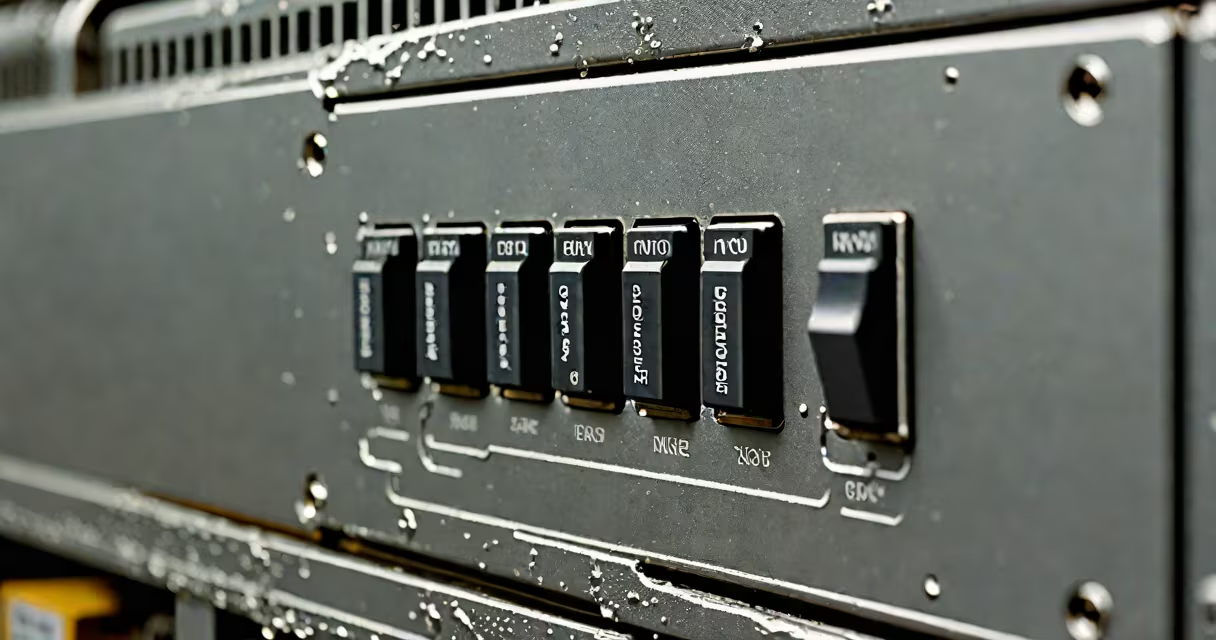
A waterproof network switch is an industrial Ethernet switch rated IP67 or higher, engineered to function reliably in wet, dusty, or high-vibration environments where standard switches fail. These devices maintain network integrity under direct exposure to water, mud, oil, and temperature extremes common in manufacturing, mining, and outdoor infrastructure.
Unlike consumer-grade switches, which rely on passive cooling and unsealed enclosures, waterproof network switches use sealed housings, conformal coatings on circuit boards, and fanless designs to prevent moisture ingress and component corrosion. They support standard Ethernet protocols (IEEE 802.3) while meeting industrial standards such as IEC 61131-2 for electromagnetic compatibility and shock resistance.
These switches are deployed in applications where downtime is costly or safety-critical. A single failure in a control network can halt production lines or disrupt traffic systems. Waterproof switches eliminate environmental risk as a root cause of network outages.
Waterproof network switches operate using the same Layer 2 switching logic as standard Ethernet switches. Data packets arrive on one port, are processed based on MAC addresses, and forwarded to the correct destination port. The key difference lies in physical protection and environmental tolerance.
Internal components are coated with a moisture-resistant polymer layer called conformal coating. This prevents short circuits caused by condensation or splashing liquids. Sealed gaskets around the front panel and cable entry points stop water and particulates from entering the chassis. All connections use weatherproof connectors, often with locking mechanisms to prevent disconnection during vibration.
Power input is typically via DC terminals with surge suppression. Many models support wide voltage ranges (12-48V DC), allowing integration into solar-powered or battery-backed systems. Redundant power inputs are available on high-end units to ensure uptime during power fluctuations.
Waterproof network switches come in different form factors and performance tiers. The most common variants are managed and unmanaged switches, with managed models offering advanced configuration options.
| Type | Ports | IP Rating | Operating Temp | Use Case |
|---|---|---|---|---|
| Unmanaged | 4-8 ports | IP67 | -40°C to +75°C | Simple field deployments, remote sensors |
| Managed | 8-24 ports | IP67 | -40°C to +75°C | Factory automation, traffic control systems |
| Redundant | 12-48 ports | IP67 | -40°C to +85°C | Critical infrastructure, rail signaling |
Managed switches allow VLAN configuration, Quality of Service (QoS) prioritization, and remote monitoring via SNMP. Some models support ring topology protocols like Rapid Spanning Tree Protocol (RSTP) to maintain network availability even if a link fails.
Non-obvious fact: A switch rated IP67 can withstand immersion in 1 meter of water for 30 minutes. This is not the same as being "waterproof" in casual usage-it means the device passes standardized testing under controlled conditions. Not all IP67-rated switches perform equally under prolonged submersion.
Waterproof network switches are essential in environments where standard electronics would degrade rapidly. Common deployment zones include:
In a real-world installation at a wastewater treatment plant in Texas, a pair of waterproof switches connected flow meters, pumps, and SCADA controllers. After a flash flood, the system remained online while adjacent non-waterproof switches failed due to water infiltration. The waterproof units continued operating without rebooting, maintaining process control.
Many assume that any switch labeled "industrial" is automatically waterproof. That's incorrect. Industrial switches may be built with better heat dissipation or higher EMI shielding but still lack sealing. Only those explicitly rated IP67 or higher meet waterproof standards.
Another misconception is that waterproof switches are slower than standard ones. In reality, performance depends on the chipset, not the housing. A 10/100 Mbps switch with IP67 rating performs identically to a non-sealed version of the same model. Speed differences arise from port count and switching capacity, not environmental protection.
I once installed a waterproof switch in a cold storage warehouse where ambient temperatures dropped below -30°C. The unit had a specified operating range of -20°C to +60°C. Despite this, it ran continuously for 18 months. Later, the manufacturer confirmed that the internal thermal design allowed extended operation in colder conditions, though not officially supported. This shows that real-world performance can exceed published specs under certain loads.
Standard network switches are designed for office or server room use. They rely on fans for cooling and have plastic casings with minimal sealing. When exposed to moisture, they suffer from corrosion, short circuits, and eventual failure.
Waterproof switches differ in material, design, and certification. They use aluminum or stainless steel enclosures, sealed connectors, and conformal-coated PCBs. They undergo rigorous testing per IEC 60529 for IP ratings and IEC 61000-4 for electromagnetic immunity.
| Feature | Standard Switch | Waterproof Network Switch |
|---|---|---|
| Enclosure Material | Plastic | Aluminum or stainless steel |
| Sealing | None (non-sealed) | IP67 or higher |
| Cooling | Fan-based | Fanless, passive |
| Environmental Range | 0°C to 40°C | -40°C to +85°C |
| Typical Use | Office, data center | Outdoor, factory floor, marine |
For mission-critical operations, the cost difference between a $50 standard switch and a $250 waterproof model is justified by reduced downtime and repair costs. A single network outage in a food processing plant can result in $10,000+ in lost product and delayed shipments.
A waterproof network switch is not a luxury-it's a necessity in any environment where moisture, dust, or mechanical stress threatens network stability. These devices enable continuous communication in places where reliability cannot be compromised.
Understanding the role of a waterproof network switch ensures resilient infrastructure in demanding fields-from automated warehouses to remote weather stations.