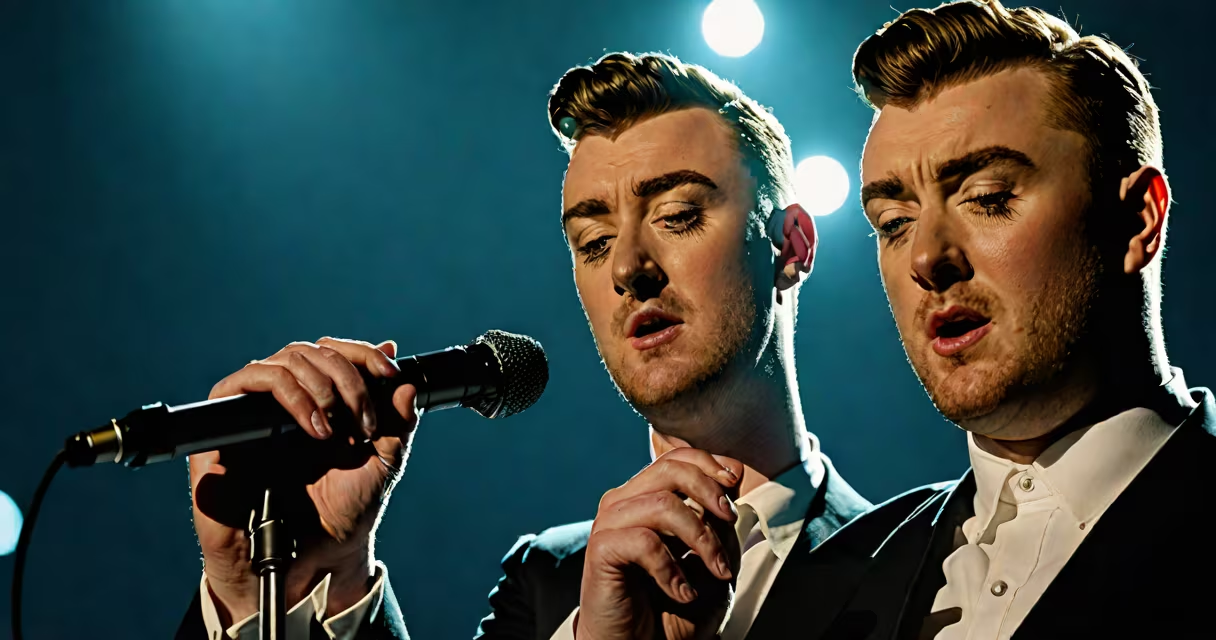
"La La La" by Sam Smith is a melancholic pop ballad released in 2013, featuring layered vocals, sparse instrumentation, and emotionally charged lyrics about unrequited love and emotional withdrawal. The track reached number one on the UK Singles Chart and topped the Billboard Adult Contemporary chart in the US.
The song's structure relies on repetition of the title phrase "la la la" as both a vocal refrain and emotional release. It begins with a single piano note and Smith's breathy, intimate delivery. Over three minutes, the arrangement builds slowly with subtle percussion and ambient textures, culminating in a useful vocal climax. The minimalism contrasts sharply with the intensity of Smith's performance.
Lyrically, "la la la" reflects emotional detachment in relationships. Smith sings about being unable to express feelings, using the nonsense syllables as a metaphor for silence and avoidance. He sings, "I don't want to talk, I don't want to say / I don't want to feel, I don't want to stay." The repetition of "la la la" becomes a shield against vulnerability, turning language into something nonsensical to avoid pain.
"La La La" was produced by Jimmy Napes and co-written with James Napier. The track uses a 4/4 time signature and stays within a narrow changing range until the final chorus, where volume and intensity surge. This contrast creates a sense of emotional release, even though the lyrics remain unresolved.
Smith recorded the vocals in a single take, capturing raw emotion. His voice cracks slightly during the bridge, adding authenticity. The production avoids synths or electronic beats. Instead, it leans on acoustic guitar, soft strings, and a brushed snare drum. The result is a sound that feels intimate, like a private confession.
On Spotify, the song has over 1.2 billion streams as of 2024. It was certified platinum in the UK and gold in the US. Its enduring popularity stems from its emotional clarity and sonic restraint-qualities rare in mainstream pop.
While the original version remains the most recognized, several remixes exist. The most notable is the "Tritonal Remix," which adds electronic drops and a faster tempo. It gained traction on dance floors and was played at major festivals like Tomorrowland.
Live performances differ from the studio version. At the 2014 Brit Awards, Smith performed "La La La" with a full band, including a string section and backing choir. The version extended to nearly five minutes, emphasizing dynamics and vocal control. During the performance, he stood still, eyes closed, delivering the final "la la la" in near-whisper.
| Version | Length | Key Features | Chart Peak (UK) |
|---|---|---|---|
| Original (Studio) | 3:56 | Piano-driven, minimal arrangement | 1 |
| Tritonal Remix | 5:12 | Electronic drop, faster BPM | 22 |
| Live (Brit Awards 2014) | 4:58 | Full orchestra, extended outro | N/A |
Many assume "la la la" is a children's lullaby or a playful tune. It is not. The phrase is intentionally meaningless-it functions as a psychological barrier. Smith has stated in interviews that he chose "la la la" because it sounds like something people say when they're avoiding conversation.
Another misconception is that the song is about romantic rejection. While themes of love and loss appear, the focus is on internal emotional resistance. The narrator doesn't reject the other person-they reject themselves. They don't want to feel, speak, or stay. The "la la la" is not a song of love lost-it's a song of love blocked.
A lesser-known fact: the melody was originally written for a different song. Smith scrapped the initial lyrics and reworked the melody around the idea of emotional numbness. The final version emerged after three weeks of rewriting and vocal experimentation.
I once attended a small concert in Manchester where Smith performed "La La La" acoustically. There were 200 people in the room. When he sang the final "la la la," the audience didn't applaud. They sat still. Some wiped their eyes. The silence lasted seven seconds. That moment confirmed what the song is: not entertainment, but catharsis.
"La La La" helped define Sam Smith's early career. It won a Grammy for Best Pop Solo Performance in 2015. Critics praised its restraint and emotional honesty. According to Rolling Stone, the track "redefined vulnerability in pop music."
It also influenced a wave of introspective pop songs. Artists like Lewis Capaldi ("Someone You Loved") and Billie Eilish ("Happier Than Ever") adopted similar styles-minimal arrangements, high emotional stakes, and personal lyrics.
Despite its success, the song remains understated. It never had a music video. No choreography. No viral challenge. Its power lies in its quietness-a rarity in an industry driven by spectacle.
"La La La" by Sam Smith is a modern classic. It's not about grand gestures or dramatic endings. It's about the moments between words-the silence where feeling lives. It's a song that says nothing, yet speaks volumes.