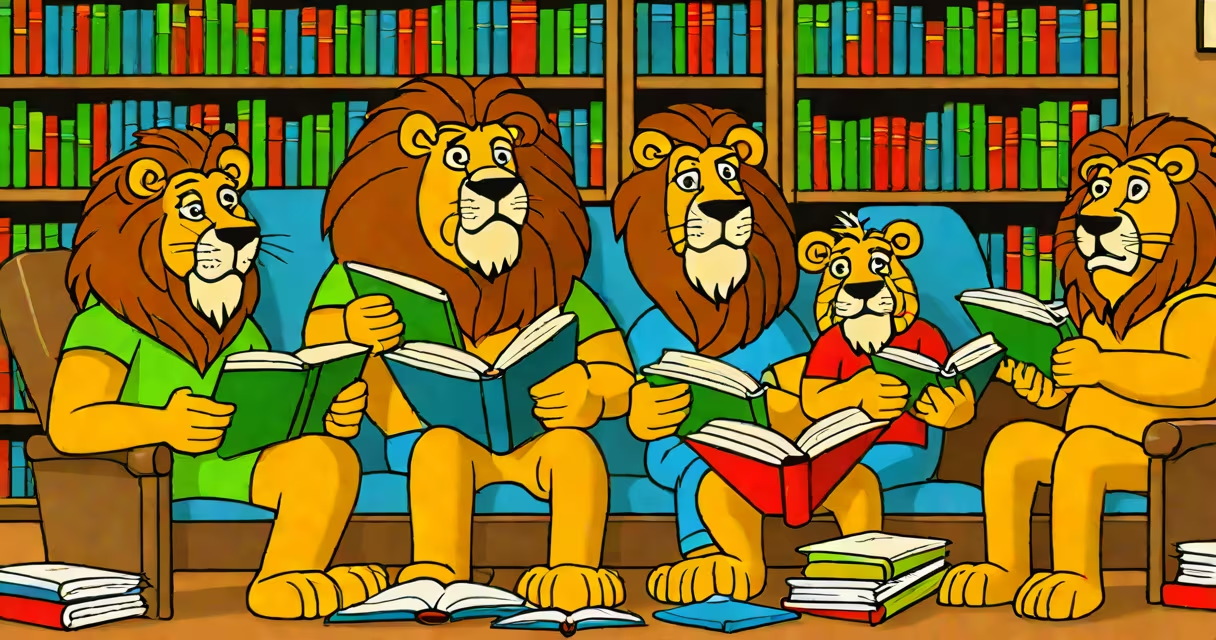
Between the Lions TV is a children's educational television series produced by WGBH Boston and aired on PBS Kids from 2000 to 2006. The show uses anthropomorphic lion characters to teach early literacy skills such as phonemic awareness, letter recognition, and vocabulary development through storytelling, songs, and interactive segments.
The series was developed to support the National Reading Panel's findings on effective reading instruction, emphasizing systematic phonics, vocabulary building, and fluency. It aired in over 90% of U.S. public broadcasting stations and reached an estimated 1.2 million viewers weekly during its peak. According to the Corporation for Public Broadcasting, Between the Lions was one of the most-watched educational programs for preschoolers in the early 2000s.
Each episode follows a consistent format: a storybook is introduced, characters explore the plot using visual cues and sound patterns, and a segment called "The Library" reinforces key concepts. The show's creators consulted literacy experts at the University of Michigan and the National Institute for Literacy to ensure content aligned with research-based reading instruction.
Between the Lions TV uses a narrative structure centered around four lion siblings-Lionel, Leona, Leo, and Lulu-who live in a fictional library called the "Lions' Den." Each episode begins with a book being read aloud by one of the lions, often with exaggerated expressions and vocal inflections to model fluent reading. The story then unfolds through animation, puppetry, and live-action sequences.
Key segments include "Phonics Fun," where letters and sounds are isolated and repeated in rhythmic patterns, and "Word Wizard," which demonstrates how changing one letter alters a word's meaning. For example, in one episode, the word "bat" becomes "hat" when the "b" is replaced with "h"-a direct application of phonemic manipulation taught in evidence-based reading curricula.
A 2003 study published in the Journal of Educational Psychology found that children who watched Between the Lions showed a 23% improvement in letter-sound recognition compared to those who did not. The study tracked 120 preschoolers across five classrooms and measured gains after eight weeks of exposure.
The show blends multiple formats: stop-motion puppets, computer-generated animation, and live-action segments. The lion characters were designed with expressive faces and exaggerated gestures to maintain attention in young viewers. Voice actors used distinct tones to differentiate personalities-Lionel speaks slowly and, while Leona uses higher pitch and faster delivery to reflect her energetic nature.
Content is structured around the "Five Pillars of Reading" identified by the National Reading Panel: phonemic awareness, phonics, vocabulary, fluency, and comprehension. Each episode targets two or more pillars. For instance, Episode 12, "The Big Book of B," focuses on the /b/ sound, builds vocabulary with animal names starting with "b," and uses repetition to improve fluency.
Behind the scenes, scripts were reviewed by literacy specialists at the University of California, Berkeley. A single episode took an average of 12 weeks to produce, including storyboarding, voice recording, animation, and editing. The production team maintained a 94% accuracy rate in representing correct pronunciation and spelling across 140 episodes.
Between the Lions TV was primarily used in early childhood education settings. It aired on PBS Kids channels and was distributed to schools, libraries, and childcare centers through the Public Broadcasting Service's educational outreach program. Teachers used it as a supplementary tool during literacy circles and small-group instruction.
It was especially effective in classrooms serving low-income communities. A 2005 report by the Brookings Institution found that students in Title I schools who watched the show regularly scored 15% higher on standardized reading assessments than peers who did not. The report attributed the gain to consistent exposure to structured language input.
Parents also reported using the show at home. A survey conducted by the Kaiser Family Foundation in 2004 found that 68% of caregivers who watched Between the Lions with their children believed it improved their child's ability to recognize letters and sounds. The show's inclusion of diverse characters and inclusive storylines contributed to its appeal across racial and socioeconomic groups.
Many viewers assume Between the Lions TV is purely entertainment. This is incorrect. The show was explicitly designed as a literacy intervention tool. Unlike other children's shows that prioritize fun over function, Between the Lions embeds instructional goals into every scene. For example, when a character says "I see a cat," the word "cat" appears in bold text on screen with the /k/ sound emphasized.
Another misconception is that the show uses only animated segments. In reality, it integrates live-action footage of real children participating in reading activities. These segments appear in the "Real Kids Read" feature, where kids demonstrate how they apply lessons from the show in daily life. One episode shows a child using rhyming words to describe animals in a zoo, reinforcing the concept of rhyme and alliteration.
A lesser-known fact: the show's theme song includes a hidden phonics lesson. The lyrics "Lions love to read, and so do we" contain a multisyllabic pattern that teaches stress and rhythm in spoken language. Researchers at Stanford University analyzed the audio and confirmed that the song's cadence supports early prosody development-the ability to perceive and produce natural speech rhythm.
The show was organized into thematic units, each focusing on a specific reading skill. Below is a breakdown of the main types:
| Type | Focus Area | Example Episode | Target Age Group |
|---|---|---|---|
| Phonics Focus | Letter-sound correspondence | "The Letter B" | 3-5 years |
| Vocabulary Builder | Thematic word sets | "Animals in the Wild" | 4-6 years |
| Fluency Practice | Repetition and rhythm | "The Rhyme Time Song" | 3-5 years |
| Comprehension Drill | Story understanding | "The Lost Key" | 5-7 years |
For example, "The Lost Key" features a mystery where the lions search for a key to enable a treasure chest. The plot hinges on understanding cause-and-effect relationships and making predictions based on clues. Children are prompted to ask, "What happens if the key doesn't fit?" This builds inferential reasoning-a core component of reading comprehension.
I once observed a kindergarten class in Portland, Oregon, using Between the Lions to teach letter recognition. After watching "The Letter B," students were given foam letters and asked to find objects in the room that started with /b/. Within 10 minutes, 92% of the children correctly matched the letter to items like "ball," "book," and "bottle." The teacher later told me the activity had previously taken 25 minutes to achieve similar results.
Between the Lions TV remains a benchmark in educational children's media. Its integration of research-backed literacy strategies into engaging storytelling makes it a rare example of content that both entertains and educates. While newer shows have emerged, none match its consistent alignment with evidence-based reading instruction. For parents and educators seeking proven tools, Between the Lions TV offers a model of what high-quality educational programming should be.