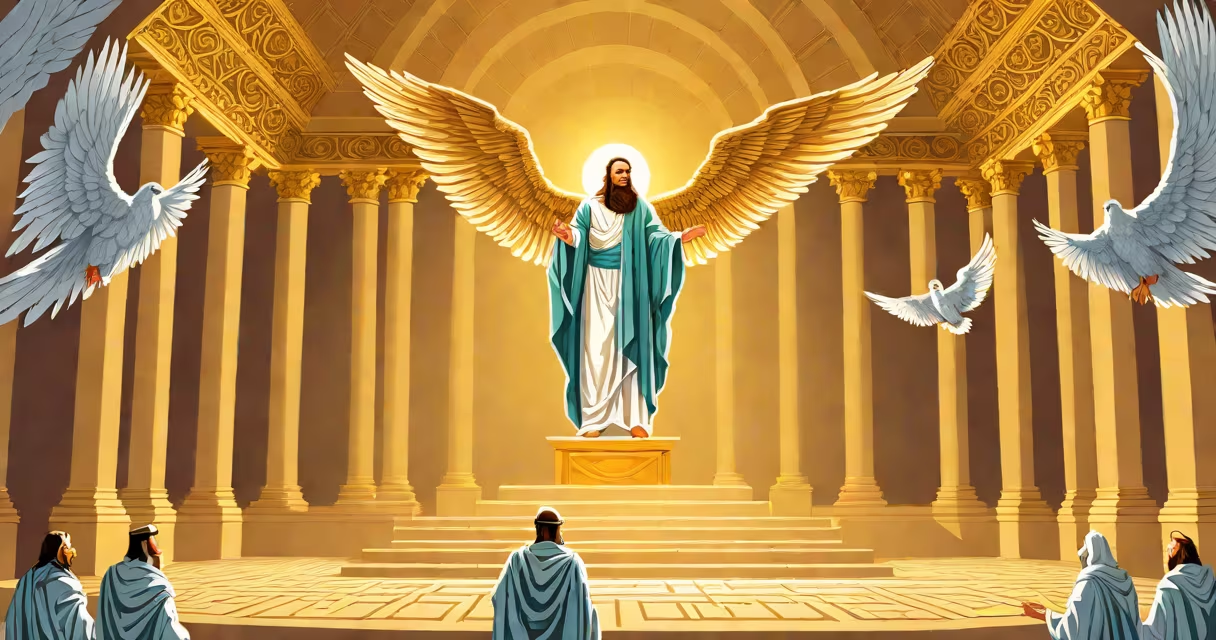
Isaiah 6 describes a visionary encounter in which the prophet sees God seated on a high throne, surrounded by six-winged seraphim who cry "Holy, holy, holy" and commission Isaiah to deliver a message of judgment and eventual restoration to Judah. This chapter marks the formal beginning of Isaiah's prophetic ministry and establishes core themes of divine holiness, human unworthiness, and redemptive purpose.
The vision unfolds in the year King Uzziah died, a key moment in Judah's history. Isaiah enters the temple and witnesses a scene of overwhelming majesty: the temple is filled with God's glory, and seraphim-angelic beings with six wings-hover above the altar. They chant "Holy, holy, holy is the Lord Almighty; the whole earth is full of his glory." The intensity of the moment causes the temple's foundations to shake and smoke to fill the space. This moment is not symbolic-it is described as a direct, sensory experience of divine presence.
Isaiah's reaction is immediate and personal. He cries out, "Woe to me! I am ruined! For I am a man of unclean lips, and I live among a people of unclean lips." His sense of moral failure arises not from sinfulness alone, but from proximity to absolute purity. The seraphim respond by flying to him with a live coal from the altar, touching his lips with it, and declaring, "Your guilt is taken away and your sin atoned for." This act of purification is essential: Isaiah cannot speak God's word unless he is cleansed first.
Isaiah 6 functions as a divine appointment. The vision is not a dream or metaphor-it is presented as a historical event. The Hebrew text uses the verb "saw" (ra'ah) in the past tense, indicating a real, observable occurrence. The imagery is consistent with other biblical accounts of divine revelation, such as Ezekiel's vision of the throne-chariot (Ezekiel 1) and John's vision in Revelation (Revelation 4).
God asks, "Whom shall I send? And who will go for us?" Isaiah responds, "Here am I. Send me." This exchange is not casual. It reflects a covenantal relationship between God and a chosen servant. The phrase "send me" echoes Abraham's obedience in Genesis 22 and Moses' response in Exodus 3. Isaiah's willingness to accept the mission despite knowing the people will not listen underscores the tension between divine authority and human resistance.
God's instruction to Isaiah is clear: "Go and tell this people: 'Be ever hearing, but never understanding; be ever seeing, but never perceiving.' Make their hearts dull, their ears heavy, and their eyes closed, so they do not see with their eyes, hear with their ears, understand with their hearts, and turn and be healed." This is not a call to deception, but a recognition of spiritual hardening. The people have already rejected earlier prophets; now, even clearer messages will fail to change them. Yet the message still holds hope: "Though the number of the children of Israel be like the sand of the sea, only a remnant will return."
The seraphim are central to the vision's theological weight. Their name derives from the Hebrew *seraf*-meaning "burning ones." Their six wings suggest complete coverage: two for flight, two for covering their faces (in reverence), and two for covering their feet (in humility). This tripartite covering mirrors the posture of worship seen in Exodus 3:5, where Moses is told to remove his sandals because the ground is holy.
The live coal from the altar symbolizes both purification and sacrifice. In Levitical law, fire from the altar was sacred (Leviticus 16:12-13). Touching Isaiah's lips with a burning coal signifies that his mouth-once unclean-will now carry God's holy word. The act is not magical; it is covenantal. It parallels the priestly consecration in Exodus 29, where blood and oil are applied to sanctify the hands and mouth.
A lesser-known detail: the seraphim do not speak. They only sing. Their song-"Holy, holy, holy"-is the only verbal expression in the entire vision. This repetition emphasizes God's absolute nature. In Hebrew, the triple "holy" (qadosh qadosh qadosh) is a literary device known as *triple emphasis*, used to convey supreme importance. The phrase appears only twice in the Old Proof: here and in Ezekiel 3:12.
Many interpret Isaiah 6 as a call to preach repentance only. But the passage includes both judgment and hope. The people will not listen, yet a remnant will survive. The vision is not about failure-it is about faithfulness in the face of futility. God sends Isaiah not because success is guaranteed, but because obedience matters.
Another misconception is that the seraphim are angels in the modern sense. In ancient Near Eastern cosmology, seraphim were not messengers but divine attendants. They serve God's throne directly. Unlike later angelic hierarchies in Jewish mysticism (e.g., Merkabah literature), seraphim in Isaiah are not intermediaries-they are part of God's immediate presence.
Some assume the vision occurred in a physical temple. But the text says nothing about the building's structure. The setting is spiritual: "I saw the Lord sitting on a high throne." The location is not Jerusalem-it is heaven. This distinction is critical. Isaiah is not in a sanctuary; he is in the divine court. His vision is a heavenly ascent, similar to Daniel's visions in Daniel 7-8.
Isaiah 6 has shaped Christian theology for centuries. The "Holy, holy, holy" refrain became a liturgical standard in both Eastern and Western churches. The Anglican Book of Common Prayer includes it in the Eucharist. In the Catholic Mass, it appears in the Sanctus during the Canon.
Historically, the passage influenced reformers. Martin Luther quoted Isaiah 6:5 in his 1520 letter to Pope Leo X, using Isaiah's cry of unworthiness to argue for justification by faith alone. John Wesley preached on the passage repeatedly, emphasizing the necessity of personal holiness before preaching.
On a practical level, the vision teaches that authentic prophetic ministry begins with humility and ends with endurance. Isaiah's message was unpopular-people would not listen-but he still delivered it. Modern pastors and public speakers can learn from this: clarity and courage matter more than popularity.
| Theme | Meaning in Isaiah 6 | Contrast/Clarification |
|---|---|---|
| Holiness | God's moral perfection and transcendence. The seraphim's cry affirms God's absolute purity. | Not a moral ideal-holiness is relational. God is holy because He is separate from sin. |
| Purification | Isaiah's lips are touched with a live coal. His sin is removed before he speaks. | Not ritual cleansing alone-this is a transformation of identity. He becomes a vessel. |
| Hardening | God says He will make the people's hearts dull so they don't understand. | This is not divine manipulation. It's a consequence of persistent rejection. See Romans 11:8. |
| Remnant | Only a small group will return. The majority will not repent. | Hope remains. The remnant is not insignificant-it is the seed of future restoration. |
I once stood in the ruins of the Church of the Primacy of St. Peter near the Sea of Galilee. A small stone carving showed seraphim with six wings. I looked at it and realized: the same vision that terrified Isaiah now inspires worship in places where the gospel is still being proclaimed. That moment reminded me that divine holiness is not distant-it is meant to be encountered, feared, and loved.
The meaning of Isaiah 6 is not simply a historical account. It is a living invitation: to see God as He truly is, to acknowledge our unworthiness, and to step forward in service-even when the message is not welcomed. The vision ends not with despair, but with a promise: a remnant will remain. The work continues.