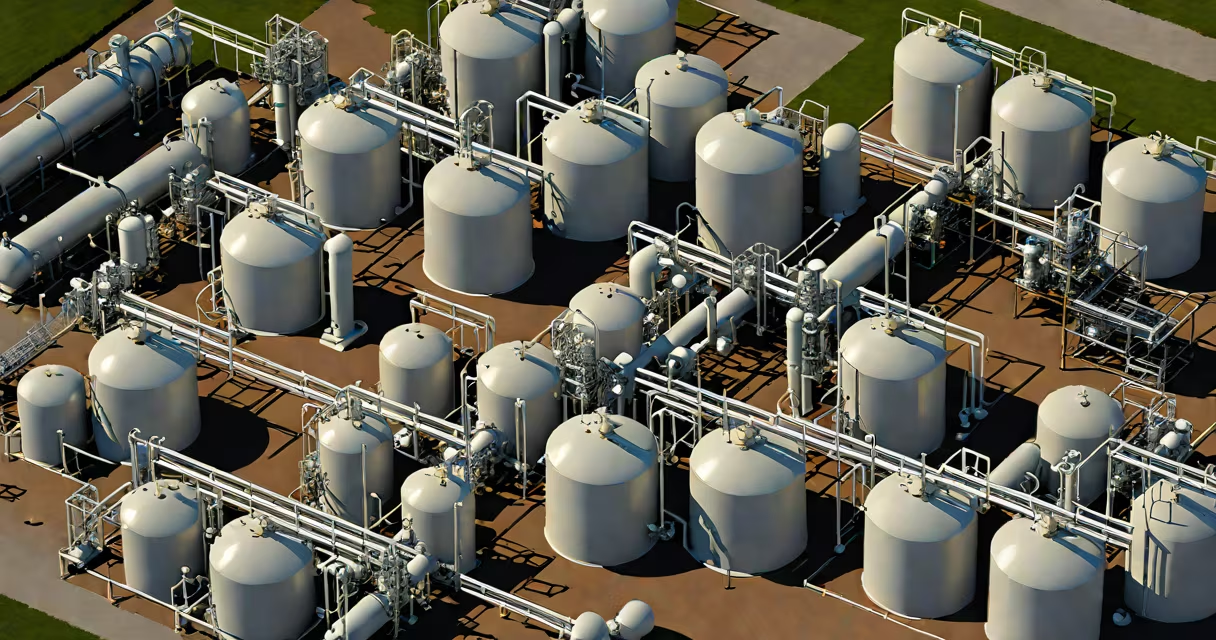
Helium is extracted from natural gas deposits where it has accumulated over geological time, primarily through the radioactive decay of elements like uranium and thorium in Earth's crust. The process begins when natural gas is pumped from underground reservoirs containing trace amounts of helium-typically 0.3% to 7% by volume. This gas is then processed at specialized facilities using cryogenic separation to isolate pure helium.
Most commercially viable helium comes from the United States, Qatar, and Russia. The U.S. National Helium Reserve in Amarillo, Texas, stores about 30% of the world's known helium supply. Extraction occurs at large-scale plants such as those operated by Air Liquide and Linde in the Texas Panhandle. These plants use low-temperature distillation to cool natural gas to around -269°C, turning helium into a liquid while other components remain gaseous or solidify.
Helium is not produced synthetically. It forms slowly over millions of years as alpha particles emitted during radioactive decay capture electrons to become stable helium atoms. Once formed, it migrates upward through porous rock layers until trapped in gas reservoirs. Because helium is lighter than air and highly inert, it doesn't react chemically and remains stable in geological formations. Only a few regions worldwide have sufficient concentrations to make extraction economically feasible.
Natural gas contains varying levels of helium, but only concentrations above 0.3% are typically worth processing. The separation process uses multiple stages: first, impurities like water vapor and carbon dioxide are removed via chemical scrubbing. Then, the remaining gas mixture-mostly methane, nitrogen, and helium-is cooled to extremely low temperatures.
Cryogenic distillation exploits differences in boiling points. Methane boils at -161°C, nitrogen at -196°C, and helium at -269°C. By cooling the gas stream stepwise, heavier components condense first. After removing methane and nitrogen, the remaining gas is almost pure helium. Final purification removes residual neon and argon using molecular sieves or additional cryogenic steps.
A single plant in the U.S. Southwest can process up to 1 million cubic meters of natural gas per day, yielding approximately 10,000 standard cubic meters of helium annually. This output supports medical imaging, semiconductor manufacturing, and scientific research. For context, a single MRI machine requires about 1,500 liters of liquid helium to maintain superconducting magnets at near absolute zero.
Helium is sourced from three primary categories: conventional natural gas fields, unconventional gas deposits, and rare mineral sources. Conventional fields dominate global supply. The largest known helium-rich deposit lies beneath the Permian Basin in West Texas, where helium concentrations reach 6.5% in some wells.
| Source Type | Location Examples | Helium Concentration Range | Extraction Feasibility |
|---|---|---|---|
| Conventional Natural Gas Fields | West Texas, Oklahoma, Russia's Yamal Peninsula | 0.3% - 7.0% | High |
| Unconventional Gas Deposits | Shale formations in China, Canada | 0.1% - 0.5% | Low to moderate |
| Rare Mineral Deposits | Uranium-rich pegmatites in Canada, Africa | Trace (<0.1%) | Very low |
China's Sichuan Basin holds significant potential due to high geothermal activity and ancient rock formations. However, current extraction rates remain below 1% of global demand. In contrast, Qatar's North Field produces helium as a byproduct of liquefied natural gas (LNG) operations, contributing nearly 15% of global helium output.
One non-obvious fact: helium cannot be extracted from air. Despite popular belief, atmospheric helium concentration is only 5.2 parts per million. Even if all air were processed, the energy cost would exceed the value of the helium recovered. This makes air-based helium recovery impractical compared to natural gas extraction.
Many assume helium is mined like ore or manufactured in labs. It is neither. Helium is a byproduct of fossil fuel extraction, not a primary product. Its presence in natural gas is accidental-formed over eons, not engineered.
Another misconception is that helium is renewable. It is not. Once released into the atmosphere, helium escapes Earth's gravity and drifts into space. The amount lost annually exceeds 100 million cubic meters. Current global reserves are estimated at 50 billion cubic meters, but consumption grows at 3% per year. At this rate, reserves could deplete within 50 years if no new sources are discovered.
I once visited a helium processing plant in Wyoming during a field study. The facility ran continuously for 18 months without shutdowns. Engineers showed me the cryogenic column-about 15 meters tall-where liquid helium was collected in insulated tanks. The sound was a constant hum from compressors and valves. That experience confirmed how reliant modern industry is on a finite resource we often treat as disposable.
Helium's unique properties-low density, high thermal conductivity, and extreme stability-make it irreplaceable in critical applications. In medicine, it cools superconducting magnets in MRI scanners. In aerospace, it pressurizes rocket fuel tanks. In semiconductors, it maintains ultra-pure environments during chip fabrication.
For example, a single advanced microchip fabrication line uses over 10,000 liters of helium annually. Without it, the yield drops by 15% due to contamination. In fusion research, helium acts as a coolant in experimental reactors like ITER in France. The plasma confinement system relies on helium to stabilize magnetic fields.
Despite its importance, helium is frequently wasted. Party balloons account for 10% of global helium consumption, though they use only 0.5% of the total supply. Replacing balloon use with hydrogen-filled alternatives would save enough helium to power 200 MRI machines for a year.
Helium is not a commodity to be taken for granted. It is a finite, non-renewable element whose extraction hinges on geology, engineering, and global cooperation. Knowing how they get helium clarifies why conservation matters-not just for science, but for survival.