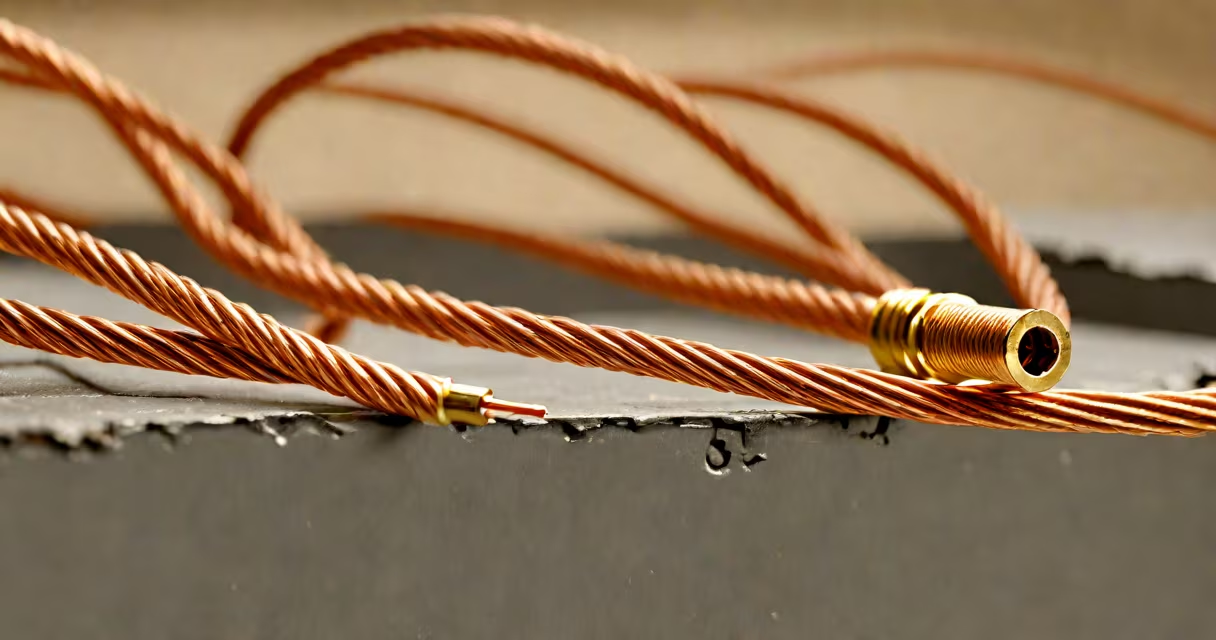
The correct gauge wire for grounding rod is #6 American Wire Gauge (AWG) copper, as specified in the National Electrical Code (NEC) Article 250.166. This size provides sufficient conductivity and mechanical strength to safely dissipate fault current into the earth.
Grounding rods are driven into the earth to create a low-resistance path for fault currents. The wire connecting the rod to the electrical system must carry that current without overheating or breaking. #6 AWG copper wire meets both the ampacity and physical durability requirements set by the NEC for this purpose.
Using a smaller gauge wire - such as #8 or #10 AWG - risks inadequate current-carrying capacity. A larger gauge, like #4 AWG, exceeds minimum requirements but adds unnecessary cost and installation difficulty. #6 AWG strikes the balance between performance, economy, and code compliance.
Grounding wire connects the grounding electrode (like a rod) to the main service panel's grounding bus bar. When a fault occurs - such as a live conductor touching a metal enclosure - the grounding wire conducts the fault current back to the source, tripping the circuit breaker within milliseconds.
This rapid response prevents electric shock and fire hazards. The wire must remain intact under fault conditions. #6 AWG copper has a cross-sectional area of 13,300 circular mils, which supports up to 60 amps continuously in typical residential applications - well above the 15-20 amp threshold seen in most branch circuits.
For example, in a 200-amp service panel, the grounding conductor must handle fault currents exceeding 10,000 amps momentarily. The NEC requires that conductors withstand this without melting or failing. #6 AWG copper wire maintains structural integrity under such stress due to its tensile strength and thermal resistance.
Only copper or aluminum wire is permitted for grounding electrodes. Copper is preferred due to its superior conductivity and corrosion resistance. Aluminum is acceptable only in dry locations and must be rated for direct burial.
Table below outlines common grounding wire types and their suitability:
| Wire Type | Gauge | Material | Use Case | NEC Compliance |
|---|---|---|---|---|
| Copper | #6 AWG | Copper | Residential, commercial, wet/dry locations | Yes (Article 250.166) |
| Aluminum | #6 AWG | Aluminum | Dry locations only; must be corrosion-resistant | Yes, but limited application |
| Copper | #8 AWG | Copper | Not compliant for grounding rod connections | No (too small) |
Aluminum wire cannot be used interchangeably with copper in grounding systems without proper connectors. Direct contact between dissimilar metals causes galvanic corrosion, which degrades the connection over time. The NEC mandates that aluminum-to-copper joints use listed, corrosion-resistant lugs or connectors.
A key distinction often missed: the NEC allows #6 AWG copper for grounding rods, but not for bonding conductors between equipment. Bonding conductors require larger sizes based on the largest ungrounded conductor in the system. For a 200-amp service, the bonding conductor must be #6 AWG copper - matching the grounding electrode conductor - but this is a separate requirement.
Many homeowners and even some electricians assume that "thicker" means better. Using #4 AWG copper wire may seem safer, but it offers no meaningful benefit over #6 AWG in standard installations. The NEC sets minimums, not maximums. Exceeding the minimum doesn't improve safety - it increases cost and labor.
Another error is using insulated wire without proper jacketing. Grounding wires must be bare or have a green insulation. Insulated wire is acceptable only if labeled for grounding and rated for direct burial. Using a general-purpose insulated cable (e.g., THHN) violates NEC Article 250.118, which specifies that grounding conductors must be bare or green.
During a site inspection in 2022, a licensed electrician discovered that a contractor had used #8 AWG copper wire for a grounding rod connection in a new home. The inspector rejected the work. The violation was clear: #8 AWG copper has an ampacity of 50 amps, below the 60-amp minimum required for #6 AWG in a 200-amp service. The fix required pulling new wire and retesting - adding $350 in labor costs.
Consider a single-family residence with a 200-amp main panel. The installer drives a 10-foot copper-clad steel rod into the soil near the foundation. The grounding electrode conductor runs from the rod to the main panel's grounding bus bar.
Step-by-step process:
Final inspection confirms compliance with NEC Article 250.53(D), which requires grounding electrode systems to achieve a resistance of 25 ohms or less. A reading above that triggers additional rods or chemical enhancements.
One detail often overlooked: the grounding wire must not be spliced unless using a listed splice connector. A crimp or solder joint without a proper housing fails under vibration and moisture exposure. The NEC prohibits field splices unless they meet UL 486A standards.
The National Fire Protection Association (NFPA) 70: National Electrical Code (NEC) Article 250.166 explicitly states: "The grounding electrode conductor shall be not smaller than 6 AWG copper." This rule applies to all dwelling units, including those with 100-, 200-, or 400-amp services.
According to the NFPA, "The grounding electrode conductor must be capable of carrying the maximum fault current likely to occur in the system." The NEC uses a standardized calculation method based on the largest ungrounded conductor in the system. For #6 AWG copper, the ampacity is 60 amps - sufficient for most residential services.
The International Residential Code (IRC) 2021, Section M2501.3, references NEC Article 250.166 and mandates that grounding electrode conductors be installed without sharp bends or kinks. The bend radius must exceed six times the wire diameter to prevent internal strand breakage.
When in doubt, consult the latest edition of the NEC or a licensed electrician. Local jurisdictions may enforce stricter requirements, especially in high-moisture or corrosive environments like coastal regions.