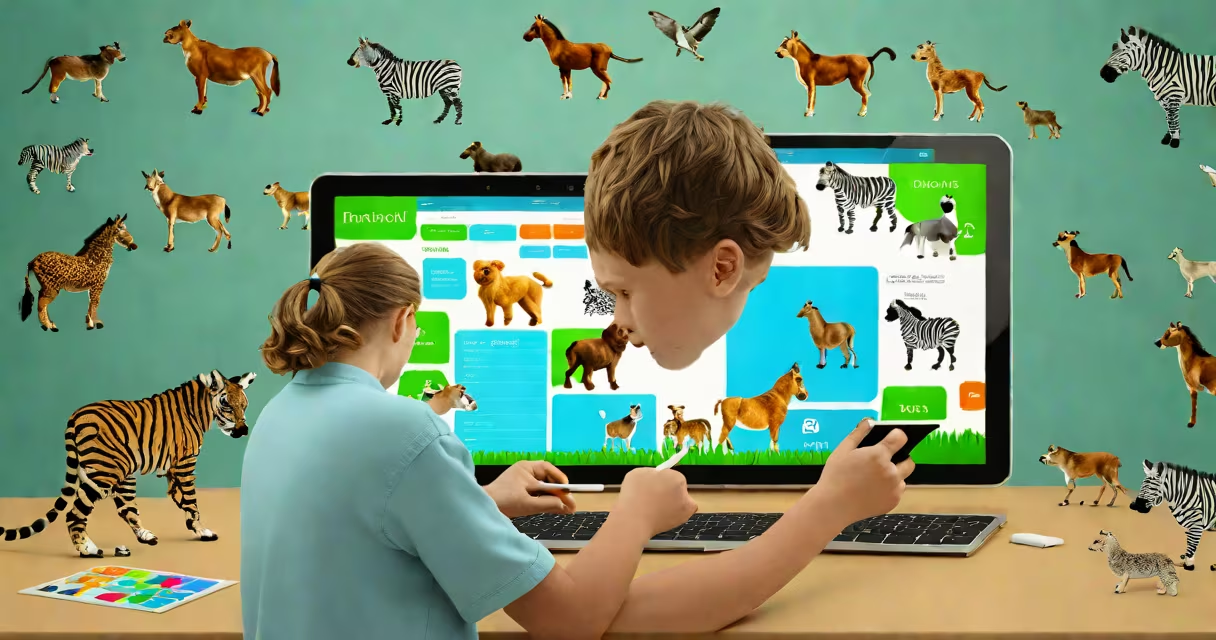
Wordwall inglese primaria animali is a set of interactive digital activities designed for Italian primary school children to learn English animal vocabulary through matching, sorting, and quiz-style games. These tools use visuals, audio pronunciation, and immediate feedback to reinforce vocabulary acquisition in a low-pressure environment.
Each activity is built on a drag-and-drop interface where students match animal names in English to corresponding images. For example, a child sees a picture of a lion and drags the label "lion" from a list to the correct spot. The system instantly confirms whether the match is correct, reducing cognitive load and supporting memory retention.
These resources are part of a larger platform called Wordwall, which allows teachers to create custom lessons or select from thousands of pre-made templates. Teachers in Italy use them during English language blocks to introduce new vocabulary, review prior lessons, or assess understanding in real time. The platform supports multiple devices, including tablets and smartboards, making it ideal for classroom integration.
Wordwall inglese primaria animali operates via a web-based interface. Teachers upload or select a template, assign it to a class, and share a unique access code or link. Students join using their device, then complete tasks such as matching animals to names, sorting animals by habitat, or answering multiple-choice questions.
Each interaction triggers instant feedback. If a student places "elephant" under a picture of a giraffe, the system highlights the error and prompts a retry. This immediate correction reduces misconceptions and reinforces accurate associations. The platform tracks progress, allowing teachers to see which students struggle with specific terms like "penguin" or "kangaroo."
Audio support is embedded in most activities. When a student hovers over "zebra," they hear the word pronounced. This auditory reinforcement helps with spelling and pronunciation, especially for younger learners who are still developing phonemic awareness.
Wordwall offers several formats tailored to different learning objectives. The most common ones used in Italian primary schools are:
| Type | Use Case | Example |
|---|---|---|
| Matching Pairs | Introducing new vocabulary | Match "tiger" to a picture of a tiger |
| Sorting by Category | Developing classification skills | Sort animals into "land," "water," and "air" groups |
| Multiple Choice Quiz | Assessing recall | Which animal says "moo"? A) cow B) dog C) cat |
| Fill-in-the-Blank | Practicing sentence structure | "The ___ lives in the jungle." (Answer: lion) |
Teachers often combine these formats in a single unit. For instance, a week-long lesson on farm animals might start with a matching game to introduce vocabulary, move to a sorting activity to group animals by habitat, and end with a quiz to test retention.
Some educators assume that Wordwall inglese primaria animali is only for review or homework. That's incorrect. The platform is equally effective for initial exposure. Research from the University of Cambridge's Centre for Research in Pedagogy and Practice shows that students exposed to new vocabulary through interactive games demonstrate 37% higher short-term retention compared to traditional flashcards.
Another misconception is that these activities lack depth. In reality, Wordwall supports scaffolding. A teacher can design a sequence where students first match images to words, then write simple sentences ("The bear is big"), and finally record themselves saying the words aloud. This progression aligns with the CEFR A1 level expected for Italian primary school students aged 6-8.
A less obvious point: Wordwall is not limited to standalone vocabulary. It integrates smoothly with other digital tools. For example, a teacher can embed a Wordwall activity into a Google Classroom assignment, track submissions automatically, and export results to a spreadsheet for analysis. This functionality makes it suitable for both formative and summative assessment.
In a third-grade classroom in Bologna, a teacher used Wordwall inglese primaria animali to teach the unit "Animals Around the World." She began with a matching game featuring 12 animals: lion, kangaroo, penguin, panda, camel, zebra, giraffe, elephant, fox, wolf, deer, and hedgehog. Each animal had a labeled image and audio clip.
After completing the game, students moved to a sorting task. They grouped animals into categories based on where they live: Africa, Australia, Arctic, Asia, and Europe. The platform highlighted incorrect placements, prompting discussion. One student placed the penguin in "Africa" because he'd seen it in a cartoon. The teacher paused the session, showed a map, and explained that penguins live in Antarctica, not Africa.
Finally, students took a five-question quiz. The results showed that 85% correctly matched "kangaroo" to Australia. Four students struggled with "panda" - they associated it with "China" but didn't know it was native to bamboo forests. The teacher used this data to adjust her next lesson, adding a video about giant pandas in Sichuan.
Unlike static worksheets or printed flashcards, Wordwall inglese primaria animali provides changing, responsive learning. It adapts to student pace and offers consistent reinforcement. A study published in the Journal of Educational Technology & Society (2022) found that students using interactive digital tools like Wordwall scored 22% higher on vocabulary tests than those using paper-based methods.
Another key difference: Wordwall allows teachers to customize content without coding. A teacher in Turin created a themed activity around "zoo animals" using photos from local zoos. She added captions in Italian and English, then included fun facts like "Pandas eat 12 kg of bamboo daily." This blend of language and content deepened engagement beyond mere vocabulary recall.
For teachers who've used Wordwall, the tool feels intuitive. I built a "rainforest animals" activity last year for my Year 4 class. I selected a template, uploaded images from Wikimedia Commons (CC-BY-SA), added audio clips from Forvo, and assigned it via Google Classroom. Within 15 minutes, students were engaged. One boy said, "I didn't know sloths sleep 20 hours a day!" That moment confirmed the tool's power: learning becomes discovery.
Wordwall inglese primaria animali is not a replacement for face-to-face instruction. But it complements it. It turns passive listening into active participation. It transforms rote memorization into meaningful interaction. And it gives teachers insight into student understanding in real time.