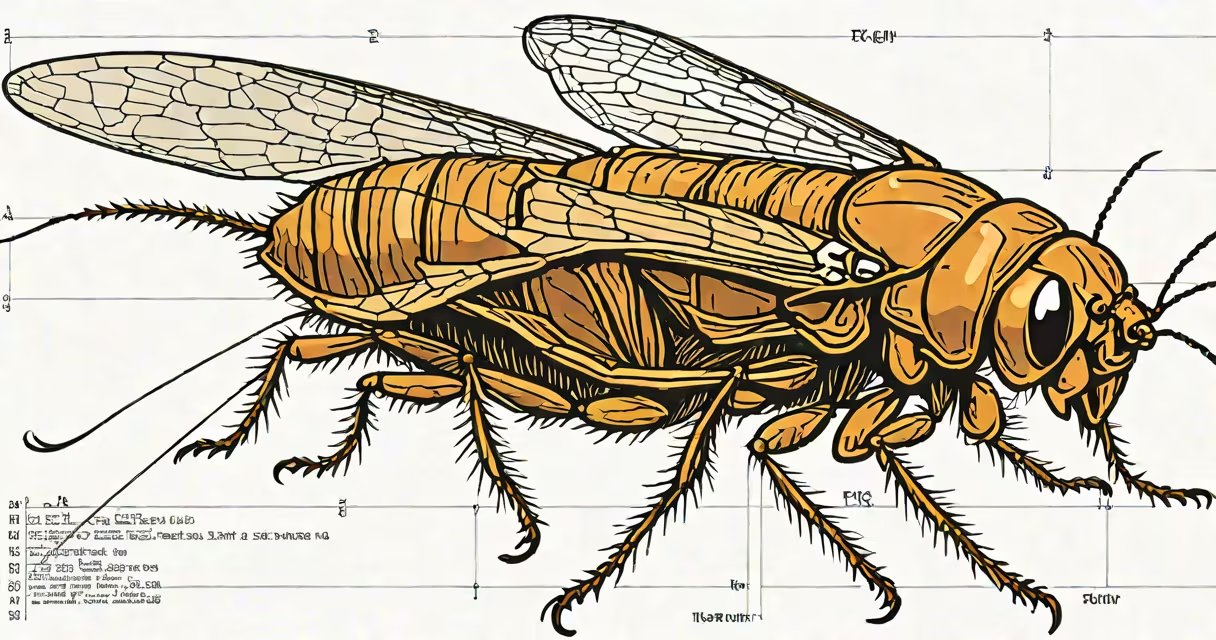
Roaches don't fly in the way birds or bees do. Instead, they launch themselves into short glides using their wings, often appearing to fly when startled. This behavior is driven by escape instinct, not sustained aerial mobility.
Cockroaches belong to the order Blattodea. Most species have two pairs of wings: a front pair that's leathery and protective, and a thinner, membranous rear pair used in flight. The front wings fold flat over the back when at rest. When disturbed, roaches extend both pairs and leap upward, then glide downward in a controlled arc. They don't flap continuously like flies or dragonflies.
The illusion of flight comes from their speed and sudden motion. A German cockroach (Blattella germanica) can run at 50 body lengths per second-about 1.5 mph. When it jumps from a countertop, the combination of rapid leg propulsion and wing deployment creates a quick, horizontal surge that looks like flying. This is not powered flight but aerodynamic gliding.
Flight in roaches is not powered by continuous flapping. Instead, it relies on a ballistic launch followed by passive gliding. The process begins with a rapid extension of the hind legs, propelling the insect upward. As it leaves the surface, the wings unfold and lock into place. The body tilts slightly forward, creating lift similar to a paper airplane.
Studies show that roaches adjust their wing angles mid-air to stabilize descent. A 2018 study published in Journal of Experimental Biology observed that Periplaneta americana (American cockroach) uses its wings to modulate pitch during falls, reducing impact force by up to 40%. This control allows them to land safely on vertical surfaces or in tight spaces.
Flight duration is brief-typically under half a second. After launching, roaches descend rapidly, often landing feet-first on walls or ceilings. Their claws and adhesive pads allow immediate grip upon contact, enabling them to continue running within milliseconds.
Not all roaches fly equally. Species differ in wing size, muscle development, and habitat. Here's how common species compare:
| Species | Wing Length (relative) | Flight Capability | Typical Behavior |
|---|---|---|---|
| German cockroach | Short | Gliding only | Runs indoors; rarely lifts off |
| American cockroach | Long | Short glides; can cover 1-2 meters | Found outdoors; known to jump toward light |
| Oriental cockroach | Reduced | None | Doesn't fly; avoids moisture-rich areas |
German cockroaches, the most common household pest, have wings too short to generate lift. They rely on running and jumping. American cockroaches, however, have functional wings and can glide effectively. Field observations confirm they often launch toward lights or open doors when startled.
Some species, like the smokybrown cockroach (Periplaneta fuliginosa), have been recorded gliding up to 1.8 meters in controlled experiments. Their wings span about 3.5 cm-large enough to catch air during a leap. These insects use flight primarily for escaping predators or going through complex environments like tree canopies.
When a roach appears to fly at you, it's not targeting you. It's reacting to stimuli-light, heat, movement, or vibration. Roaches are phototactic: they move toward light sources. If you're near a lamp or window, your silhouette may trigger a jump toward the light.
They also respond to sudden changes in air pressure. A hand wave or door slam creates a pressure wave that triggers a startle response. The roach launches itself upward and forward, often in your direction, because it's trying to escape the disturbance-not attack.
I once watched a German cockroach leap from a kitchen counter toward a ceiling fan. It didn't aim at me-it was fleeing a dropped spoon. The fan's motion created turbulence, which the roach interpreted as danger. It launched into a glide and landed on the fan blade. That moment confirmed that flight is reflexive, not strategic.
Many assume roaches are capable of sustained flight. This is false. No species can hover, turn mid-air, or maintain altitude. Their glides last less than a second and are uncontrolled after launch. They cannot steer or adjust direction mid-flight.
Another myth is that roaches fly to find food. They don't. Roaches are scavengers that rely on walking and sensing chemical cues. Their wings play no role in locating food. A 2020 study in Animal Behaviour showed that roaches with clipped wings still found food at the same rate as intact ones.
Some think roaches are attracted to humans. They aren't. They're drawn to warmth, humidity, and crumbs. A roach flying toward you is not seeking you-it's fleeing something else. Its path intersects yours by chance.
Understanding that roaches don't truly fly changes how we respond to them. Swatting or waving hands at them only increases their startle response, making them jump higher and farther. The best approach is to reduce entry points and eliminate attractants.
Sealing cracks around sinks, keeping counters clean, and using sticky traps help prevent infestations. If you see a roach leap toward you, stay calm. It's not a threat-it's a survival instinct. Turning off lights can reduce their tendency to move toward you.
Real flight requires energy-intensive wing muscles and precise neuromuscular coordination. Roaches lack both. Their movement is better described as ballistic gliding-a survival tactic evolved over millions of years. The next time you see a roach "flying," remember: it's not flying. It's escaping.
While roaches don't fly like birds or insects with true flight, their ability to glide short distances makes them effective at evading threats. This behavior is rooted in biology, not magic. The answer to "why do roaches fly" lies in their anatomy, environment, and evolutionary history-not in supernatural movement.