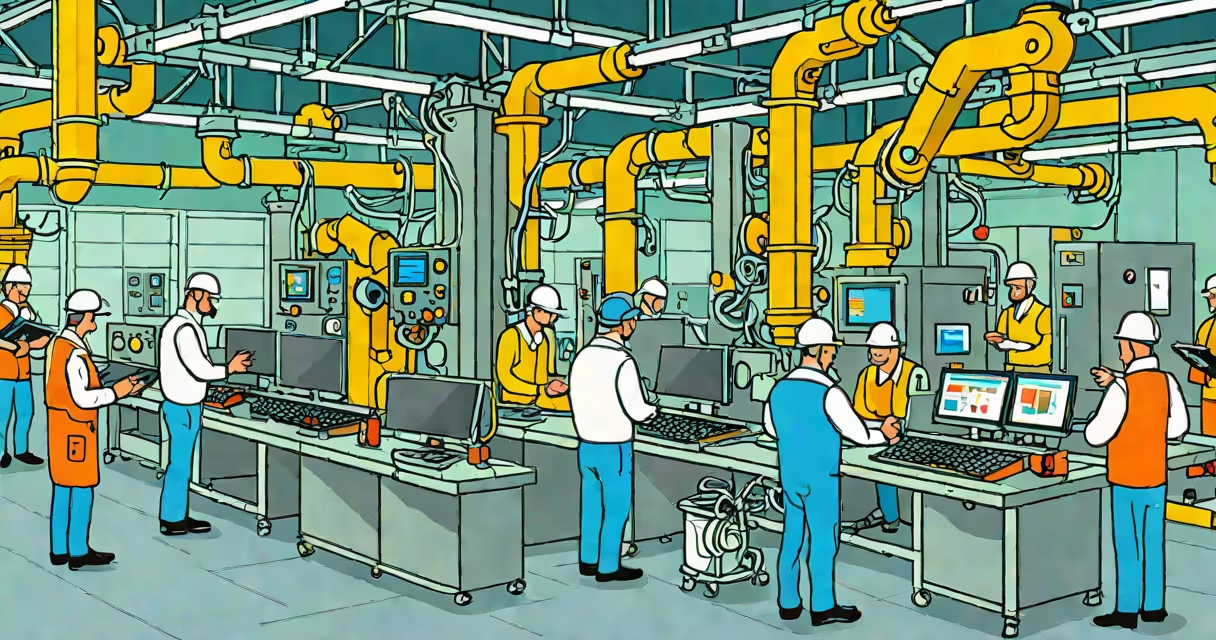
A production engineer oversees the planning, implementation, and optimization of manufacturing processes to ensure products are made efficiently, reliably, and at scale. They translate design specifications into real-world production systems, balancing speed, cost, safety, and quality. This role sits at the intersection of engineering, operations, and continuous improvement.
Production engineers work across industries including automotive, electronics, pharmaceuticals, and food processing. Their core responsibility is to turn blueprints and prototypes into repeatable, high-volume manufacturing processes. They analyze workflow bottlenecks, select equipment, define machine parameters, and implement quality checks-all while minimizing downtime and material waste.
According to the U.S. Bureau of Labor Statistics, production engineers often hold bachelor's degrees in mechanical, industrial, or manufacturing engineering. Many gain experience through internships or roles in plant operations before advancing into engineering leadership positions. The field demands hands-on problem solving, familiarity with automation tools, and strong collaboration skills.
Production engineers begin by reviewing product designs and manufacturing requirements. They assess whether components can be assembled at scale using existing machinery or if new tooling or automation is needed. For example, a smartphone casing designed with tight tolerances may require custom jigs and vision-guided robotic arms to maintain consistency across thousands of units.
Once the process is mapped, engineers create detailed work instructions, set up production lines, and validate output against specifications. They use statistical process control (SPC) to monitor variation and detect early signs of defects. If a batch of circuit boards shows solder joint failures, the engineer traces the issue to temperature settings on a reflow oven and adjusts the thermal profile accordingly.
After initial rollout, production engineers monitor performance metrics such as cycle time, yield rate, and equipment effectiveness (OEE). They apply lean manufacturing principles-like 5S and Kaizen-to eliminate waste and improve throughput. When a bottleneck appears at a packaging station, they may redesign the layout, add a second conveyor, or integrate a robot arm to handle load balancing.
Modern production engineers rely on software and hardware systems to manage complexity. Common tools include:
For instance, a beverage bottling facility uses a PLC to synchronize label applicators, fillers, and cappers. A production engineer programs the timing logic so that each bottle receives the correct label at the right moment-preventing misalignment or wasted product. If a sensor detects a missing cap, the system halts the line and alerts operators within seconds.
| Type | Focus Area | Typical Output |
|---|---|---|
| Process Optimization | Reducing cycle time and scrap rate | 15% faster throughput, 8% lower defect rate |
| Automation Integration | Adding robotics or sensors | 200 units/hour increase, fewer manual errors |
| Quality Assurance | Implementing inspection protocols | 99.7% pass rate on final tests |
Production engineers are not the same as maintenance technicians, even though both work on the factory floor. While maintenance staff fix broken machines, production engineers prevent breakdowns by designing solid processes and selecting reliable components. One engineer I observed in a semiconductor plant prevented a recurring defect by changing the alignment tolerance on a wafer handler-reducing rework by 40% without replacing any hardware.
Another confusion arises between production engineering and industrial engineering. Industrial engineers focus on workflow efficiency, labor allocation, and supply chain logistics. Production engineers specialize in the physical execution of manufacturing-equipment setup, process validation, and real-time troubleshooting. A project to reduce changeover time between product models requires both disciplines: industrial engineers map the workflow, while production engineers adjust machine settings and tooling.
Some assume production engineers only work in large factories. But they're equally important in small-batch or high-precision environments. In medical device manufacturing, a single defective implant can lead to patient harm. Here, production engineers enforce strict documentation, traceability, and environmental controls-often working under FDA or ISO 13485 compliance standards.
In a car assembly plant, a production engineer was tasked with reducing the time required to install engine mounts. Initial cycle time stood at 47 seconds per vehicle. After analyzing the current process, the engineer discovered that workers had to manually align three bolts with threaded inserts in a confined space.
The solution involved redesigning the mounting bracket with pre-aligned guides and integrating a pneumatic torque wrench controlled by a PLC. The new setup reduced installation time to 22 seconds. The engineer also added a sensor to verify bolt torque and flag any under-tightened joints. Over six months, this change eliminated 120 hours of rework annually and improved line uptime by 11%.
This example illustrates how production engineers drive measurable improvements-not through theory alone, but by applying physics, materials science, and operational data to real problems. Their decisions impact product cost, delivery timelines, and customer satisfaction.
When asked about their daily routine, one production engineer told me: "I spend most of my time walking the floor, watching machines, talking to operators, and then going back to my computer to run simulations." That blend of observation and analysis defines the role.
Understanding what a production engineer does reveals a critical function in modern industry. They don't just make things-they make them better, faster, and more consistently. Their work helps innovation moves from lab bench to factory floor without losing precision or scalability.