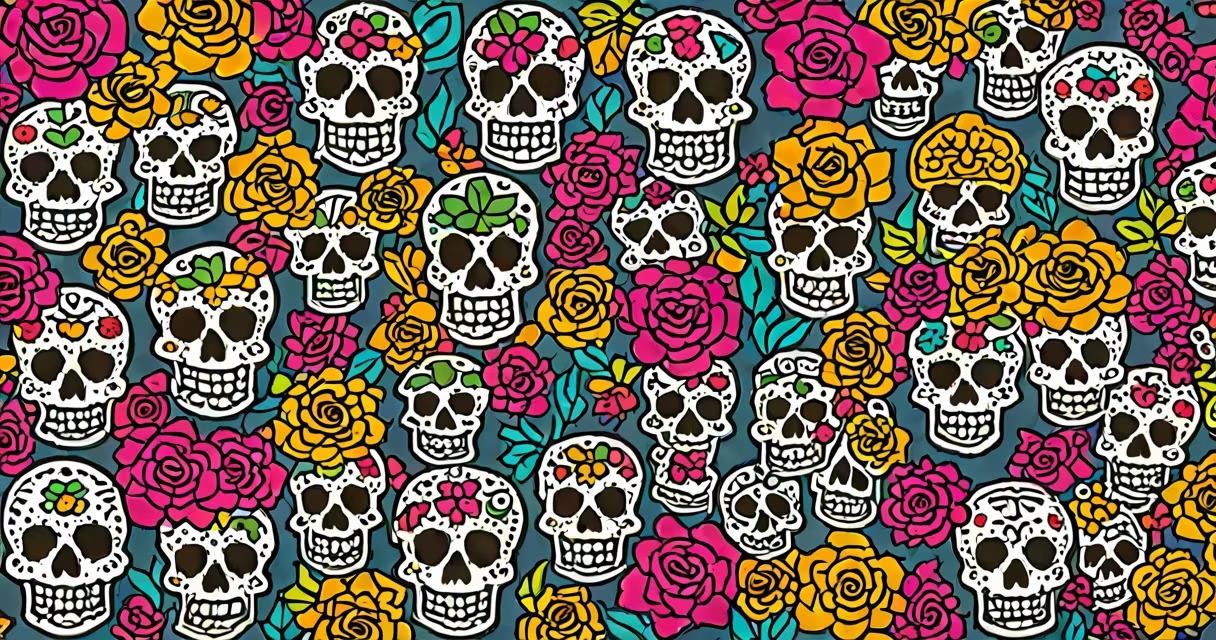
papel picado dia de muertos refers to hand-cut paper banners traditionally displayed during Mexico's Day of the Dead celebrations. These delicate, multi-colored sheets feature complex geometric and symbolic patterns, often suspended between poles or across doorways to honor deceased loved ones.
The craft originated in central Mexico centuries ago, with roots in pre-Hispanic traditions involving offerings and rituals for the dead. Today, papel picado remains a core element of Día de Muertos altars, symbolizing the fragility of life and the connection between the living and the departed. Each design is made by folding thin tissue paper and cutting it with scissors or a small blade, producing symmetrical, lace-like patterns.
Modern papel picado uses vibrant colors-red, orange, yellow, green, blue, and purple-each carrying cultural significance. Red represents blood and life force; orange stands for the sun and the path to the afterlife; yellow signifies marigolds, the flower of the dead. The most common shapes include skeletons, calaveras (skulls), flowers, and religious symbols such as crosses or saints.
Artisans begin with a single sheet of tissue paper, typically 12 inches by 12 inches. They fold it accordion-style-usually 4 to 6 folds-to create symmetry. Using a sharp blade or small scissors, they cut out complex designs through all layers at once. A single misstep can ruin the entire piece, making precision essential.
Once cut, the banner is unfolded and hung. Common placements include above doorways, along walls, or strung between trees. The movement of air causes the pieces to flutter, symbolizing the breath of the spirit and the impermanence of life. The sound of rustling paper is considered sacred in many communities.
A 2018 study by the National Institute of Anthropology and History (INAH) documented over 300 distinct regional styles of papel picado across Mexico. In Puebla, designs often feature floral motifs and religious themes. In Michoacán, artisans incorporate indigenous Purépecha patterns. In Oaxaca, the work tends toward bold, high-contrast cuts with symbolic animals like eagles and jaguars.
Each motif in papel picado carries layered meaning. Below are key symbols and their interpretations:
| Symbol | Meaning | Regional Variation |
|---|---|---|
| Skeletons (calacas) | Playful depictions of the dead; celebrate life beyond death | Popular in Mexico City and Guadalajara; often shown dancing or playing music |
| Marigolds (cempasúchil) | Guide spirits back to the world of the living with scent and color | Used in all regions; petals are scattered on altars and pathways |
| Skulls (calaveras) | Represent mortality and the cyclical nature of life | Often stylized with flowers or jewelry; seen in both papier-mâché and paper forms |
| Geometric patterns | Symbolize balance, infinity, and spiritual continuity | Common in Oaxaca and Chiapas; often based on ancient Mesoamerican designs |
One non-obvious fact: the number of cuts in a single banner often corresponds to the number of days in the Día de Muertos cycle. While the holiday spans two days-November 1 for children (Día de los Inocentes) and November 2 for adults-the most elaborate banners may have 13 or 17 cuts, referencing the 13 levels of the underworld in Nahua cosmology.
Papel picado is primarily used in altar displays (ofrendas) during Día de Muertos. These altars are built in homes, cemeteries, schools, and public spaces. They contain food, drinks, photographs, candles, and personal items meant to welcome returning souls.
According to UNESCO, the tradition of Día de Muertos was inscribed on the Representative List of the Intangible Cultural Heritage of Humanity in 2008. Papel picado is listed as a key expression of this heritage, especially in states like Puebla, Oaxaca, and San Luis Potosí.
A fully realized altar in Mexico City's Zócalo during 2023 included over 1,200 individual papel picado banners. Each was handmade by local artists and hung in overlapping layers, creating a changing, shifting canopy. The effect mimicked a living veil between worlds.
Many assume papel picado is purely decorative or festive. This is incorrect. The art form functions as ritual space-making. Its placement is intentional: banners are hung at eye level or slightly above to allow spirits to pass through unimpeded. If placed too low, they're believed to obstruct the soul's return.
Another misconception is that all papel picado is mass-produced. While factory-made versions exist, authentic pieces are still handmade using traditional tools. A 2021 report by the Mexican Ministry of Culture found that 78% of artisanal papel picado in rural areas is still produced by hand, often passed down through families.
I once spent a weekend in San Juan Teotihuacán observing a family prepare their annual altar. The grandmother, aged 82, taught her granddaughter to fold and cut a banner using only a pair of kitchen scissors and a wooden ruler. "The knife doesn't make the art," she said. "The hands do." That moment confirmed what research shows: the act of creation is part of the honoring.
Papel picado is sometimes mistaken for papel de China (Chinese paper), which is thinner and used in different festivals. It's also not the same as papel maché, which involves layering paper pulp to form sculptures. Unlike those materials, papel picado uses tissue paper specifically chosen for its translucency and ability to catch light.
Another confusion arises with similar crafts in other cultures. For example, Japanese kirie (paper cutting) shares aesthetic similarities but differs in purpose. Japanese kirie often depicts nature scenes or calligraphy and is displayed in homes year-round. Papel picado is seasonal, tied to specific dates and ancestral veneration.
When choosing papel picado for a celebration, look for signs of handwork: slight irregularities in the cut lines, uneven spacing, and visible creases from folding. Machine-cut versions tend to have perfectly uniform patterns and lack the subtle imperfections that mark authenticity.