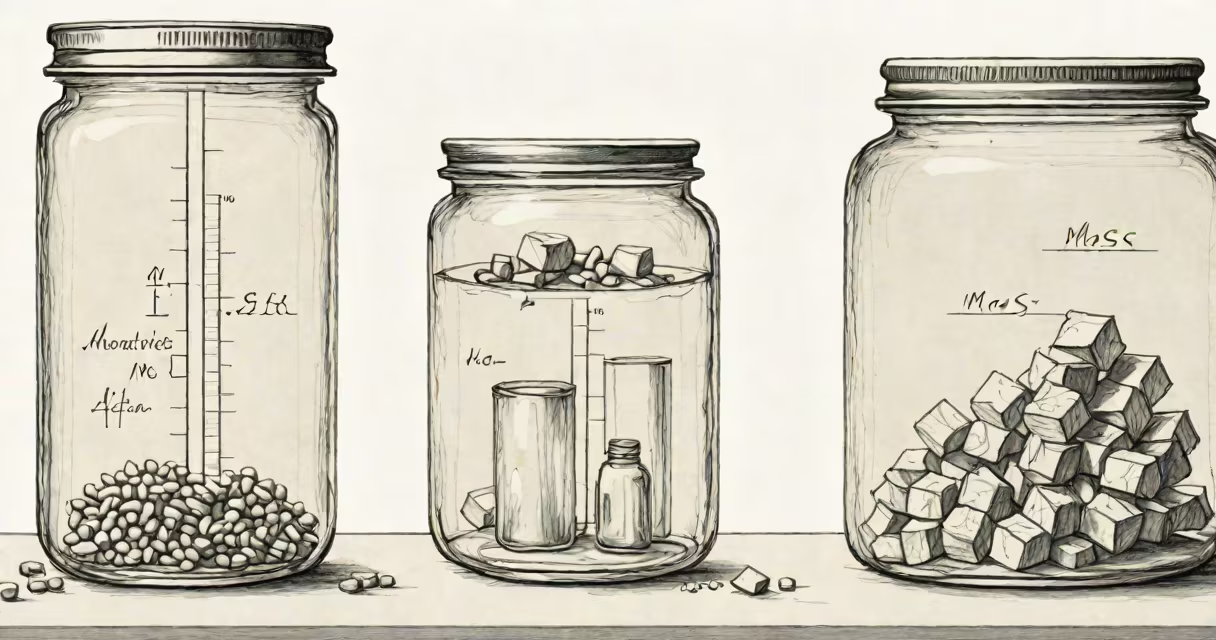
The conservation of mass is a fundamental principle stating that in a closed system, the total mass remains constant during physical and chemical changes. Mass cannot be created or destroyed, only rearranged or transformed.
This law forms the basis for tracking material inputs and outputs in processes ranging from industrial manufacturing to biological metabolism. It applies universally across classical mechanics and chemical reactions, provided no mass crosses the system boundary.
For example, when wood burns in a sealed chamber, the mass of the ash, gases, and smoke equals the original mass of the wood and oxygen consumed. The apparent loss of solid mass is offset by the gain in gaseous products.
In a balanced chemical equation, the total mass of reactants equals the total mass of products. Atoms are rearranged, not annihilated or generated. For instance, in the combustion of methane:
CH₄ + 2O₂ → CO₂ + 2H₂OMolar masses: CH₄ = 16 g/mol, O₂ = 32 g/mol × 2 = 64 g/mol. Total reactant mass = 80 g/mol. Products: CO₂ = 44 g/mol, 2H₂O = 36 g/mol. Total product mass = 80 g/mol. Mass is conserved.
Even in nuclear reactions, where mass converts to energy per Einstein's E=mc², the total mass-energy remains constant. But in non-relativistic contexts-like most lab-scale chemistry-the conservation of mass holds precisely.
The principle appears in different forms depending on context. In fluid dynamics, it's expressed as a continuity equation. In environmental science, it guides pollution modeling. In food processing, it ensures accurate ingredient tracking.
| Field | Application | Example |
|---|---|---|
| Chemistry | Balancing equations | 12g carbon + 32g oxygen → 44g CO₂ |
| Engineering | Process design | Tracking feedstock and output in a reactor |
| Environmental Science | Waste flow analysis | Calculating pollutant mass in wastewater streams |
Mass balance calculations rely on this law. Engineers use it to size equipment, predict yields, and verify process efficiency. A plant producing 100 kg of product daily must account for all incoming raw materials and outgoing byproducts.
People often think mass disappears when something burns or evaporates. That's incorrect. The mass transforms into invisible forms-gases, heat, or radiation-but doesn't vanish. A burning candle loses visible wax, but the total mass of carbon dioxide, water vapor, and soot equals the initial mass.
Another confusion arises in open systems. If a reaction occurs in an open beaker, mass may appear to change due to gas escape. But the law still holds-it just requires defining the system boundaries correctly. In a closed flask, mass remains unchanged.
A key distinction: conservation of mass differs from conservation of matter. Matter can change form, but mass is invariant under classical conditions. This was formalized by Antoine Lavoisier in the late 18th century, who demonstrated that the mass of reactants equaled the mass of products in his experiments with mercury oxide decomposition.
Consider a brewery fermenting 1,000 liters of wort (unfermented beer) into 1,000 liters of beer. The wort contains 10% sugar by mass. After fermentation, yeast converts sugar into ethanol and CO₂.
Initial mass: 1,000 kg wort × 10% sugar = 100 kg sugar. Final products: 90 kg residual sugars, 10 kg ethanol, and 10 kg CO₂ gas. Total mass: 110 kg. But the CO₂ escapes into the air. So the remaining liquid weighs less-about 100 kg.
Without accounting for the gas, mass seems lost. But the full system-including the atmosphere-still conserves mass. The 10 kg of CO₂ adds to the ambient air mass. This is why engineers define control volumes carefully.
I once observed this in a pilot-scale bioreactor where pressure buildup from CO₂ release caused a sensor error. Only after recalibrating the system to include gas output did the mass balance close. The lesson: boundary definition matters.
Lavoisier's work in the 1780s established the law through meticulous weighing. He showed that the mass of a sealed vessel didn't change during combustion, disproving the phlogiston theory. His findings were published in *Traité Élémentaire de Chimie* (1789).
Modern validation comes from NASA's Mars rovers, which use mass balance models to analyze soil samples. The European Space Agency confirms that mass conservation holds in microgravity environments, supporting mission-critical calculations.
According to the National Institute of Standards and Technology (NIST), "In all non-nuclear chemical processes, mass is conserved within measurement uncertainty." Similarly, the American Physical Society notes that while relativity allows mass-energy conversion, the conservation of mass remains valid in everyday applications.
The conservation of mass is not the same as conservation of energy. Energy can be converted between forms-kinetic, thermal, electromagnetic-without changing total energy. Mass and energy are related via E=mc², but they are distinct quantities.
Also, it does not imply that matter is indestructible. Matter can be transformed-carbon atoms in coal become CO₂ molecules-but their mass stays constant. The law governs quantity, not identity.
Some confuse it with the law of conservation of momentum. Momentum conservation applies to motion and forces. Mass conservation applies to substance quantity. Both are essential in physics, but they describe different properties.
The conservation of mass is a foundational concept in science and engineering. It asserts that mass remains constant in isolated systems. This principle enables accurate predictions in chemical reactions, industrial processes, and environmental modeling.