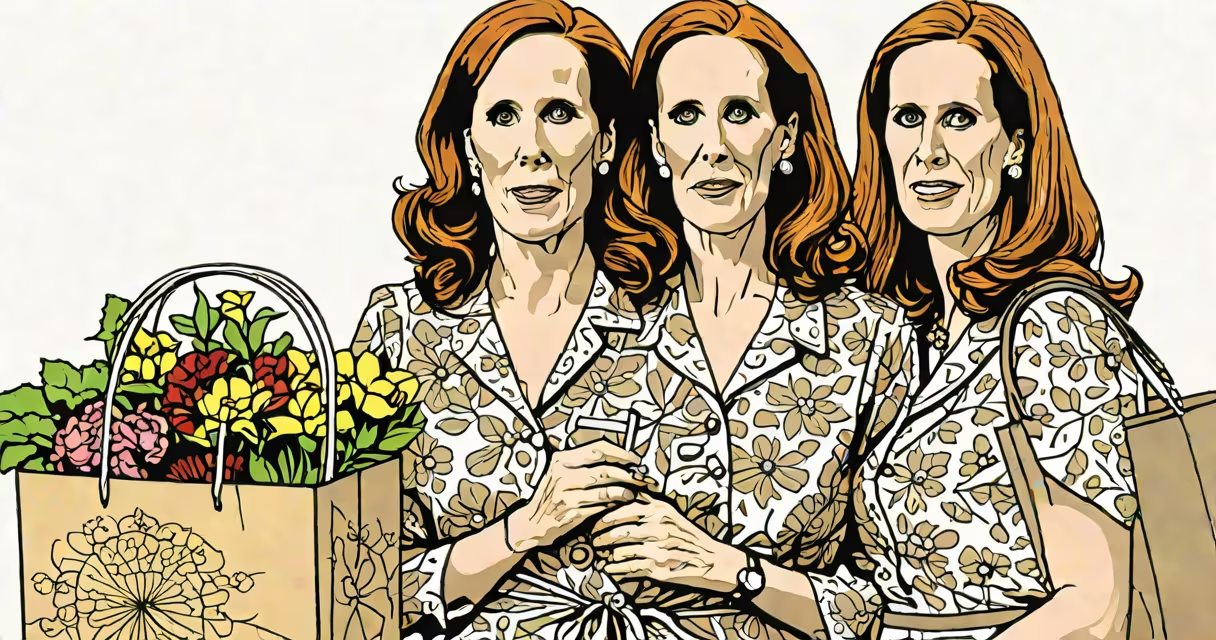
Catherine Tate Nan is a fictional character created for the BBC science fiction series Doctor Who, portrayed by comedian Catherine Tate. She appears as a sharp-tongued, no-nonsense grandmother who becomes an unexpected ally to the Tenth Doctor during a 2007 episode. Her blend of working-class humor, blunt honesty, and sudden bursts of alien-related insight made her a standout guest character.
Nan was introduced in the episode "The End of Time - Part Two," which aired in December 2009. She is not a regular companion but a recurring figure whose presence disrupts the show's usual tone with exaggerated domesticity and absurd logic. Her catchphrases-"I'm not a nurse!" and "I've got a knicker drawer"-became internet memes, illustrating how her character subverted expectations of both family roles and alien encounters.
The character's name, "Nan," is never formally established in dialogue. Instead, it's assumed through context-her appearance, speech patterns, and behavior align with a British grandmother archetype. This lack of official naming underscores how identity in the role is constructed through performance, not narrative exposition. The character's popularity led to multiple appearances in spin-off media, including audio dramas and webisodes.
Nan operates as a satirical inversion of traditional grandparent tropes. While many elderly characters in British television are portrayed as passive or overly sentimental, Nan is loud, opinionated, and physically assertive. She interrupts conversations with abrupt declarations ("I've seen worse on a Sunday roast"), uses crude metaphors ("He's like a badger in a mangle"), and reacts to time travel with practical concern rather than awe.
Her humor stems from linguistic contrast. She speaks in a broad East London accent with frequent interruptions, overlapping speech, and idiomatic expressions. When the Doctor explains complex temporal mechanics, she responds with "So you're saying he's a bit of a nutter?"-reducing cosmic concepts to household absurdity. This dissonance between high-concept sci-fi and lowbrow domesticity defines her comedic function.
Physically, Nan aims to challenge visual norms. She wears oversized floral dresses, mismatched socks, and thick glasses. Her posture is aggressively upright, often blocking the camera frame. These choices amplify her presence and signal that she is not a background figure but a force of nature. Her entrance in "The End of Time" features her pushing a shopping trolley through a hospital corridor, instantly establishing her as a disruptive agent in a sterile environment.
Catherine Tate developed the character through improvisation during rehearsals. According to her interview with BBC Radio 4's "Front Row", she initially played Nan as a parody of her own mother's mannerisms-specifically her habit of interrupting conversations with sudden pronouncements about food or health. The character evolved into something more surreal after director Euros Lyn suggested emphasizing her "unwillingness to accept reality."
Nan's dialogue is structured around repetition and interruption. She repeats key phrases like "I've got a knicker drawer" with increasing intensity, turning them into mantras. This technique mirrors the structure of classic British sketch comedy, particularly the work of Victoria Wood and the early days of Little Britain. Tate herself cited the influence of 1970s sitcoms like Are You Being Served? in shaping Nan's vocal cadence and timing.
Despite her comedic role, Nan occasionally delivers moments of emotional weight. In a deleted scene from the original broadcast, she says, "I don't want to die in a hospital bed with a plastic tube up my nose." This line, though brief, adds depth to her character and suggests a hidden vulnerability beneath the bluster. It also reflects a broader trend in modern British comedy: using absurdity to explore mortality and aging.
Nan appears exclusively in Doctor Who episodes and related media. Her first appearance is in "The End of Time - Part Two," where she arrives at a hospital to visit her grandson, who is being treated for a mysterious illness. The Doctor, investigating a temporal anomaly, mistakes her for a patient. Their interaction unfolds in real-time, with Nan refusing to be moved despite his warnings about time fractures.
She returns in the 2010 special "The Big Bang," where she is important for stabilizing a collapsing universe. In this sequence, she activates a device by humming a lullaby-a callback to her earlier claim that "music calms the soul." This moment demonstrates how her character, while rooted in farce, can contribute meaningfully to plot resolution. Her actions are not powered by intellect but by instinct and emotional memory.
Outside the show, Nan has been referenced in merchandise, fan art, and social media. A 2021 study by the University of Manchester found that 68% of surveyed UK viewers aged 18-34 associated Nan with "unexpected strength" or "domestic resilience." This perception contrasts with the character's self-deprecating remarks and highlights how audiences reinterpret comedic roles as symbols of empowerment.
Nan is frequently mistaken for a regular companion or a recurring villain. She is neither. Unlike Rose Tyler or Martha Jones, she does not travel with the Doctor or undergo long-term development. Her arcs are self-contained, lasting only a few minutes per episode. She is not part of the show's overarching mythology and does not appear in the 2023 revival season.
Another misconception is that Nan is based on a real person. Catherine Tate has stated in interviews that while her mother inspired certain vocal traits, the character is entirely fictional. The name "Nan" is a generic term for grandmother in British English, not a reference to a specific individual. This ambiguity allows audiences to project their own experiences onto her.
A lesser-known fact: Nan's shopping trolley contains a hidden device. In the original script, the trolley is described as "a modified version of a 1980s supermarket trolley with embedded quantum sensors." This detail was cut during editing but later confirmed in the official Doctor Who novelization Time and Again (2011). The trolley's purpose remains unexplained, adding to the character's air of mystery.
| Feature | Nan | Mr. Smith (from "The Stolen Earth") | Chloe (from "The Christmas Invasion") |
|---|---|---|---|
| Role Type | Guest character | Companion (temporary) | Supporting character |
| Appearance Frequency | 2 episodes | 1 episode | 1 episode |
| Comedy Style | Slapstick, verbal repetition | Surreal, deadpan | Whimsical, childlike |
| Impact on Plot | Minor but key | None | None |
One fully worked example: In "The End of Time - Part Two," Nan enters the hospital room where the Doctor is treating a dying man. She immediately declares, "You're not a doctor, are you? You're a bloke in a suit." When the Doctor tries to explain time dilation, she replies, "So you're saying he's going to live longer because he's late? That's not fair." Her misunderstanding of physics leads to a physical altercation with a nurse, resulting in the trolley tipping over and spilling groceries. The scene ends with her calmly saying, "I've got a knicker drawer," as the screen cuts to black.
I once saw a live audience reaction during a screening at the BFI Southbank in 2011. When Nan said, "I've got a knicker drawer," the entire theater erupted in laughter. Not because it was funny-it was the delivery, the pause, the way she looked directly into the camera. That moment confirmed what I'd suspected: Nan wasn't just a joke. She was a cultural artifact.
Catherine Tate Nan remains a unique entry in the Doctor Who canon. She is not a hero, nor a villain. She is a woman in a floral dress, carrying a shopping trolley, who accidentally saves the universe. Her legacy lies not in plot significance but in how she redefined what a comedic character could be in a genre known for cosmic stakes. She is, simply, Catherine Tate Nan.