Basalt is primarily extrusive, meaning it forms when lava cools quickly on Earth's surface. Its fine-grained texture results from rapid solidification, which prevents large crystals from forming.
Extrusive rocks like basalt cool rapidly after eruption, producing small mineral grains or even glassy textures. This contrasts with intrusive rocks, which cool slowly beneath the surface and develop larger crystals. Basalt is the most common extrusive igneous rock on Earth.
Geologists classify basalt based on composition and cooling environment. The term "extrusive" applies because basalt typically originates from lava flows, especially in oceanic settings and volcanic regions such as Hawaii and Iceland.
Basalt forms when basaltic magma-rich in iron, magnesium, and calcium-reaches the surface and cools quickly. Magma with low silica content flows easily and erupts as lava, which then solidifies into basalt within hours to days.
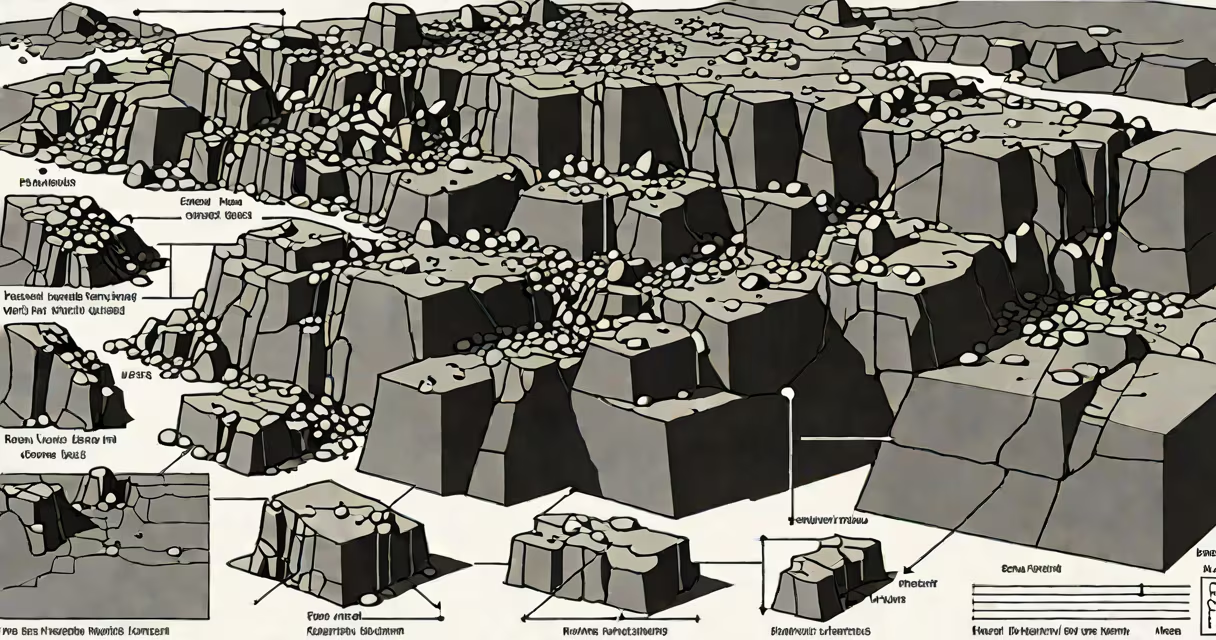
When lava flows spread across the surface, they cool unevenly. The outer layer hardens first, forming a skin, while the interior remains molten longer. This creates columnar jointing-vertical cracks that form hexagonal or polygonal columns-as the rock contracts during cooling.
A well-documented example is the Giant's Causeway in Northern Ireland, where about 60 million years ago, repeated lava flows cooled into thousands of interlocking basalt columns. Each column measures between 1 and 2 meters in diameter and extends tens of meters downward.
Basalt is composed mostly of plagioclase feldspar, pyroxene, and olivine. Its chemical makeup includes 45-52% silica, placing it in the mafic category-rich in dark minerals and metals.
The texture of basalt is typically aphanitic (fine-grained), meaning individual minerals are too small to see without magnification. In rare cases, vesicles-gas bubbles trapped during eruption-create a porous appearance. Pillow lavas, shaped like rounded pillows, form when lava erupts underwater and cools rapidly.
Basalt differs from gabbro, its intrusive equivalent. Gabbro forms under similar conditions but cools slowly underground, allowing crystals to grow larger. A single outcrop may contain both basalt and gabbro, indicating a magmatic system that fed both surface flows and subsurface intrusions.
Basalt dominates the ocean floor. The Mid-Atlantic Ridge, where tectonic plates diverge, produces new oceanic crust through basaltic eruptions. Seafloor spreading generates approximately 10 kilometers of new basaltic crust annually, according to the U.S. Geological Survey (USGS).
On land, basalt appears in flood basalt provinces. The Columbia River Basalt Group in the northwestern United States covers over 210,000 square kilometers and erupted between 17 and 14 million years ago. These flows were among the largest in Earth's history, with individual layers reaching up to 300 meters thick.
Volcanic islands like those in the Hawaiian chain are built almost entirely from basalt. Kīlauea's recent eruptions have produced fresh basalt flows that cover roads and reshape terrain within weeks.
Some assume that all dark, dense rocks are basalt. However, not all dark igneous rocks are extrusive. For example, diabase-a fine-grained, dark rock-is often mistaken for basalt but is actually intrusive, formed at shallow depths.
Another error is equating basalt with all volcanic rock. While basalt is the most abundant volcanic rock, other types exist, including rhyolite (felsic, high-silica) and andesite (intermediate). Basalt is distinct due to its low silica content and high iron-magnesium ratio.
Basalt is not always extrusive. Rare occurrences of basaltic intrusions-called sills or dikes-exist. But these are exceptions. The defining characteristic of basalt is its formation from surface-cooled lava, not subsurface magma.
The table below compares basalt with key intrusive and extrusive igneous rocks:
| Rock Type | Texture | Crystal Size | Formation Environment | Common Location |
|---|---|---|---|---|
| Basalt | Aphanitic, sometimes vesicular | Microscopic to very small | Surface, underwater, or above-ground lava flow | Ocean floors, Hawaii, Iceland |
| Gabbro | Phaneritic | Larger crystals (visible) | Deep underground, slow cooling | Continental crust, oceanic crust roots |
| Rhyolite | Porphyritic or glassy | Variable; large phenocrysts in fine matrix | Surface, explosive eruptions | Yellowstone, western U.S. |
| Andesite | Intermediate texture | Moderate-sized crystals | Subduction zones, stratovolcanoes | Andes Mountains, Cascades |
Understanding basalt requires recognizing that its classification hinges on formation process, not just composition. Even though basalt and gabbro share nearly identical chemistry, their textures differ due to cooling rate.
I once observed a basalt flow field in northern California during a geology field trip. The surface was cracked into polygonal shapes, and the rock felt dense and cold. When I tapped it with a hammer, it broke cleanly along fracture lines-evidence of columnar jointing. That moment confirmed how quickly lava can solidify into basalt under natural conditions.
Basalt is extrusive by definition. Its formation from rapid cooling lava explains its widespread presence on Earth's surface and ocean floor. Despite rare exceptions involving shallow intrusions, basalt remains the quintessential extrusive rock.
Knowing whether basalt is intrusive or extrusive matters for interpreting Earth's geologic history. It reveals how tectonic forces shape crust, how volcanoes build land, and how oceans form. The answer to "is basalt intrusive or extrusive?" is clear: basalt is extrusive.