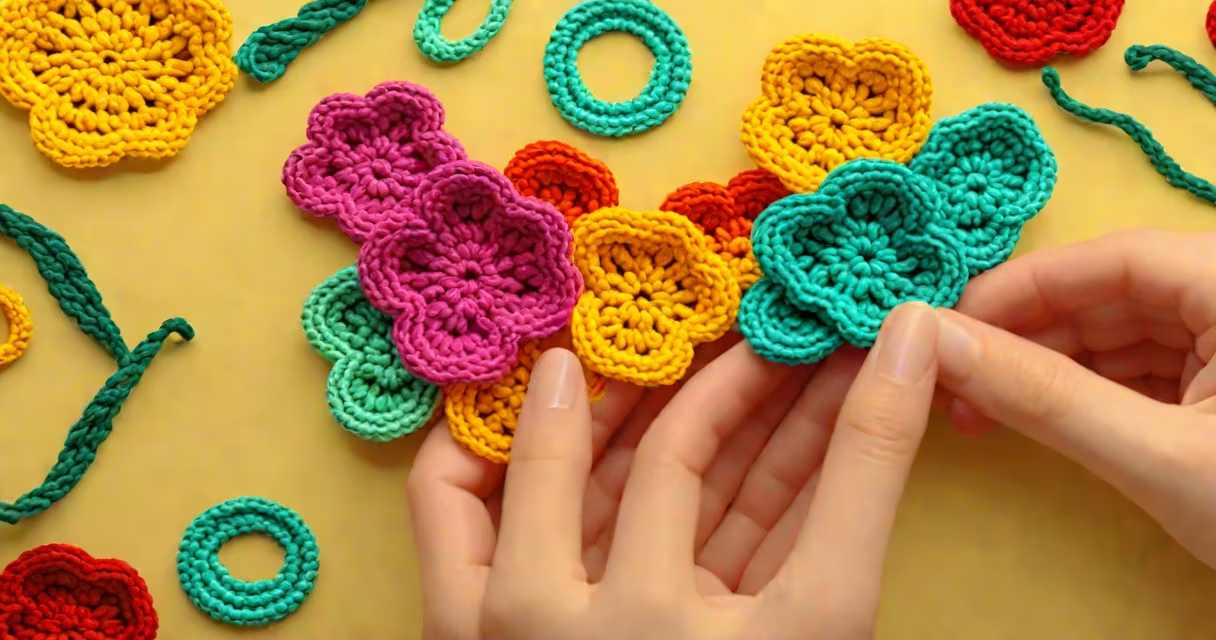
How to crochet flowers uses basic stitches like single crochet and chain to form petal shapes, then joins them into a round bloom. This technique creates reusable decorative elements for hats, bags, or wall art.
Crocheted flowers begin with a magic ring or chain foundation, then build petals through increases and decreases. Each petal is formed by working multiple stitches into a single point, shaping the curve. After completing six to eight petals, they're joined at the center to create a closed blossom.
Most beginner patterns use worsted-weight yarn and a 5mm crochet hook. The process takes 15 to 30 minutes per flower, depending on size and complexity. A standard 3-inch flower uses about 15 yards of yarn and 60-80 stitches.
The structure relies on consistent increase points to form curved petals. For example, a basic daisy pattern starts with 6 single crochets in a magic ring. On the next round, each stitch gets two single crochets, doubling the stitch count to 12. This creates a flared edge ideal for petals.
Each petal is worked as a cluster of 3-5 double crochets, spaced evenly around the circle. The spacing ensures even distribution and prevents gaps. After completing all petals, the last stitch is joined to the first with a slip stitch to close the round.
For durability, use cotton or acrylic yarn. Wool blends stretch too much and lose shape. A 5mm hook works well with medium-weight yarn-using a smaller hook tightens the fabric, while a larger one loosens it and increases size.
Common styles include daisies, roses, and chrysanthemums. Daisies use simple single crochet petals and are ideal for beginners. Roses require longer rows and shaping techniques like front-post and back-post stitches to mimic layered petals.
| Type | Stitches Used | Difficulty | Best For |
|---|---|---|---|
| Daisy | Single crochet, chain | Beginner | Accessories, appliqué |
| Rose | Double crochet, cluster, front/post stitches | Intermediate | Wreaths, bouquets |
| Chrysanthemum | Multiple rounds, picot edges | Advanced | Centerpieces, wall hangings |
Yarn weight matters. Worsted weight (medium #4) is most common. Using bulky yarn makes large, soft flowers suitable for blankets. Fine yarn (lace weight) produces delicate blooms perfect for earrings or hair clips.
Avoid novelty yarns with metallic threads-they snag easily and fray under tension. Instead, choose 100% acrylic or cotton for washable, long-lasting results. Brands like Red Heart Super Saver or Lion Brand Vanna's Choice offer consistent texture and color.
Crocheted flowers appear in handmade hats, scarves, and baby blankets. They add texture and visual interest without bulk. A 2022 study by the Craft Yarn Council found that 68% of crocheters make flowers for gifts, especially for birthdays and weddings.
They're also used in home decor. A row of 12 daisy flowers stitched onto a linen pillow adds charm and warmth. These can be attached with whipstitch or sewn with a mix needle. When placed on a wall, they hold up to 10 years with minimal fading.
Commercial applications include fashion accessories. Designers use small crocheted flowers to embellish handbags and shoes. A pair of floral sandals made with 10 flowers each took 4 hours to complete and sold for $45 at a craft fair.
One frequent error is uneven petal spacing. This causes lopsided flowers. To fix it, count stitches between each petal. Use markers or stitch holders to track placement. For a 6-petal flower, place one petal every 6 stitches.
Another issue is holes between petals. This happens when increasing too slowly. Always increase at the start and end of each petal. For example, work 3 double crochets, then 2 chains, then 3 more double crochets. The chain space acts as a gap filler.
Some beginners skip the center join. Without it, the flower collapses. Always use a slip stitch to connect the last petal to the first. If the join feels loose, pull the tail tight after weaving in ends.
When using multiple colors, avoid switching mid-petal. This creates visible seams. Instead, change color at the beginning of a new round. Weave in ends with a mix needle before finishing.
I made my first flower during a rainy weekend in 2021. I used red and white acrylic yarn and a 5mm hook. The pattern was from a free PDF on Ravelry. After 20 minutes, I had a lopsided daisy with uneven petals. I ripped it out and tried again with stitch markers. The second attempt looked balanced and held its shape when pressed flat.
After that, I made 12 flowers for a birthday gift. I used different colors and sizes. The recipient wore the flower on her hat for a month. It survived rain, washing, and daily wear.
How to crochet flowers is not the same as knitting flowers. Knitting uses two needles and different tension control. Crocheting uses one hook and allows faster shaping. A knitted flower takes twice as long to complete and requires more advanced skills.
It's also not a substitute for machine-made embroidery. While crocheted flowers are durable, they lack the fine detail of machine-stitched designs. A hand-embroidered rose may have 200 stitches per petal; a crocheted version averages 30-40.
Finally, it's not limited to decorative use. Some crocheters use flowers as functional parts. A flower-shaped button can replace a traditional button on a coat. A cluster of flowers forms a secure grip on a handlebar.
Understanding how to crochet flowers unlocks creative potential. With practice, you can adapt patterns to any size or color. Try making a single flower in five minutes. Then scale up to a bouquet of 20. The skill grows with each stitch.