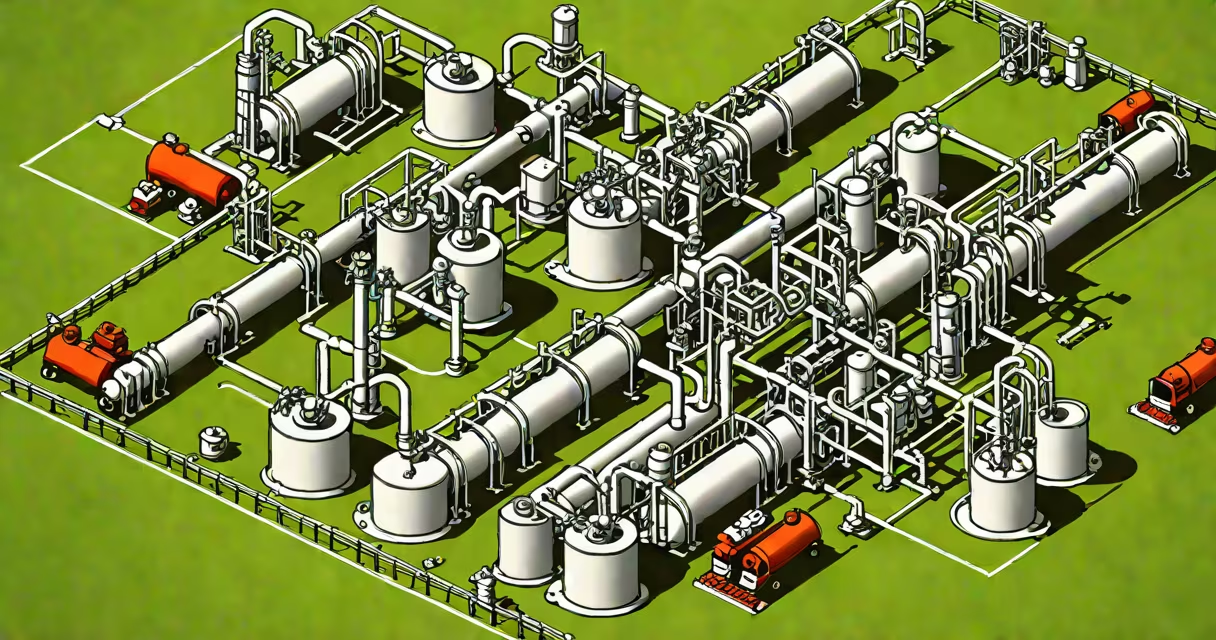
Midstream refers to the segment of the oil and gas industry responsible for transporting, storing, and processing raw hydrocarbons-primarily crude oil and natural gas-after they are extracted and before they reach refineries or end users. This phase includes pipelines, terminals, storage hubs, and processing plants that move energy products across regions.
Midstream operations are essential for connecting remote production sites to markets. Without them, crude oil and natural gas would remain stranded at the wellhead. The midstream sector ensures flow continuity across long distances, often spanning hundreds of miles through diverse terrain and regulatory jurisdictions.
According to the U.S. Energy Information Administration (EIA), midstream infrastructure accounts for roughly 60% of the total physical movement of crude oil and natural gas in the United States. These systems are engineered to handle high volumes under pressure, with safety and efficiency as primary design goals.
After crude oil or natural gas is produced at a wellhead, it enters the midstream system via gathering lines-small-diameter pipes that collect output from multiple wells. These lines feed into larger transmission pipelines, which carry the product over long distances at high pressure. Along the way, compressors or pumps maintain flow velocity and prevent pressure drops.
Natural gas undergoes additional treatment during midstream processing. Raw gas contains impurities such as water vapor, carbon dioxide, hydrogen sulfide, and heavier hydrocarbons (like ethane and propane). These contaminants are removed in gas processing plants, where the remaining methane is compressed and sent to market. The separated liquids-known as natural gas liquids (NGLs)-are further refined and sold separately.
Crude oil also undergoes stabilization and dehydration before transport. Water and sediment are removed using separators and filters. The resulting dry, stable crude is then moved via pipeline or rail to refineries. In some cases, crude is stored temporarily in large underground salt caverns or aboveground tanks near major transport routes.
The midstream sector consists of several key components, each serving a distinct function in the energy logistics chain.
| Type | Function | Example |
|---|---|---|
| Gathering Systems | Collect oil/gas from individual wells | 10-inch diameter lines in North Dakota's Bakken formation |
| Transmission Pipelines | Move large volumes over long distances | TransCanada's Keystone Pipeline (1,179 miles) |
| Storage Facilities | Hold crude or NGLs during supply/demand shifts | Strategic Petroleum Reserve in Texas (70 million barrels capacity) |
| Processing Plants | Separate natural gas into marketable components | Plains All American's Saddle Mountain facility in Wyoming |
Each component operates under strict federal and state regulations. The Federal Energy Regulatory Commission (FERC) oversees interstate pipeline rates and access rights, ensuring fair service to shippers regardless of ownership.
Midstream infrastructure is most prevalent in resource-rich basins such as the Permian Basin in West Texas and New Mexico, the Marcellus Shale in Pennsylvania and West Virginia, and the Canadian oil sands near Alberta. These areas produce vast quantities of oil and gas, requiring extensive midstream networks to move output efficiently.
For example, the Permian Basin produces over 5 million barrels of crude oil per day. Without midstream pipelines and rail terminals, much of this output would be stranded due to insufficient export capacity. In 2022, the region added over 1,200 miles of new pipeline infrastructure to alleviate congestion and reduce price differentials between regional benchmarks like WTI and Brent.
Midstream also plays a role in international trade. Export terminals like those in Corpus Christi, Texas, and Sabine Pass, Louisiana, allow U.S.-produced LNG (liquefied natural gas) to be shipped globally. These facilities require significant midstream investment-up to $2 billion per terminal-to liquefy, store, and load gas onto tankers.
Many people mistakenly assume midstream is synonymous with refining or distribution. That's incorrect. Refining occurs in the downstream sector, where crude oil is converted into gasoline, diesel, and petrochemicals. Distribution involves delivering finished products to consumers via trucks, pipelines, or retail outlets.
Another common error is equating midstream with "oil transport." While pipelines are central, midstream also includes storage, compression, and processing. A single midstream company may operate a network of pipelines, a gas plant, and a storage hub-all integrated under one operational model.
A lesser-known fact: midstream companies often don't own the commodity they move. They act as service providers, charging fees based on volume transported or processed. This business model reduces exposure to commodity price swings and provides stable revenue streams. For example, Enterprise Products Partners (EPD) earned $2.3 billion in distributable cash flow in 2023, largely from midstream fees-not from selling oil or gas.
I once visited a midstream terminal in Oklahoma where a control room operator showed me how real-time data from sensors along a 300-mile pipeline network fed into a central monitoring system. When a pressure drop was detected, automated valves closed within seconds to isolate a section, preventing a spill. The system didn't rely on human judgment-it reacted faster than any person could. That moment clarified how automation and engineering define midstream resilience.
Midstream is not a single activity but a complex, interconnected system that moves energy from source to destination. It enables global energy markets by bridging gaps between production zones and consumption centers. Understanding midstream is essential for grasping how oil and gas reach homes, factories, and vehicles worldwide.
When you hear about energy infrastructure projects, especially those involving pipelines or storage, you're likely hearing about midstream. It's the invisible core of the fossil fuel economy-one that operates quietly, reliably, and at scale.