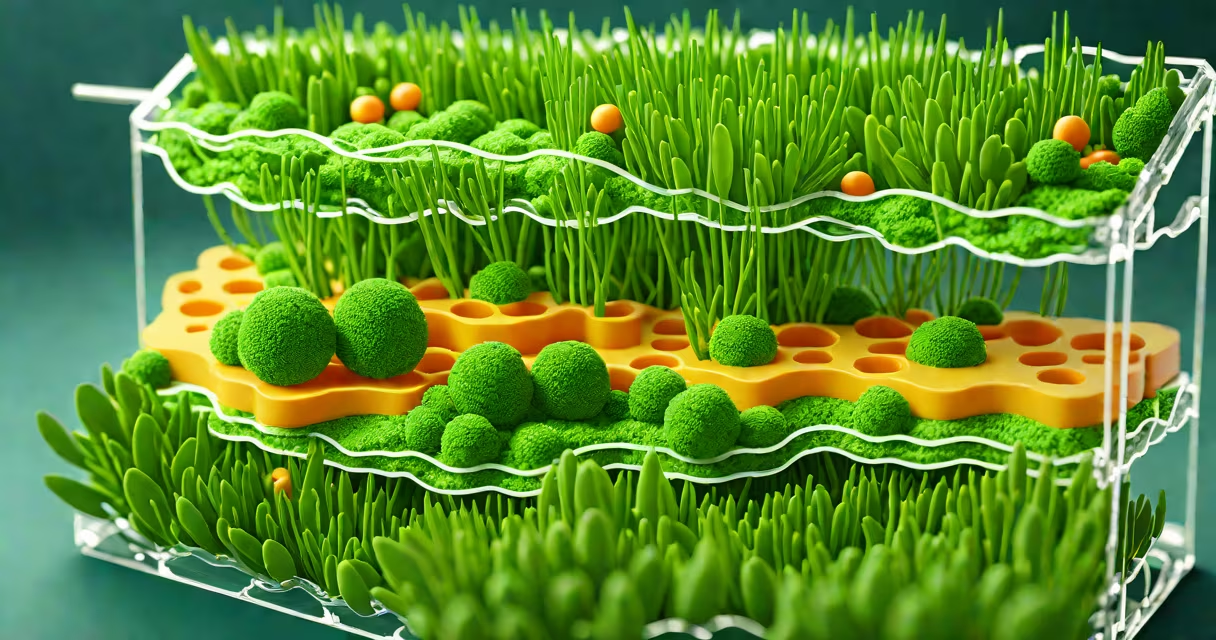
Cell walls are rigid, structural layers outside the plasma membrane in plants, fungi, and most bacteria. They are composed of complex carbohydrates like cellulose, chitin, and peptidoglycan, which provide mechanical strength and regulate water movement.
Plant cell walls consist mainly of cellulose fibers embedded in a matrix of hemicellulose and pectin. These polymers form a strong, flexible network that resists internal pressure from water influx. Bacterial cell walls contain peptidoglycan-a mesh-like polymer of sugars and amino acids-providing rigidity and protection against osmotic lysis. Fungal cell walls are primarily made of chitin, a nitrogen-containing polysaccharide similar to the material in insect exoskeletons.
Cell walls do not exist in animal cells. Without them, animal cells rely solely on the cytoskeleton and extracellular matrix for structural integrity. This difference explains why plant cells maintain their shape even when dehydrated, while animal cells collapse under stress.
Cell walls prevent rupture during osmosis. When plant cells absorb water through root hairs, internal pressure increases. The cell wall resists expansion, maintaining cell turgor. This turgor pressure supports stems and leaves, enabling upright growth without skeletal structures.
In bacteria, the peptidoglycan layer acts as a molecular sieve. It allows small nutrients to pass while blocking large toxins. Its thickness determines whether a bacterium is Gram-positive (thick layer) or Gram-negative (thin layer with an outer membrane). This distinction affects antibiotic susceptibility-penicillin targets peptidoglycan synthesis, making it effective against Gram-positive bacteria but less so against Gram-negative ones.
Fungi use chitin-based walls to withstand environmental stresses. Chitin's nitrogen content makes fungal walls more resistant to enzymatic degradation than cellulose. This property is exploited in antifungal drugs that inhibit chitin synthase enzymes.
The primary materials differ across kingdoms:
| Organism Group | Main Structural Polymers | Additional Components | Functional Role |
|---|---|---|---|
| Plants | Cellulose (β-1,4-glucan chains) | Hemicellulose, pectin, lignin (in woody tissues) | Support, water regulation, defense |
| Bacteria | Peptidoglycan (N-acetylglucosamine and N-acetylmuramic acid) | Lipopolysaccharides (Gram-negative), teichoic acids (Gram-positive) | Osmotic protection, antibiotic targeting site |
| Fungi | Chitin (N-acetylglucosamine polymer) | Glucans, mannoproteins | Structural stability, immune evasion |
Each composition reflects evolutionary adaptation. For example, cellulose forms microfibrils that align in parallel, creating tensile strength. Peptidoglycan cross-links between peptide chains create a dense, net-like structure. Chitin chains stack into crystalline sheets that resist compression.
Many assume all cell walls are made of cellulose. This is false. While plants rely on cellulose, fungi and bacteria use entirely different materials. Confusing these leads to errors in drug design-antibiotics targeting peptidoglycan have no effect on fungal infections.
Another misconception is that cell walls are static. They are changing. During cell division, plant cells build a new cell plate from vesicles containing pectin and cellulose. As the plate matures, it becomes a functional cell wall separating daughter cells. This process occurs in 12-24 hours depending on species and temperature.
A lesser-known fact: some protists, such as diatoms, have siliceous (silicon dioxide) cell walls. These are not organic polymers but mineralized structures formed intracellularly. Diatom frustules are highly ordered, porous, and used in nanotechnology research due to their precise geometry.
When a fungus like *Magnaporthe oryzae* infects rice, it secretes enzymes called cell wall-degrading enzymes (CWDEs). These include polygalacturonases that break down pectin and cellulases that cleave cellulose bonds. The pathogen uses these to breach the host's cell wall and enter cells.
Researchers at the National Center for Biotechnology Information identified 12 CWDE genes in *M. oryzae*. Disrupting one gene reduced infection rates by 60%. This shows that understanding cell wall composition directly informs disease control strategies.
I once observed this in a greenhouse experiment. Rice seedlings treated with a mutant strain lacking cellulase showed no visible lesions after 72 hours, while wild-type strains developed blight within 24 hours. The absence of enzyme activity halted invasion, proving that cell wall breakdown is essential for pathogenesis.
Cell walls are critical in agriculture, medicine, and biotechnology. In crop breeding, altering cell wall composition improves drought resistance. For example, modifying pectin levels reduces fruit softening during storage, extending shelf life by up to 40%.
In medicine, antibiotics like penicillin work by inhibiting transpeptidase enzymes that cross-link peptidoglycan. Without this cross-linking, the cell wall weakens and bursts under osmotic pressure. This mechanism kills bacteria selectively-human cells lack peptidoglycan and are unaffected.
Understanding what cell walls are made of enables targeted interventions. A study published in Biophysical Journal demonstrated that synthetic peptidoglycan analogs can be used to train immune systems to recognize bacterial infections earlier, improving vaccine development.
Knowing the specific composition of cell walls prevents misdiagnosis and ineffective treatments. A patient with a suspected fungal infection treated with penicillin will see no improvement because penicillin targets bacterial cell walls, not fungal ones.
Cell walls are not passive barriers. They are active, adaptive structures shaped by evolution to meet environmental challenges. Their composition defines biological function across kingdoms-from supporting towering redwoods to resisting antibiotics in hospital pathogens.
Understanding what are cell walls made of reveals deeper truths about life's diversity and resilience. From the cellulose-rich walls of a maple leaf to the chitin-laced shells of a mushroom cap, these structures define how organisms interact with their environment.