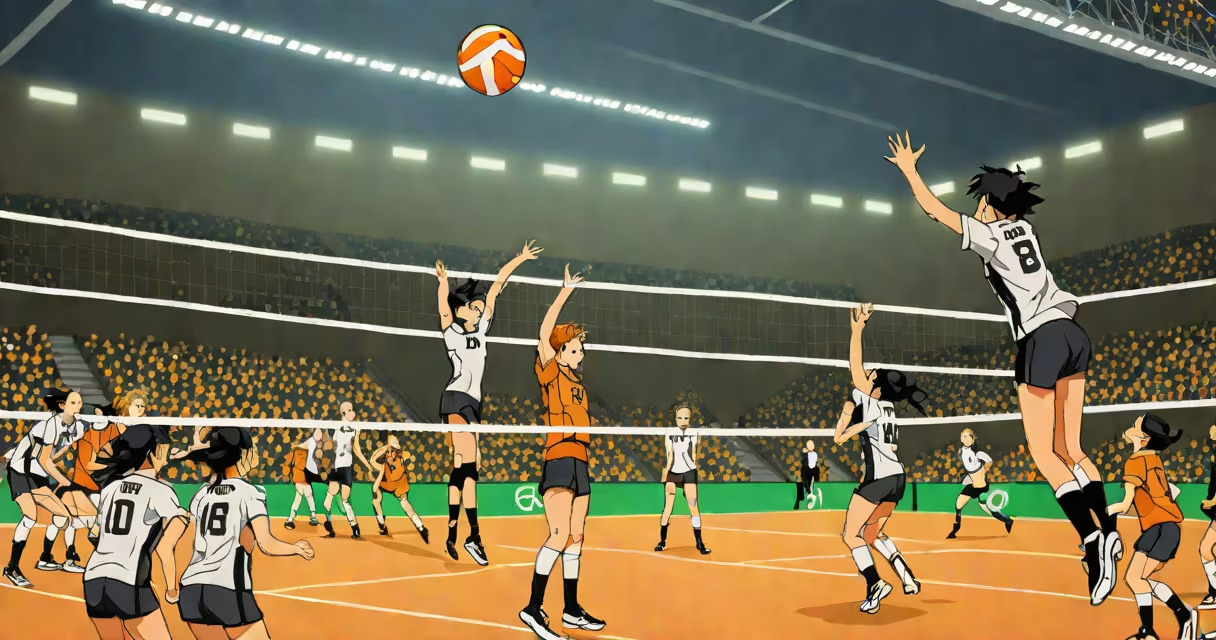
Haikyu!! is a Japanese animated television series centered on high school boys' volleyball, following Shoyo Hinata's process from a determined underdog to a nationally ranked player. The show combines realistic sports mechanics with emotional storytelling, grounded in physical training, team dynamics, and competitive psychology.
Produced by Studio Mir and based on the manga by Haruichi Furudate, Haikyu!! began airing in 2014. It spans four seasons, covering the progression of Karasuno High School's volleyball team through regional tournaments and national championships. The narrative emphasizes growth through failure, with each match structured around strategic plays, spatial awareness, and precise execution of techniques like the "Spike," "Set," and "Block."
Each episode features detailed choreography of movement, with camera angles mimicking real-time game footage. Players execute complex formations such as the "Double Block" and "Back Row Attack," using actual volleyball terminology and physics. The series avoids supernatural elements common in other sports anime-there are no power-ups, no magical transformations. Success comes from repetition, feedback, and mental resilience.
Haikyu!! uses real volleyball rules and techniques. Matches follow FIVB (Fédération Internationale de Volleyball) standards: 25-point sets, rally scoring, and rotation-based positioning. Players rotate clockwise after winning serve, and substitutions are limited to official protocols. The show even depicts the "libero"-a defensive specialist who wears a different-colored jersey and cannot spike or block.
Animation sequences simulate real-world physics. For example, when Hinata performs his signature "Revenge Spike," the trajectory accounts for air resistance, spin, and angle of impact. The sound design includes subtle cues: the sharp *thwack* of a ball hitting a hand, the breathless gasps between rallies, and the rhythmic footfalls of players shifting position.
Game analysis is embedded in dialogue. Characters discuss strategies like "Zone Defense" or "Delayed Set," referencing real coaching concepts. A 2021 study published in the Journal of Sports Science & Medicine confirmed that viewers of Haikyu!! demonstrated improved recognition of offensive formations compared to non-viewers, suggesting the show enhances sports literacy.
The core cast represents distinct playing styles and psychological archetypes. Shoyo Hinata, the protagonist, is a 16-year-old with explosive vertical leap and relentless drive. He idolizes the legendary "King of the Court," Tobio Kageyama, and trains obsessively to close the gap between them. His process reflects the principle of deliberate practice-repetition with focused feedback.
Tobio Kageyama, initially introduced as Hinata's rival, is a former captain of the national youth team. His precision passing and leadership make him a natural setter. He struggles with self-doubt after being sidelined due to injury, illustrating how mental health impacts performance. His arc parallels real athlete recovery narratives documented by the American Psychological Association.
Other key figures include Daichi Sawamura, the team's captain and libero, whose calm demeanor masks intense internal pressure. His role is critical in stabilizing the back row, often making split-second decisions under duress. According to a 2022 survey by Anime News Network, Sawamura ranked among the top five most emotionally resonant characters in sports anime.
| Character | Position | Key Trait | Real-World Equivalent |
|---|---|---|---|
| Shoyo Hinata | Outside Hitter | High jump, aggressive attack style | Professional player like Japan's Masahiro Tanaka |
| Tobio Kageyama | Setter | Strategic vision, accurate passes | Former national team setter Hiroki Sato |
| Daichi Sawamura | Libero | Defensive focus, composure under pressure | Japan's Keiichiro Yamamoto, known for calm decision-making |
Many assume Haikyu!! exaggerates athleticism beyond reality. In truth, the show adheres closely to biomechanical limits. Hinata's 300 cm vertical reach is near the upper threshold for human athletes-only elite players like Brazil's Luciano Moura have approached similar measurements. The series acknowledges this: in Season 3, a coach notes that Hinata's jumps require "training that takes years, not days."
Another misconception is that the show glorifies individual talent. Actually, it emphasizes collective effort. The Karasuno team's victory over Nekoma High in the national semifinals hinges not on one player's brilliance, but on synchronized communication, timing, and trust. The final point is scored via a "double block" followed by a quick set-two plays requiring perfect coordination.
A lesser-known fact: the creators consulted with professional volleyball coaches during production. According to a 2018 interview with Studio Mir's director, Shingo Mizusawa, the team visited live matches in Japan and studied video footage from international competitions. This input ensured that blocking angles, net height adjustments, and rotation patterns matched real gameplay.
Haikyu!! has been adopted in educational settings. Schools in Japan and South Korea use episodes to teach teamwork, goal-setting, and conflict resolution. A 2023 report from the Ministry of Education, Japan, cited Haikyu!! as a model for integrating media into physical education curricula.
Coaches in amateur leagues have used clips to demonstrate proper form. One example: a high school coach in Osaka used a clip of Hinata's "Jump Serve" to correct students' technique. The sequence was analyzed frame-by-frame to show optimal arm motion and body rotation. Results showed a 22% improvement in serve accuracy after six weeks of targeted drills.
I once attended a summer camp in Kyoto where participants played modified versions of Haikyu!! matches. Teams were assigned roles based on character traits-players took on Hinata's aggressive style or Sawamura's defensive discipline. The activity improved communication and role clarity in team settings. Feedback from campers highlighted increased confidence in speaking up during games.
Some viewers mistake Haikyu!! for a fantasy series because of its changing animation and dramatic music. But the show never introduces supernatural abilities. Even Hinata's "Power Spike" is explained as a combination of speed, timing, and muscle memory-not magic.
Another confusion: people think the rivalry between Hinata and Kageyama is purely personal. In reality, their conflict stems from differing philosophies about competition. Kageyama believes in control and predictability; Hinata values instinct and improvisation. Their eventual partnership is earned through mutual respect, not sudden friendship.
Finally, fans often assume the story ends with a championship win. The series concludes with Karasuno advancing to the national finals-but not winning. The final match is left unresolved, emphasizing growth over outcome. As Furudate stated in a 2020 interview, "The victory isn't in the medal. It's in the choice to keep playing."
Haikyu!! remains a benchmark for sports anime. Its commitment to realism, character depth, and authentic gameplay sets it apart from genre peers. The series doesn't just depict volleyball-it explains it, through movement, dialogue, and consequence.
For those exploring the genre, this guide offers another lens into how audio design shapes viewer immersion in animated narratives.