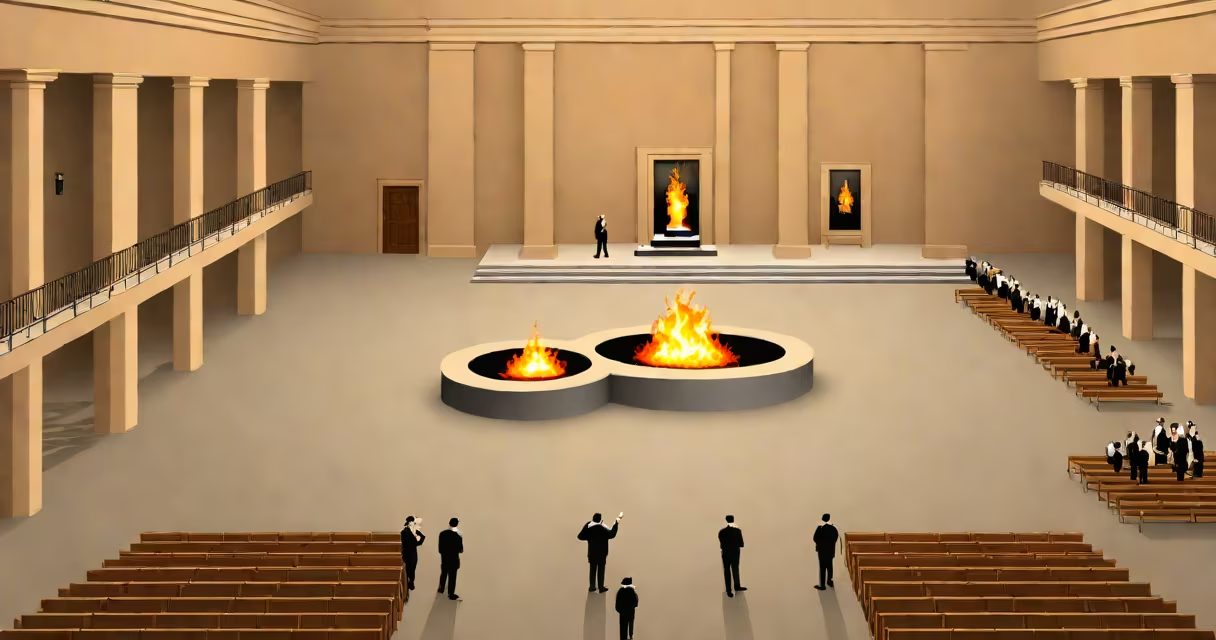
The US Holocaust Memorial Museum in Washington DC is a national institution dedicated to documenting the genocide of six million Jews during World War II, preserving survivor testimony, and promoting human rights education. Located on the National Mall, it serves as both a memorial and a center for research, education, and public engagement.
Established by Congress in 1978 and opened in 1993, the museum is part of the Smithsonian Institution's network of cultural and historical organizations. Its mission is to ensure that the Holocaust is remembered not only as a historical event but as a warning against hatred, prejudice, and indifference. The building itself, designed by architect James Ingo Freed of Pei Cobb Freed & Partners, features a 60-foot-high glass wall facing the National Mall, symbolizing transparency and remembrance.
Exhibits are arranged chronologically and thematically, beginning with the rise of Nazi Germany and ending with the liberation of concentration camps. Visitors walk through reconstructed spaces such as a Berlin apartment from 1938, a train car used to transport prisoners, and a scale model of Auschwitz-Birkenau. The permanent exhibition spans 100,000 square feet and includes over 1,000 artifacts, 10,000 photographs, and 400 hours of recorded survivor testimony.
The museum operates as a repository of primary source material. It houses the Visual History Archive, a collection of over 52,000 video interviews with Holocaust survivors, liberators, rescuers, and others who experienced the period firsthand. These interviews were gathered under the auspices of the USC Shoah Foundation, which partnered with the museum to digitize and preserve them. Access to the archive is available to researchers, educators, and students through the museum's online portal.
Each year, the museum hosts over 2 million visitors, including 100,000 school groups. Programs are tailored for K-12 students, college faculty, and international educators. The museum offers free guided tours, curriculum materials aligned with state standards, and professional development workshops. For example, the "Echoes of Memory" program brings high school students from across the U.S. to Washington DC to meet survivors and participate in civic discussions about ethics and responsibility.
One non-obvious fact: the museum's design incorporates a central courtyard known as the Hall of Witness, which contains a permanent exhibit titled "The Holocaust." This space is intentionally dimly lit, with walls inscribed with the names of victims from 42 countries. The absence of natural light reinforces the idea that the Holocaust was a systematic effort to erase identity and humanity.
The museum's core exhibitions are organized around four thematic zones:
| Zone | Focus | Key Feature |
|---|---|---|
| Before | Rise of antisemitism in Europe | Reconstructed synagogue from Sosnowiec, Poland, displayed in 1938 context |
| During | Persecution and genocide | Interactive timeline of Nazi policies from 1933-1945 |
| Aftermath | Liberation and displacement | Survivor testimonies in multiple languages, including Yiddish and Hebrew |
| Legacy | Memory, justice, and human rights | Rotating exhibits on contemporary genocides and hate crimes |
One of the most impactful installations is the "Children's Holocaust Memorial," a glass case containing 1,500 shoes recovered from concentration camps. Each pair represents a child who died during the Holocaust. The display is accompanied by a single quote from a survivor: "I remember their laughter. I remember their shoes."
Another notable feature is the Hall of Names, a digital memorial that allows visitors to search for and view the names of over 4 million Jewish victims. The database is updated monthly with new records from archives in Eastern Europe. As of 2023, the museum had verified 3.8 million names, with ongoing efforts to cross-reference with local records in Lithuania, Ukraine, and Belarus.
Many visitors assume the US Holocaust Memorial Museum is a federal government agency. It is not. While funded in part by congressional appropriations and overseen by a bipartisan board of trustees, it operates independently under the authority of the United States Holocaust Memorial Museum Act of 1980. The museum is not part of the National Park Service or the Department of State.
A frequent confusion is equating it with the United States Holocaust Memorial Museum in New York City. There is no such institution. The Washington DC location is the only federally designated Holocaust memorial in the United States. The New York site referred to in some media is actually the Museum of Jewish Heritage - A Living Memorial to the Holocaust, located in Battery Park City.
Another misconception is that the museum focuses solely on Jewish victims. While the Holocaust targeted Jews primarily, the museum explicitly documents the persecution of Roma, disabled individuals, Poles, Soviet prisoners of war, and others. The "Other Victims" exhibit includes a 1942 photograph of a Romani family in a German labor camp, alongside a map showing the forced relocation of 20,000 Roma from Berlin to Theresienstadt.
In 2022, I visited the museum during a school group tour. The experience began with a mandatory audio guide, which provided contextual narration for each gallery. At the end of the "Before" section, a quiet room played ambient sounds of a 1930s Berlin street-children laughing, a radio playing news, a shopkeeper calling out prices. When the audio cut to silence, the weight of what came next became immediate.
I spent 4.5 hours walking through the galleries. The most emotionally resonant moment was standing before a wall of 1,000 photographs of children who died in the Holocaust. Each photo was labeled with name, birth date, and place of death. One boy, David Schreiber, was born in 1931 in Vienna and murdered in Treblinka in 1942. His face, smiling in a school photo, contrasted sharply with the date of his death.
Afterward, I attended a 30-minute session led by a museum educator on "Why We Remember." The facilitator emphasized that remembrance is not passive-it requires action. She cited a 2021 study by the Anti-Defamation League showing that 35% of Americans aged 18-24 could not identify Auschwitz as a concentration camp. The museum's outreach programs aim to close that gap.
The museum is located at 100 Raoul Wallenberg Place SW, Washington DC 20024. It is open daily except December 25, with free admission. Visitors must reserve timed-entry passes online in advance, especially during peak seasons (spring and fall). The museum provides multilingual signage and audio guides in 12 languages, including Arabic, Mandarin, and Russian.
Accessibility features include wheelchair ramps, tactile maps for visually impaired guests, and ASL-interpreted tours. The museum also partners with local schools to offer virtual field trips. In 2023, over 12,000 students participated in remote sessions using Zoom and interactive digital exhibits.
The us holocaust memorial museum washington dc stands as a solemn yet important institution. It does not merely recount history-it demands reflection, accountability, and moral clarity. Its message is clear: memory is not passive. It is a call to act.