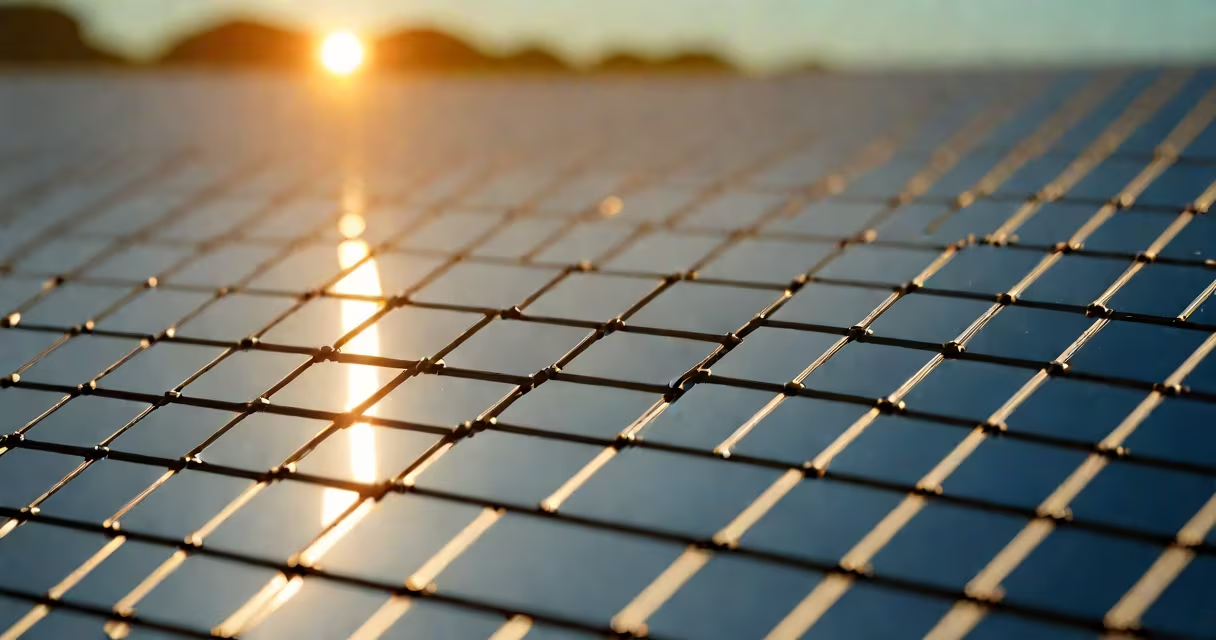
Solar power is electricity generated by capturing sunlight through photovoltaic cells, primarily made from purified silicon. These cells convert photons into direct current (DC) electricity via the photovoltaic effect. The system includes panels, inverters, mounting hardware, and wiring-all designed to capture and deliver usable energy.
The core of solar power lies in semiconductor materials, most commonly crystalline silicon. When sunlight strikes these materials, electrons are freed and flow as electric current. This process begins at the atomic level: photons from sunlight transfer energy to electrons in silicon atoms, breaking them loose and creating a directional flow of charge. The resulting DC electricity is then converted to alternating current (AC) by an inverter for household or grid use.
Modern solar installations integrate multiple layers beyond the cell itself. A glass cover protects the delicate silicon layer, while a backing sheet prevents moisture intrusion. Aluminum frames provide structural support, and junction boxes manage electrical connections. All components work together to ensure efficiency, durability, and safety under outdoor conditions.
Each part of a solar power system uses specific materials chosen for performance, cost, and longevity. Silicon dominates the market due to its abundance and favorable electronic properties. Over 95% of commercial solar panels rely on either monocrystalline or polycrystalline silicon, both derived from quartz sand processed into high-purity ingots.
| Component | Primary Material | Function |
|---|---|---|
| Photovoltaic Cell | Purified silicon (mono- or poly-crystalline) | Converts sunlight into electricity via the photovoltaic effect |
| Encapsulant | EVA (ethylene-vinyl acetate) | Seals and protects the cell from environmental damage |
| Front Cover | Tempered glass | Allows light transmission while resisting impact and weather |
| Backsheet | Multi-layer polymer film (e.g., Tedlar) | Insulates and shields against moisture and UV degradation |
| Frame | Anodized aluminum | Provides rigidity and facilitates secure mounting |
While silicon remains dominant, emerging technologies use alternatives like cadmium telluride (CdTe) or perovskite compounds. CdTe thin-film panels offer lower production costs and better performance in low-light conditions but have lower efficiency than silicon-based systems. Perovskite materials show promise with lab efficiencies exceeding 25%, though stability and scalability remain challenges for widespread deployment.
A complete solar power setup doesn't rely on a single material-it functions as an integrated system. Sunlight hits the front glass of a panel, passes through the encapsulant, and reaches the silicon cells. Electrons move through conductive pathways within the cell, generating DC current. This current flows into a junction box, then to an inverter, which transforms DC into AC for home appliances or grid feed-in.
For example, a typical residential rooftop installation with 20 panels, each rated at 400 watts, produces 8,000 watts (8 kW) of DC power under peak sunlight. An inverter converts this to ~7.2 kW of AC power, sufficient to run most household loads during daylight hours. Excess energy can be stored in batteries or fed back into the utility grid under net metering programs.
During my time installing solar arrays in Arizona, I observed that even minor shading from tree branches reduced output by up to 30% in string-configured systems. That's why microinverters-installed per panel-improve resilience. They allow each panel to operate independently, minimizing losses when partial shading occurs.
Many assume solar power is made solely from "sunlight." While sunlight is the energy source, the physical infrastructure relies on mined and refined materials. Solar panels contain metals like silver, copper, and aluminum, along with plastics and rare earth elements in inverters and batteries. The manufacturing process consumes significant energy-about 1.5 to 2.5 kWh per watt of installed capacity-but this is offset within 2 to 4 years of operation, according to the National Renewable Energy Laboratory (NREL).
Another misconception is that solar panels degrade rapidly. In reality, most manufacturers guarantee 80% output after 25 years. Degradation rates average 0.5% per year, meaning a panel loses less than half a percent of efficiency annually. Real-world data from NREL shows that properly maintained systems maintain 90% of original output after 20 years.
Some confuse solar power with solar thermal systems. Solar thermal uses mirrors or lenses to concentrate heat for steam generation, typically in large-scale power plants. Solar photovoltaic systems, which make up over 90% of new installations globally, generate electricity directly from light without moving parts or fluid cycles.
Recycling solar panels is becoming increasingly important. The International Renewable Energy Agency (IRENA) estimates that by 2050, 78 million metric tons of solar waste could accumulate if recycling rates remain low. Current processes recover over 95% of silicon, glass, and aluminum from end-of-life panels. Companies like First Solar have established closed-loop recycling systems that reuse materials in new panels.
Costs have dropped dramatically since 2010. The U.S. Department of Energy reports that average solar panel prices fell from $6.60 per watt in 2010 to $0.30 per watt in 2023. This reduction stems from economies of scale, improved manufacturing techniques, and automation in factories across China, India, and Southeast Asia.
Understanding what solar power is made of clarifies its sustainability profile. While extraction and processing involve environmental trade-offs, lifecycle analysis confirms solar power emits 40 grams of CO₂ equivalent per kilowatt-hour-far below coal (820 g/kWh) or natural gas (490 g/kWh). The carbon payback period-the time needed to offset emissions from production-is typically less than two years.
Solar power is not a single substance but a system built from layered materials, each selected for function and durability. Its foundation is silicon, but success depends on integration, engineering, and ongoing innovation.