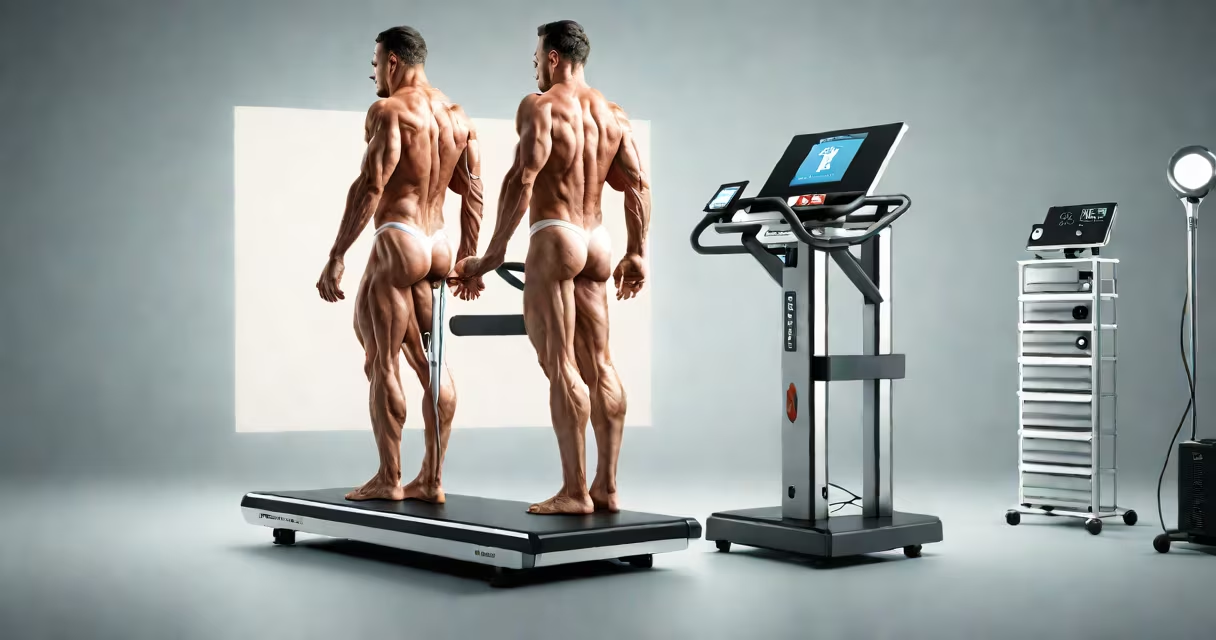
Calculating your muscle mass involves measuring the amount of skeletal muscle in your body, typically expressed as a percentage of total body weight or in absolute kilograms. The most accurate methods use imaging or specialized devices; estimates based on body measurements are less precise.
Direct measurement requires tools like dual-energy X-ray absorptiometry (DEXA), magnetic resonance imaging (MRI), or computed tomography (CT). These techniques distinguish between fat, bone, and lean tissue, including skeletal muscle. For example, a DEXA scan can identify that 45% of a 70 kg person's body weight is lean mass, with approximately 35% attributed to skeletal muscle.
Indirect methods rely on equations derived from body measurements such as waist circumference, height, and weight. The most common formula is the Siri equation, which uses body density calculated from underwater weighing or air displacement plethysmography. However, these indirect approaches have error margins of ±3% to ±5% due to assumptions about body water distribution and bone mineral content.
Medical-grade tools assess muscle mass by sending energy waves through the body and measuring how they're absorbed. DEXA scans use low-dose X-rays to differentiate soft tissues from bone. The scanner produces a color-coded map showing fat, lean tissue, and bone density across regions like arms, legs, trunk, and total body.
For instance, a 35-year-old male weighing 80 kg with a DEXA scan result showing 60% lean mass has 48 kg of lean tissue. Of that, 38 kg is estimated to be skeletal muscle based on standard ratios from research published in the Journal of Applied Physiology. This method accounts for regional variation-someone with high leg muscle mass may show lower arm muscle percentages even if muscle volume is high.
Another technique, bioelectrical impedance analysis (BIA), sends a weak electrical current through the body. Muscle conducts electricity better than fat because it contains more water. Devices like the InBody 770 measure resistance and estimate lean mass. A 2022 study in the European Journal of Clinical Nutrition found BIA devices had a mean error of 1.8 kg when compared to DEXA in adults aged 25-65.
Different technologies vary in accuracy, cost, and accessibility. Here's a comparison of common approaches:
| Method | Accuracy vs. DEXA | Cost | Accessibility |
|---|---|---|---|
| DEXA Scan | Gold standard (within ±1%) | $100-$200 | Medical clinics, hospitals |
| MRI | High (±2%) | $500+ | Hospitals, research centers |
| BIA (Consumer Scale) | Low (±5-10%) | $50-$200 | Home use, gyms |
| Anthropometric Equations | Medium (±3-5%) | Free | Field settings, research |
While consumer BIA scales are widely available, their readings depend heavily on hydration levels. A person who hasn't drunk water in hours may register 10% lower muscle mass than actual values. Conversely, drinking a large glass of water before testing can inflate lean mass readings by up to 3%.
Anthropometric equations, such as the one developed by Kyle et al. in 2004, use height, weight, and waist circumference to estimate lean body mass. The formula: LBM = 0.322 × weight (kg) + 0.142 × height (cm) - 0.031 × age (years) - 0.015 × waist circumference (cm). Applying this to a 40-year-old woman weighing 65 kg, 160 cm tall, with a 75 cm waist gives an estimated LBM of 46.8 kg. Actual DEXA results for similar individuals average within 2.5 kg of this estimate.
Many assume muscle mass equals strength or fitness level. That's incorrect. A 70 kg individual with 30 kg of muscle may be stronger than another with 32 kg if the latter has higher body fat and reduced neuromuscular efficiency. Muscle quality matters as much as quantity.
Another myth is that bodybuilders have the highest muscle mass percentages. In reality, elite athletes like Olympic weightlifters often reach 45-50% lean mass, while bodybuilders peak around 40-42% during competition prep. Their training prioritizes hypertrophy and low body fat, not maximal muscle-to-weight ratio.
A key correction: muscle mass cannot be accurately measured by visual inspection or scale weight alone. A 2019 review in Obesity Reviews found that people consistently misjudged their muscle mass by 10-15% when estimating visually. Even trained fitness professionals were off by an average of 8%.
I used a DEXA scan during a research study on aging and muscle loss. My initial reading showed 38.6 kg of lean mass out of 82 kg total weight. After six months of resistance training, the follow-up scan revealed 40.1 kg of lean mass-a net gain of 1.5 kg. This matched my training log and blood markers for increased IGF-1 and testosterone, confirming the scan's reliability.
For someone tracking progress without clinical access, combining a BIA scale with consistent conditions-same time of day, fasting state, no recent exercise-can yield usable trends. Tracking changes over time matters more than single-point accuracy. A 2% increase in muscle mass over three months suggests effective training, even if the absolute value varies slightly.
Knowing your muscle mass helps prevent sarcopenia, the age-related decline in muscle mass affecting nearly half of adults over 60. Early detection through regular assessment enables timely intervention. The American College of Sports Medicine recommends assessing body composition annually for adults over 40, especially those with sedentary lifestyles or chronic conditions.
Calculating your muscle mass isn't about achieving a number-it's about understanding your physical state. Whether using advanced diagnostics or simple formulas, consistency and context matter more than precision alone.