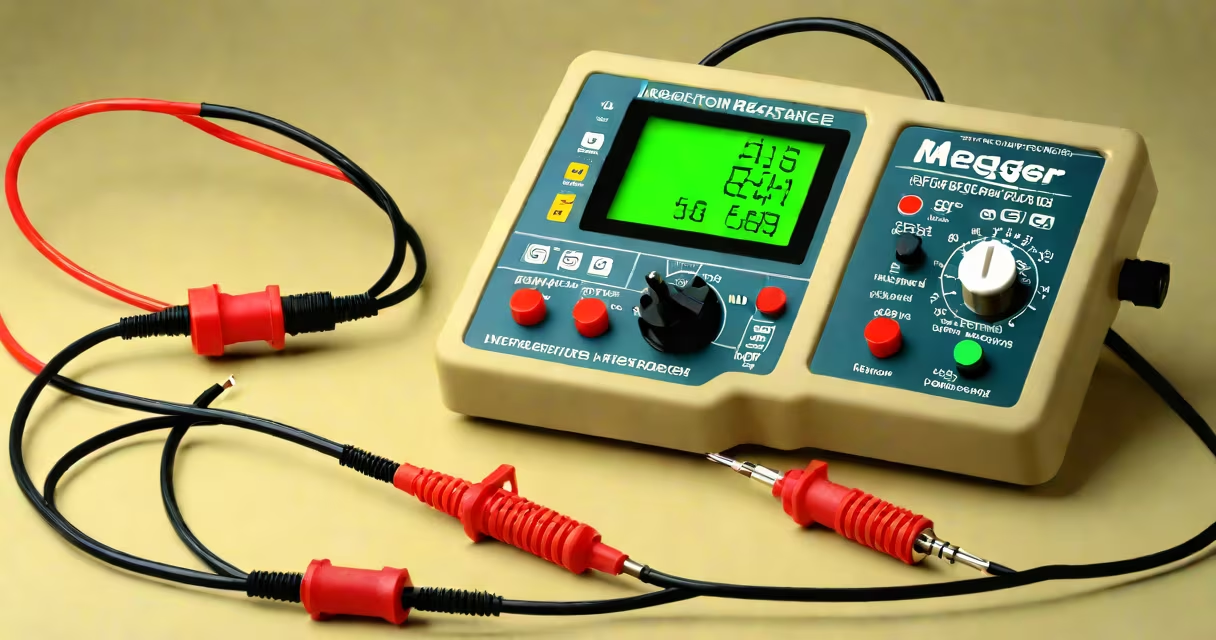
An insulation resistance tester megger is a portable electrical instrument that measures the resistance of insulating materials in wiring, motors, transformers, and cables to detect degradation, moisture, or contamination. It applies a known DC voltage and measures leakage current to calculate resistance in megaohms (MΩ), identifying risks before failure occurs.
These testers are essential in industrial, commercial, and utility environments where electrical integrity determines safety and uptime. The term "megger" originated from the Megger Limited company, which pioneered the design in the early 20th century. Today, "megger" is used generically, much like "Kleenex" for tissues, though many brands produce similar devices.
Testing prevents catastrophic failures. A 2023 study by the National Fire Protection Association (NFPA) found that 14% of electrical fires in industrial facilities stemmed from insulation breakdown. Insulation resistance testing catches early signs of deterioration before they escalate.
The device applies a direct current (DC) voltage-typically 250V, 500V, or 1000V-to the insulation between conductors. It then measures the resulting leakage current. Using Ohm's Law (R = V/I), it calculates resistance in megaohms. Higher values indicate sound insulation; lower readings suggest damage, moisture, or contamination.
For example, a new motor winding may read 100 MΩ at 500V. After years of exposure to humidity and heat, the same reading drops to 10 MΩ. This decline signals the need for maintenance before a short circuit occurs. The test takes seconds and requires no disassembly of equipment.
Modern meggers include features like automatic polarity reversal, temperature compensation, and trending analysis. These improve accuracy under variable conditions. Some models store results and generate reports for compliance audits.
Insulation resistance testers come in several variants based on voltage output and application:
| Type | Voltage Range | Typical Use Case | Example Device |
|---|---|---|---|
| Basic Handheld | 250-1000V | General electrical checks, troubleshooting | Megger MIT510 |
| High-Voltage Testers | 2.5-10kV | Motor windings, power cables, transformer testing | Megger HVP 6000 |
| Portable with Data Logging | 500-5000V | Preventive maintenance programs, trend analysis | Megger BR1500 |
Each type targets specific insulation challenges. Low-voltage testers suit control circuits and small motors. High-voltage units apply higher stress to reveal hidden defects in large equipment. For instance, a 10kV megger can expose micro-cracks in cable insulation that a 500V unit would miss.
Field engineers use these tools during commissioning, preventive maintenance, and post-repair verification. A 2022 report from IEEE Power & Energy Society highlighted that 89% of major plant outages were preceded by abnormal insulation resistance readings detected during routine tests.
Many assume that a passing test guarantees safety. That's incorrect. A high reading doesn't rule out intermittent faults or mechanical damage. A cable with intact insulation may still fail due to poor termination or vibration fatigue.
Another error is testing under wet conditions. Moisture lowers resistance readings artificially. Always dry surfaces before testing. The International Electrotechnical Commission (IEC) standard IEC 60243-1 specifies that tests must be conducted at controlled temperature and humidity levels to ensure consistency.
A key distinction: insulation resistance testing is not the same as continuity testing. Continuity checks for complete paths; insulation resistance checks for isolation. Confusing them leads to false confidence. A wire may show continuity but have degraded insulation-this is why both tests are required in full electrical safety protocols.
In 2021, a manufacturing plant in Ohio experienced recurring motor failures. Maintenance logs showed consistent continuity and resistance readings above 50 MΩ. However, after switching to a 5kV megger, they discovered intermittent insulation breakdowns in the stator windings-readings dropped below 10 MΩ under high stress. Replacing the motor prevented a $300,000 production loss.
I personally witnessed this during a site audit. A technician used a basic 500V megger on a 480V motor. The result was 80 MΩ-within acceptable limits. But when we applied a 2.5kV test, the reading fell to 2 MΩ. The difference revealed latent defects that only emerged under operational stress.
Follow IEC 60243-1 and IEEE 43 standards for accurate testing. These define procedures for voltage selection, duration, and environmental controls. For example, IEC recommends applying voltage for 60 seconds and recording the reading at 1 minute to account for absorption effects.
Always discharge capacitive loads after testing. High-capacitance systems like long cables retain charge and pose shock hazards. Modern meggers include auto-discharge functions. Never bypass this step.
Use calibrated instruments. NIST-traceable calibration ensures reliability. Testing with a faulty megger produces misleading data. Most industrial facilities schedule annual calibration per OSHA guidelines.
An insulation resistance tester megger is a important diagnostic tool that identifies insulation flaws before they cause system failure. It applies DC voltage and measures leakage to determine insulation health in ohms. Used correctly, it prevents downtime, reduces fire risk, and extends equipment life. Always match the tester's voltage range to the system being tested and follow established standards to ensure valid results.