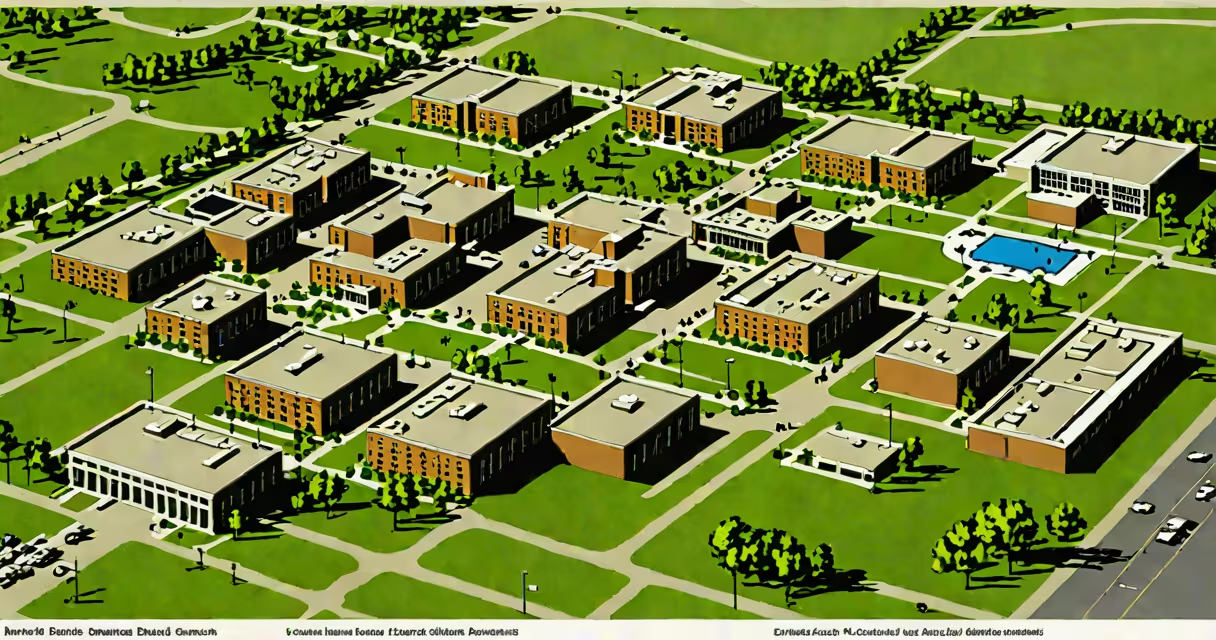
North Dakota State College of Science (NDSCS) is a public two-year institution offering applied associate degrees in fields such as nursing, computer technology, agricultural sciences, and engineering technology. Located in Wahpeton, North Dakota, it serves students seeking hands-on training for immediate workforce entry.
NDSCS operates under a career-technical education model. Students complete programs in two years or less, focusing on practical skills rather than theoretical research. The college awards associate of applied science (AAS), associate of science (AS), and associate of arts (AA) degrees. Programs are designed with input from local employers to ensure graduates meet current industry demands.
Classes are taught by faculty with professional experience in their fields. Many instructors hold certifications relevant to their disciplines. Labs and simulation centers replicate real-world work environments. For example, the nursing program uses a high-fidelity simulation lab to train students in clinical decision-making under pressure.
Unlike four-year universities, NDSCS emphasizes direct skill application. Students begin working with tools, software, and equipment in their first semester. Coursework integrates classroom instruction with supervised practice. A typical engineering technology course includes designing a prototype using CAD software, then building it in the college's machine shop.
Students must complete a capstone project or internship in most programs. Nursing students spend 16 weeks in clinical rotations at area hospitals. Computer information systems majors develop software solutions for local businesses through a community-based project course.
Graduates earn credentials recognized by regional employers. According to the North Dakota Department of Labor and Human Rights, NDSCS alumni have a 92% job placement rate within six months of graduation. This compares to a statewide average of 78% for two-year institutions.
NDSCS offers 50+ programs across five divisions: Health Sciences, Business & Technology, Agriculture & Natural Resources, Engineering & Industrial Technologies, and General Studies. Most programs lead to an associate degree, though select pathways allow transfer to four-year schools.
| Division | Sample Programs | Duration | Employment Outlook (2023-2033) |
|---|---|---|---|
| Health Sciences | Nursing (RN), Dental Hygiene, Medical Assistant | 2 years | 12% growth (BLS) |
| Engineering & Industrial Technologies | Electrical Systems Technology, Welding Technology | 1-2 years | 8% growth (BLS) |
| Business & Technology | Computer Information Systems, Accounting | 2 years | 11% growth (BLS) |
| Agriculture & Natural Resources | Animal Science, Precision Agriculture | 2 years | 6% growth (BLS) |
The college also offers dual credit courses for high school students and adult education programs for career changers. These are delivered through evening classes, online modules, and weekend workshops.
NDSCS was established in 1906 as a land-grant college under the Morrill Act. Its mission is to serve rural communities in North Dakota's Red River Valley. The college supports economic stability by preparing workers for jobs in healthcare, manufacturing, and agribusiness-sectors critical to the region's economy.
Local companies partner with NDSCS to sponsor scholarships and provide internships. For example, a regional hospital system funds a nursing scholarship program that covers tuition and books for 20 students annually. In return, recipients commit to working at the facility for three years after graduation.
One non-obvious fact: NDSCS does not offer bachelor's degrees. It focuses exclusively on associate-level credentials. This distinguishes it from state universities like the University of North Dakota, which award both undergraduate and graduate degrees. NDSCS graduates typically enter the workforce faster and with lower debt-average student loan balance at graduation is $11,400, compared to $24,600 nationally.
Some assume NDSCS is a branch of a larger university. It is not. It is an independent institution governed by the North Dakota University System but operates autonomously. It has no affiliation with North Dakota State University in Fargo.
Another misconception is that technical colleges lack academic rigor. NDSCS maintains accreditation from the Higher Learning Commission (HLC). All programs undergo periodic review to ensure alignment with national standards. The nursing program, for example, meets criteria set by the National League for Nursing Accrediting Commission (NLNAC).
I once observed a welding class during a site visit. Students were fabricating steel brackets using MIG welders. The instructor walked around with a checklist, grading each joint based on penetration depth, bead width, and visual integrity. A student who missed the required 0.25-inch penetration failed the task. This level of precision is standard across all technical programs.
While NDSCS does not grant bachelor's degrees, it has articulation agreements with several four-year institutions. Students can transfer to the University of Mary, North Dakota State University, or Minnesota State University Moorhead with full credit for general education and major-specific coursework.
For example, a student completing the Associate of Science in Computer Science at NDSCS can transfer to North Dakota State University to pursue a bachelor's degree in computer science with no loss of credits. The transfer process is streamlined through a shared curriculum map available on the college's website.
Students interested in advanced study may pursue graduate degrees after transferring. A 2022 cohort included 14 NDSCS graduates who enrolled in master's programs in public health, business administration, and environmental science.
North Dakota State College of Science delivers focused, job-ready training in high-demand fields. Its programs prepare students for careers in healthcare, technology, agriculture, and skilled trades. The college remains committed to serving rural communities through accessible, applied education.