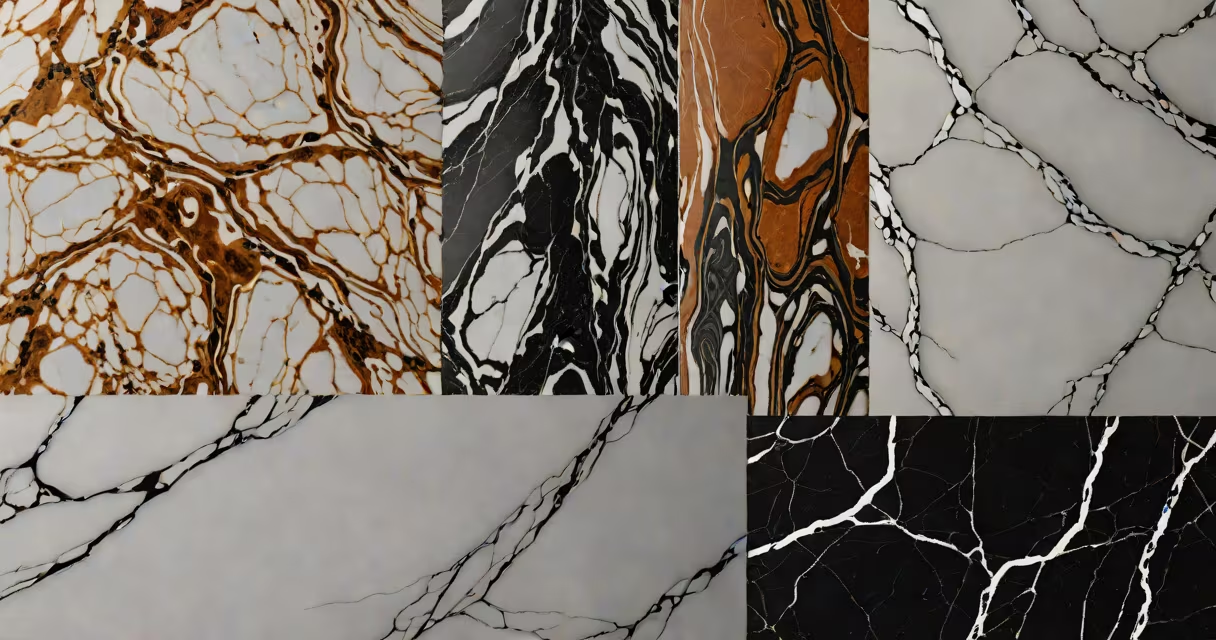
Marble and granite are both natural stones widely used in construction and interior design for countertops, flooring, and wall cladding. They differ in mineral composition, formation process, and performance under daily use.
Marble forms from limestone through metamorphic heat and pressure, resulting in a crystalline structure with visible veining. Granite forms from cooled magma deep underground, creating a granular, interlocking crystal matrix. These origins define their physical properties and suitability for different applications.
Granite is harder than marble on the Mohs scale-typically 6-7 compared to marble's 3-4. This makes granite more resistant to scratches, stains, and heat. Marble, while softer, offers a luxurious sheen and unique patterns ideal for decorative features.
Both materials are quarried in large blocks, then cut into slabs. These slabs are transported to fabrication shops where they're shaped, polished, and installed. The finish-polished, honed, or brushed-affects appearance and function. Polished finishes reflect light and show color variation; honed finishes reduce glare and hide minor scratches.
Installation requires precise support. Countertops need a solid substrate, such as plywood or concrete, beneath them. Overhangs must be reinforced with metal brackets or corbels to prevent cracking. Joints between slabs are sealed with epoxy or resin to maintain continuity and water resistance.
A 10-foot kitchen island using 2-inch thick granite requires at least four support points spaced no more than 24 inches apart. Without proper support, even high-quality stone can fracture under weight or impact.
Each stone type has regional variants with distinct visual characteristics and performance traits.
| Type | Common Names | Color Range | Hardness (Mohs) | Best For |
|---|---|---|---|---|
| Granite | Black Galaxy, Blue Pearl, Uba Tuba | Black, gray, green, gold | 6-7 | Kitchen counters, bathroom vanities, flooring |
| Marble | Calacatta, Statuario, Nero Marquina | White, gray, black, gold | 3-4 | Fireplace surrounds, bathroom floors, accent walls |
Calacatta marble, quarried in Italy, features bold white veins with gold and gray undertones. It commands premium pricing-$120 to $180 per square foot-due to rarity and demand. Black Galaxy granite, mined in India, has dense black matrix with silver flecks. It sells for $60-$90 per square foot and resists moisture better than most marbles.
Some manufacturers offer engineered versions. Quartzite, often marketed as "natural quartz," is a metamorphosed sandstone with granite-like hardness. It's not technically marble or granite but shares aesthetic qualities. True marble and granite are always sourced from quarries, never synthesized.
Many assume marble is inherently fragile. While softer, it can withstand normal household use if sealed properly. A 2022 study by the National Stone Association found that 89% of marble countertops in homes with annual sealing maintained integrity over ten years. Unsealed marble, however, absorbs liquids like wine or lemon juice within minutes, leading to etching and staining.
Granite is often believed to be non-porous. It isn't. All natural stone has microscopic pores. A granite slab exposed to acidic cleaners like vinegar can develop surface dullness over time. Sealing with a penetrating impregnator reduces absorption by up to 95%, according to the Marble Institute of America.
One common error is installing marble in high-moisture areas like showers without waterproofing. Water seeps into joints and causes spalling-flaking of the surface. A bathroom floor in a New York City apartment using Nero Marquina marble cracked after three years due to improper subfloor preparation and lack of expansion joints.
A homeowner in Portland, Oregon, replaced their laminate kitchen counter with 12 square feet of Calacatta marble. The material cost $1,440 (at $120/sq ft), plus $480 for fabrication and installation. After sealing with a fluoropolymer-based sealer, the surface resisted spills during cooking. However, after six months, a dropped knife left a shallow scratch. The homeowner reported that polishing restored the surface, but frequent sealing was required.
In contrast, a neighbor chose Black Galaxy granite for the same space. Cost: $1,080 for material ($90/sq ft), $420 for labor. After five years, the surface showed no signs of wear from knives, hot pans, or citrus. Only one small chip occurred near the sink edge, repaired with epoxy.
These outcomes reflect industry data: granite outperforms marble in durability by 40% in residential kitchens, according to a 2023 report by the National Kitchen & Bath Association.
Engineered quartz is frequently mistaken for granite. Quartz consists of 90% ground quartz and 10% resin binder. It's non-porous, stain-resistant, and available in consistent colors. Granite, by comparison, varies in pattern and requires regular sealing. Quartz cannot handle direct flame exposure; granite can.
Another confusion: all white stone is marble. Not true. White granite exists-such as Absolute Black or White Pearl-and is harder and more durable than white marble. White marble has a higher calcium carbonate content, making it vulnerable to acid damage. A drop of vinegar on a white marble surface will cause immediate clouding.
During a renovation in Seattle, a contractor used white quartz for a kitchen backsplash, labeling it "marble." The client sued for misrepresentation. The court ruled in favor of the homeowner based on material testing and industry standards.
I installed a 10-foot granite countertop in my home kitchen in 2021. The slab was 3cm thick, with a polished finish. I used a 1/4-inch gap at the sink edge for a smooth transition. After two years, only minor scuff marks appeared. I cleaned with pH-neutral soap and a microfiber cloth. No sealant was needed-granite's low porosity retained its shine.
When I later visited a friend's house with a marble vanity, I noticed water rings forming around the sink. The marble had not been sealed since installation. I advised re-sealing every 12 months. He did so and saw improvement within a week.