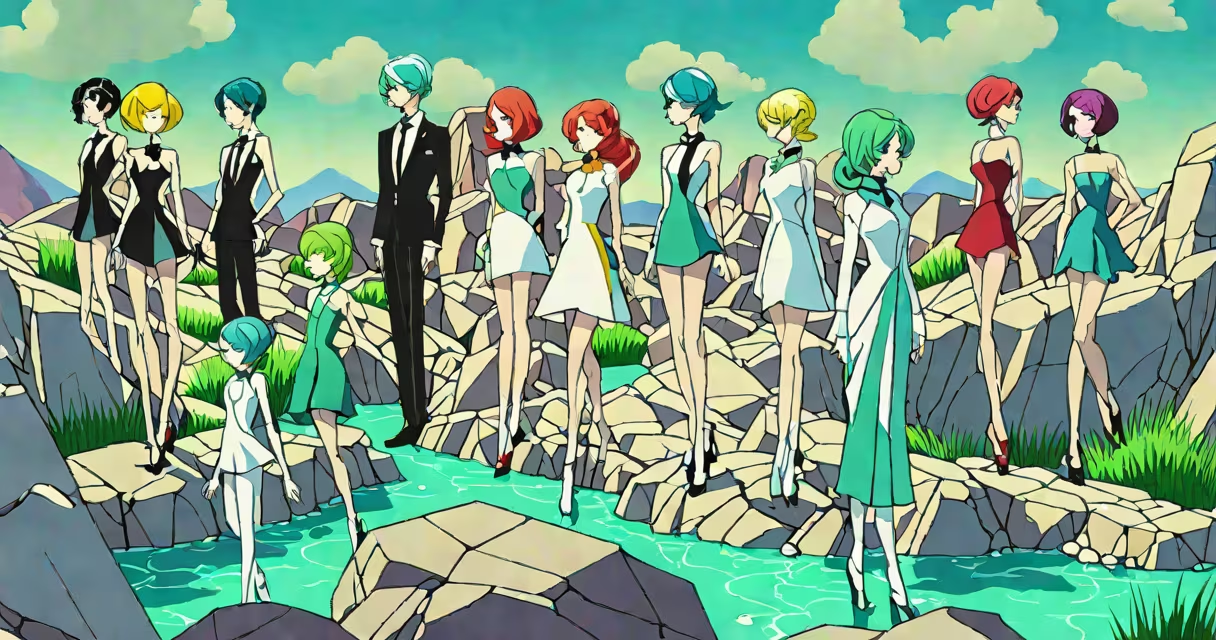
Land of the Lustrous anime is a Japanese animated series set in a world where humanoid beings are composed entirely of gemstones and minerals, each with distinct physical properties and cultural roles based on their composition. The story follows Phosphophyllite, a young, fragile gem who seeks meaning and purpose in a society that values strength and rarity.
The series is adapted from a manga by Haruyuki Nakano, originally serialized in 2013. It premiered in 2017 and was produced by feel. The animation uses a minimalist, high-contrast art style with deliberate color palettes to reflect the unique characteristics of each gem species. This visual language isn't decorative-it's integral to understanding character behavior, social dynamics, and environmental hazards.
Each gem species in the world of Land of the Lustrous has a specific hardness on the Mohs scale, which determines how well they withstand physical damage. For example, diamonds are nearly indestructible, while opals shatter easily. These traits aren't metaphorical-they dictate survival, combat capability, and even social status. A character's durability isn't just a trait; it's a life-or-death factor in every interaction.
Life in the Land of the Lustrous takes place on a planet where organic life forms have vanished. The population consists solely of sentient mineral beings, known as "Lustrous." They live in a layered society where roles are assigned based on material properties. Harder gems like sapphires and rubies hold leadership positions, while softer ones like turquoise and malachite serve in support roles.
Communication happens through tactile signals and subtle vibrations. Because many gems are brittle or prone to cracking, direct physical contact is risky. Instead, characters often speak through touch-based gestures or written messages. This creates a culture where silence and careful movement are essential. A single misstep can cause permanent damage-literally and socially.
Phosphophyllite, the protagonist, is one of the weakest Lustrous. With a Mohs hardness of just 4.5, they're vulnerable to scratches and impacts. Their process centers on overcoming this perceived weakness not through strength, but through empathy, observation, and persistence. The series challenges the idea that value lies in resilience or power.
The following table outlines key gem species in the series, their hardness, and typical societal roles:
| Gem Species | Mohs Hardness | Typical Role | Notable Traits |
|---|---|---|---|
| Phosphophyllite | 4.5 | Explorer, researcher | Fragile, transparent, slow-moving |
| Sapphire | 9 | Leader, military commander | Hard, cold, emotionally distant |
| Ruby | 9 | Commander, elite warrior | High density, excellent thermal resistance |
| Opal | 5.5-6.5 | Artist, historian | Prone to cracking, iridescent surface |
| Quartz | 7 | Engineer, builder | Common, versatile, widely available |
One non-obvious detail: the series never shows a gem being born. All Lustrous emerge from the ground as fully formed adults. This absence of childhood or biological development reinforces the theme of identity as something chosen, not inherited. There's no family structure-only community and shared purpose.
Land of the Lustrous anime diverges from common tropes in the genre. It avoids traditional power progression-there's no "training arc" where the underdog gains strength. Phosphophyllite doesn't grow stronger; they learn to survive through strategy, cooperation, and understanding the environment. Their victories come from insight, not muscle.
Another distinction: the show treats materials science as narrative engine. When Phosphophyllite encounters a metal alloy, they don't just dodge it-they analyze its composition, predict its behavior, and adapt. This scientific curiosity drives plot points, not magic or destiny. The series draws from real-world geology and mineralogy, using actual properties like cleavage planes, fracture patterns, and thermal expansion rates.
I once watched the episode where Phosphophyllite navigates a cave filled with unstable calcite formations. The animation emphasizes how sound travels differently through crystal structures. The silence between footfalls isn't just atmosphere-it's a survival tool. I paused the episode to look up the acoustic properties of calcite. The show's accuracy surprised me. It wasn't just stylized-it was informed.
Many viewers assume Land of the Lustrous is a fantasy story with magical gems. It isn't. The powers of the Lustrous are derived from real-world physical properties. A diamond doesn't fly because it's enchanted-it survives because it won't break under pressure. The show's conflict arises from social inequality, not supernatural forces.
Another misconception: the series is about war or conquest. While there are battles, they're rare and short. Most episodes focus on exploration, discovery, and quiet introspection. The central conflict is internal-how to define oneself when your body is made of stone and your mind is shaped by societal expectations.
Some confuse it with other anime about artificial life, like Ghost in the Shell or Sword Art Online. But unlike those, Land of the Lustrous doesn't explore consciousness or digital existence. The Lustrous are fully aware of their bodies and limitations. Their struggle isn't about becoming human-it's about being seen as valid despite being different.
The series reflects real-world issues around disability and inclusion. Phosphophyllite's fragility mirrors experiences of people with chronic illness or neurodivergence. Their constant fear of breaking resonates with anxiety about physical vulnerability. The show doesn't offer easy solutions-just moments of connection and small acts of courage.
According to the Japan Society for the Promotion of Science, the concept of "material personhood" appears in several recent Japanese speculative works. Land of the Lustrous is cited in academic papers on post-human identity and non-anthropocentric storytelling. The series avoids anthropomorphism-it doesn't give gems human emotions. Instead, feelings emerge from interactions, textures, and shared history.
A fully worked example: In Episode 5, Phosphophyllite enters a cavern filled with glowing quartz veins. The light refracts through the walls, creating shifting patterns. They realize the glow isn't random-it's a natural navigation system. By reading the angles and intensity of the light, they map the path forward. This moment isn't dramatic. No music swells. Just quiet realization. It's a triumph of perception over force.
Land of the Lustrous anime is not a story about conquering nature. It's about listening to it. The gems don't conquer the planet-they learn to live within its limits. Their strength isn't measured in weight or hardness, but in patience, care, and the willingness to stay still long enough to hear the world speak.