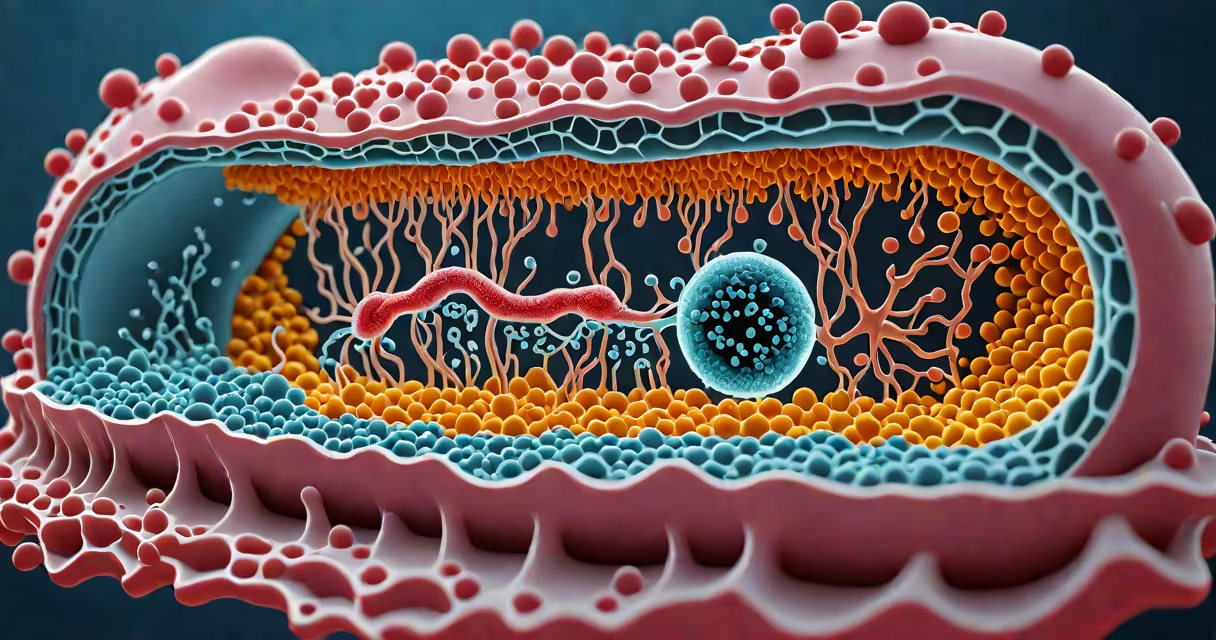
The function of plasma membrane is to regulate the movement of substances in and out of a cell, maintain cellular integrity, and help communication with the environment through specialized proteins and a lipid bilayer structure.
The plasma membrane forms a changing barrier between the cell's internal environment and the external space. It is composed primarily of a phospholipid bilayer, with hydrophilic heads facing outward and hydrophobic tails forming the interior. Embedded within this layer are proteins that serve as channels, receptors, and enzymes. This arrangement allows the membrane to control what passes through while maintaining stability under varying conditions.
According to Alberts et al., in Molecular Biology of the Cell, the plasma membrane's selective permeability is essential for homeostasis. Without it, ions, nutrients, and waste products would freely diffuse, disrupting metabolic processes. The membrane achieves this control through passive diffusion for small nonpolar molecules and active transport mechanisms for larger or charged substances.
Substances move across the plasma membrane via two primary pathways: passive and active transport. Passive transport requires no energy and includes simple diffusion, facilitated diffusion, and osmosis. Small nonpolar molecules like oxygen and carbon dioxide pass directly through the lipid bilayer. Polar molecules such as glucose and amino acids require specific transport proteins to cross.
Active transport uses ATP to move substances against their concentration gradient. The sodium-potassium pump (Na⁺/K⁺ ATPase) is a key example. It exports three Na⁺ ions and imports two K⁺ ions per ATP molecule hydrolyzed. This maintains electrochemical gradients critical for nerve impulse transmission and nutrient uptake.
A non-obvious fact: the membrane is not static. Lipids and proteins diffuse laterally within the bilayer, enabling rapid responses to environmental changes. This fluidity is maintained by cholesterol, which stabilizes the membrane at both high and low temperatures. Too much or too little cholesterol disrupts function-this is why hypercholesterolemia increases cardiovascular risk.
Membrane proteins fall into two categories: integral and peripheral. Integral proteins span the entire bilayer and often act as transporters or receptors. Peripheral proteins attach to the surface and assist in signaling or structural support.
| Type | Location | Function | Example |
|---|---|---|---|
| Transmembrane | Span both layers | Transport, signaling | Sodium-glucose cotransporter (SGLT1) |
| Peripheral | Attach to surface | Enzymatic activity, scaffolding | Protein kinase C (PKC) |
| Integral monotopic | Embedded in one side | Signal anchoring | GPI-anchored alkaline phosphatase |
Receptor proteins bind signaling molecules like insulin or epinephrine. When insulin binds to its receptor on muscle cells, it triggers a cascade that inserts glucose transporters (GLUT4) into the membrane. This allows glucose to enter the cell-a process disrupted in type 2 diabetes.
Every living cell relies on the function of plasma membrane to survive. In animal cells, it defines the boundary and enables interactions with neighboring cells. In plant cells, the plasma membrane lies beneath the rigid cell wall and controls water balance via aquaporins-proteins that allow rapid water passage during drought stress.
In neurons, the membrane's ability to rapidly change ion permeability generates action potentials. Voltage-gated sodium channels open in response to depolarization, allowing Na⁺ influx. This triggers adjacent channels to open, propagating the signal along the axon. Disruptions in this process cause neurological disorders like epilepsy or multiple sclerosis.
I once observed a lab experiment where red blood cells were placed in distilled water. Within seconds, they swelled and burst-hemolysis-because the plasma membrane could not withstand the osmotic pressure. The membrane ruptured due to unregulated water entry, demonstrating how important its regulatory function is.
Many assume the plasma membrane is a rigid wall. In reality, it is fluid and flexible. The fluid mosaic model, proposed by Singer and Nicolson in 1972, describes it as a changing patchwork of lipids and proteins. This model remains foundational in cell biology education and research.
Another misconception is that all transport is passive. Active transport accounts for up to 40% of a cell's ATP consumption in metabolically active tissues like the brain and kidneys. The Na⁺/K⁺ pump alone consumes about 25% of resting energy in human cells.
Some confuse the plasma membrane with the cell wall. The cell wall exists only in plants, fungi, and bacteria-it provides structural support but lacks selective permeability. The plasma membrane is universal across all domains of life.
Understanding the function of plasma membrane is critical in pharmaceutical design. Many drugs target membrane proteins. For example, statins inhibit HMG-CoA reductase, an enzyme in the endoplasmic reticulum-but their effectiveness depends on crossing the plasma membrane to reach intracellular targets.
Hydrophobic drugs like diazepam cross membranes easily. Hydrophilic drugs like penicillin rely on porins or transporters. A 2021 study in Journal of Medicinal Chemistry showed that modifying drug polarity improves delivery efficiency by up to 60% in cancer cells.
When designing a new antiviral, researchers must ensure the compound can traverse the membrane to reach viral replication sites inside the cytoplasm. Failure to do so results in ineffective dosing-even if the drug binds well to its target.
The function of plasma membrane is not just biological theory-it shapes medical outcomes. Its role in regulating cellular traffic makes it central to treating diseases ranging from cystic fibrosis to Alzheimer's.