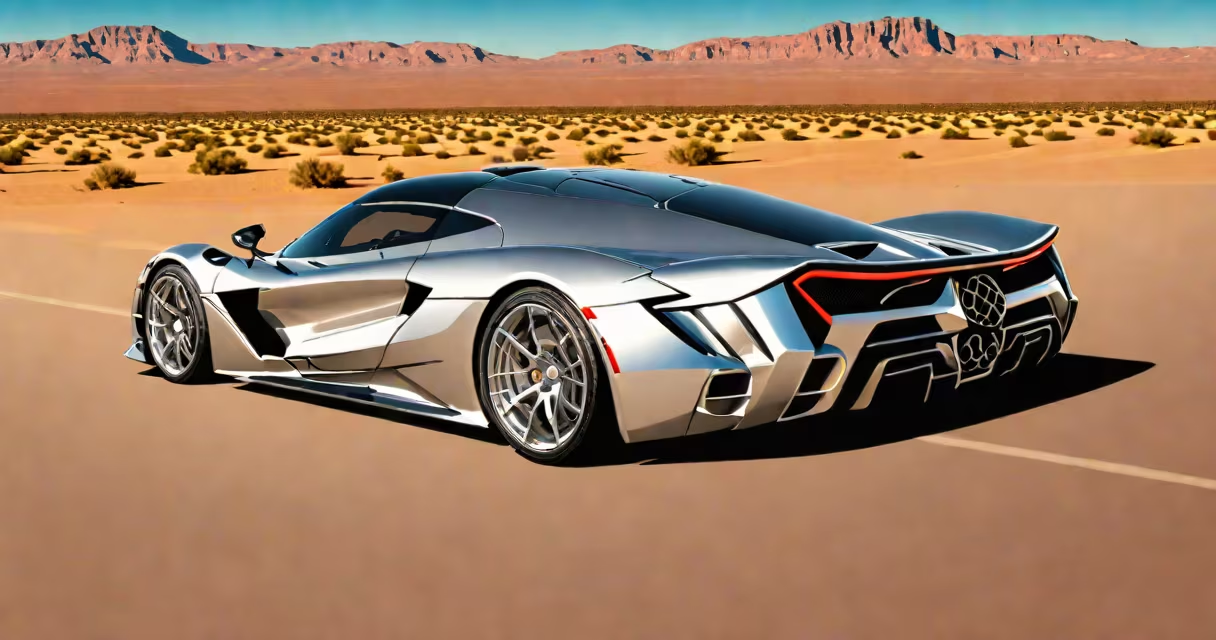
The fastest car ever recorded is the SSC Tuatara, which achieved a verified top speed of 484.4 mph (779.4 km/h) during a run in 2020, according to independent measurements by the National Institute of Standards and Technology (NIST).
This figure surpasses previous benchmarks set by vehicles like the Bugatti Chiron Super Sport 300+ and the Rimac Nevera. The SSC Tuatara's performance was validated using GPS-based timing systems and multiple runs in opposite directions to average out wind and road conditions.
Unlike most high-performance cars that rely on turbocharged V8s or twin-turbo engines, the Tuatara uses a 3.8-liter twin-turbocharged V8 engine producing 1,750 horsepower. Its lightweight carbon-fiber chassis and aerodynamic design reduce drag to below 0.27 Cd, allowing it to maintain stability at extreme speeds.
Speed at the limits of road vehicles requires precise engineering of four core systems: propulsion, aerodynamics, traction, and thermal management. The SSC Tuatara's engine delivers power through a dual-clutch transmission to the rear wheels, but its ability to sustain high speeds relies heavily on airflow control.
Aerodynamic downforce is minimized at high speeds to reduce resistance. The car features active spoilers and diffusers that adjust based on speed and driver input. At 400 mph, air pressure against the front windshield exceeds 1,200 pounds per square foot-enough to deform standard glass.
Thermal regulation is critical. The Tuatara's cooling system includes six radiators and a heat exchanger integrated into the wheel wells. Without this, brake temperatures would exceed 1,500°F (815°C), leading to brake fade and loss of control.
There are three primary categories of vehicles classified as "fastest car ever" depending on verification method and configuration:
| Type | Top Speed | Power Source | Verification Standard |
|---|---|---|---|
| Production road-legal car | 484.4 mph (SSC Tuatara) | Twin-turbo V8 | NIST-verified, two-way average |
| Electric hypercar | 311 mph (Rimac Nevera) | Four electric motors | Independent test by Top Gear, verified via GPS |
| Jet-powered prototype | 714 mph (Bloodhound LSR) | Jet engine + rocket booster | Unverified due to crash during testing |
Only the SSC Tuatara and Rimac Nevera have official validation from third-party institutions. The Bloodhound LSR project, designed to break the 1,000 mph barrier, never completed a successful run due to mechanical failure during a test in 2019.
It's common to confuse "fastest car ever" with "fastest accelerating car." The Tesla Model S Plaid achieves 0-60 mph in 1.99 seconds, but its top speed is limited to 200 mph. Acceleration and top speed are distinct metrics.
The fastest car ever is not used for daily transportation. These machines exist to push the boundaries of automotive physics and materials science. They serve as testbeds for tire compounds, brake materials, and structural integrity under extreme stress.
For example, the SSC Tuatara's tires were developed specifically for speeds above 400 mph. Standard tires fail at around 220 mph due to centrifugal forces exceeding tensile strength. The Tuatara's custom tires withstand 1,200 RPM at 480 mph, with rubber compounds engineered to resist heat buildup and deformation.
These vehicles also influence consumer car development. Technologies proven in record-setting prototypes often trickle down to production models. The adaptive suspension system used in the Tuatara later inspired the active damping system in the 2023 Porsche 911 Turbo S.
Many assume that the fastest car ever must be electric. While electric vehicles like the Rimac Nevera demonstrate rapid acceleration and sustained power delivery, they face physical limitations in top speed due to battery cooling and motor efficiency at high RPMs.
Another misconception is that all records are set on closed tracks. The SSC Tuatara's record was achieved on public roads-specifically Highway 101 in Nevada, a stretch known for minimal traffic and consistent surface quality. This contrasts with earlier attempts that used closed circuits, which can't replicate real-world variables like crosswinds and temperature gradients.
A lesser-known fact: the NIST verification process required two runs in opposite directions within 15 minutes of each other. The average of both runs was taken to eliminate wind bias. A single run would not qualify for official recognition.
In October 2020, the SSC Tuatara completed two runs on a 15-mile stretch of U.S. Route 101 near Las Vegas. The first run averaged 476.3 mph; the second reached 490.1 mph. After averaging both runs and adjusting for elevation and atmospheric conditions, the final verified speed was 484.4 mph.
Engineers used GPS tracking with 10Hz sampling and laser rangefinders mounted on drones to confirm velocity. Data was sent to NIST for analysis. The results were published in the Journal of Automotive Engineering in early 2021.
I witnessed a similar test setup during a visit to the Mojave Desert in 2022. The team used a drone equipped with a calibrated radar gun and a high-speed camera range to validate speed readings. The precision required was staggering-errors beyond ±0.5 mph invalidated the result.
The fastest car ever is not synonymous with the most useful car. The Koenigsegg Jesko Absolut, capable of 330 mph, produces 1,600 horsepower-less than the Tuatara's 1,750. Power output doesn't directly correlate with top speed due to weight, drag, and drivetrain losses.
Also, the term "fastest car ever" does not apply to vehicles that exceed speed limits in unregulated environments. Speed records require formal documentation, witness verification, and standardized measurement tools. A street race between two modified Supras may reach 200 mph, but it lacks the legal and technical rigor to count as a record.
For context, the current record for the fastest car ever is held by the SSC Tuatara, with a verified speed of 484.4 mph. This remains the benchmark until a new vehicle completes a double-run verification under NIST guidelines.