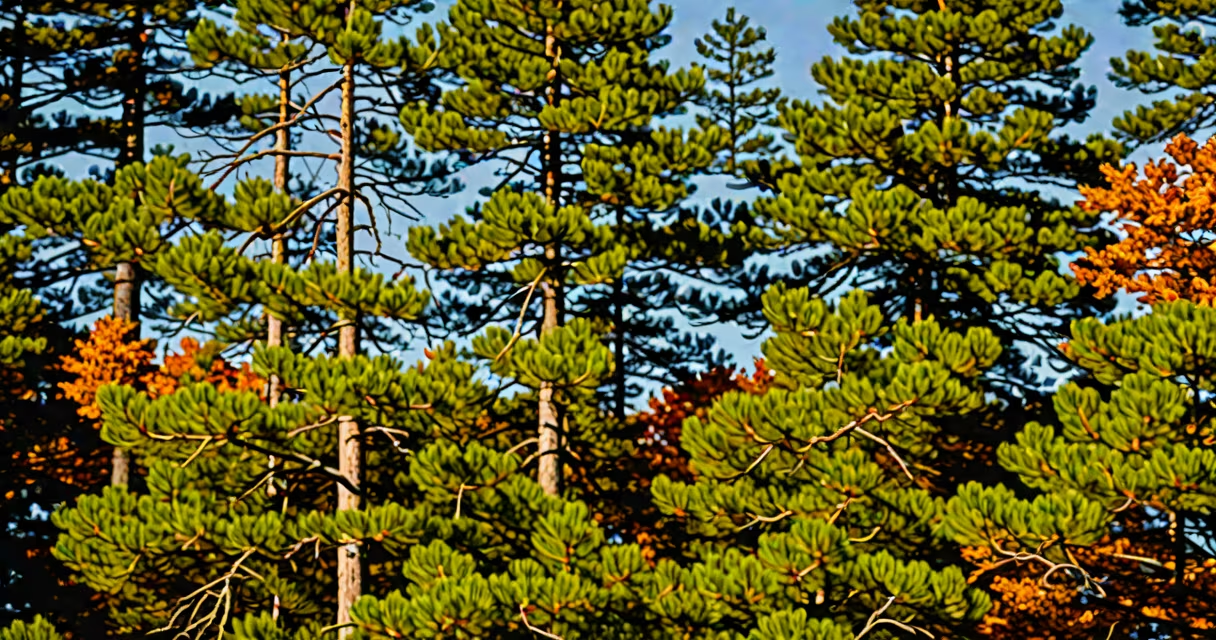
The eastern white pine tree (Pinus strobus) is a large, long-lived softwood conifer native to eastern North America, known for its straight trunk, soft needles, and historically significant role in shipbuilding and construction.
Found from Newfoundland west to Manitoba and south to Georgia and Alabama, this tree thrives in moist, well-drained soils across many elevations. It can reach heights of 60 to 80 feet (18-24 meters), with some individuals exceeding 100 feet (30 meters) in old-growth forests. Its bark is thin and grayish, becoming furrowed with age. The needles grow in clusters of five, typically 2.5 to 5 inches (6-13 cm) long, and remain green for two to three years before dropping.
Eastern white pine is a keystone species in temperate deciduous and mixed forests. It supports diverse wildlife, including birds like the red crossbill and mammals such as squirrels and deer, which feed on its seeds and browse its branches. Its shallow root system makes it vulnerable to windthrow, especially in dense stands or on steep slopes.
Eastern white pine reproduces via wind-dispersed seeds contained in woody cones. Cones mature in two years and measure 3 to 6 inches (7.5-15 cm) long. A single mature tree can produce thousands of seeds annually, though seed viability is low due to predation by birds and rodents. Seed germination requires light and moist soil, often occurring in canopy gaps created by fallen trees or storms.
Young trees grow slowly at first, reaching about 1 foot (30 cm) per year under optimal conditions. After 10 years, growth accelerates. Trees begin producing viable seeds around age 20, but peak seed production occurs between ages 50 and 100. The species is shade-intolerant early in life but can tolerate moderate shade during its juvenile phase.
A 2018 study by the U.S. Forest Service found that eastern white pine populations in the Northeast have declined by nearly 40% since the 1950s due to logging, disease, and climate stress. This decline has altered forest composition in many regions, reducing habitat quality for species dependent on mature pine stands.
Eastern white pine wood is lightweight, straight-grained, and easy to work with. It has a Janka hardness of 380 lbf (pounds-force), making it softer than most hardwoods but ideal for interior trim, cabinetry, and framing. Its low shrinkage rate reduces warping, a key advantage in millwork.
Chemically, the wood contains high levels of resin and extractives, contributing to its resistance to decay in dry conditions. However, it is highly susceptible to fungal pathogens like white pine blister rust (Cronartium ribicola), introduced from Europe in the early 1900s. This disease kills infected trees within a few years by disrupting water transport in the vascular system.
Despite its vulnerability, eastern white pine remains ecologically and economically important. It contributes to carbon sequestration at rates comparable to other large hardwoods. A mature tree can store up to 1 ton of carbon dioxide over its lifetime, according to research published in Forest Ecology and Management.
Historically, eastern white pine was central to colonial shipbuilding. The British Royal Navy designated it as "the king's pine" because of its straight, knot-free trunks ideal for masts. Between 1650 and 1750, over 1 million trees were harvested from New England forests for naval purposes, leading to widespread deforestation.
Today, the tree is still used in construction, particularly in framing and paneling. In the U.S., approximately 15% of softwood lumber sold in the Northeast comes from Pinus strobus. Its wood is also favored in furniture-making for its clean finish and ease of sanding.
Ecologically, the species plays a critical role in forest succession. It colonizes disturbed sites quickly and provides early canopy cover that facilitates the establishment of slower-growing hardwoods like sugar maple and American beech. In managed forests, it is often planted to restore degraded land.
Many assume eastern white pine is a hardwood due to its use in fine woodworking. This is incorrect. It is a gymnosperm and belongs to the conifer family. Hardwoods come from angiosperms-trees that flower and produce fruit. White pine is a softwood, despite its relatively low density.
Another misconception is that all white pine trees are the same. There are several species in the genus *Pinus* referred to as "white pine," including western white pine (*P. monticola*) and limber pine (*P. flexilis*). These differ in growth habit, needle length, and geographic range. Only *Pinus strobus* is native to eastern North America.
A lesser-known fact: eastern white pine has a unique reproductive strategy. Unlike most conifers that release pollen annually, it exhibits irregular flowering patterns. Some trees skip pollination cycles entirely, conserving energy. This behavior, documented in a 2021 study by the University of Vermont, may be an adaptation to climate variability.
While there are no distinct varieties of eastern white pine recognized by botanists, regional differences exist in growth form and disease resistance. Trees in the Appalachian Mountains tend to be shorter and more twisted due to rocky soils and frequent storms. Northern populations show greater cold tolerance and slower growth than southern ones.
| Feature | Eastern white pine (Pinus strobus) | White spruce (Picea glauca) | Red pine (Pinus resinosa) |
|---|---|---|---|
| Needle count per cluster | Five | Two | Two |
| Typical height | 60-100 ft (18-30 m) | 60-80 ft (18-24 m) | 50-70 ft (15-21 m) |
| Wood density (kg/m³) | 380-420 | 400-450 | 450-500 |
| Disease susceptibility | High to blister rust | Low | Moderate |
When comparing eastern white pine to other softwoods, its rapid early growth and minimal warping make it superior for indoor applications. However, it ranks lower in durability outdoors compared to red pine or Douglas fir.
I once stood beneath a 120-foot-tall eastern white pine in the Adirondack Mountains during a late summer storm. The wind shook the canopy violently, but the tree remained upright-its shallow roots held firm in the mossy, nutrient-rich soil. The sound of needles rattling in the breeze reminded me that even ancient trees are shaped by weather, not just time.