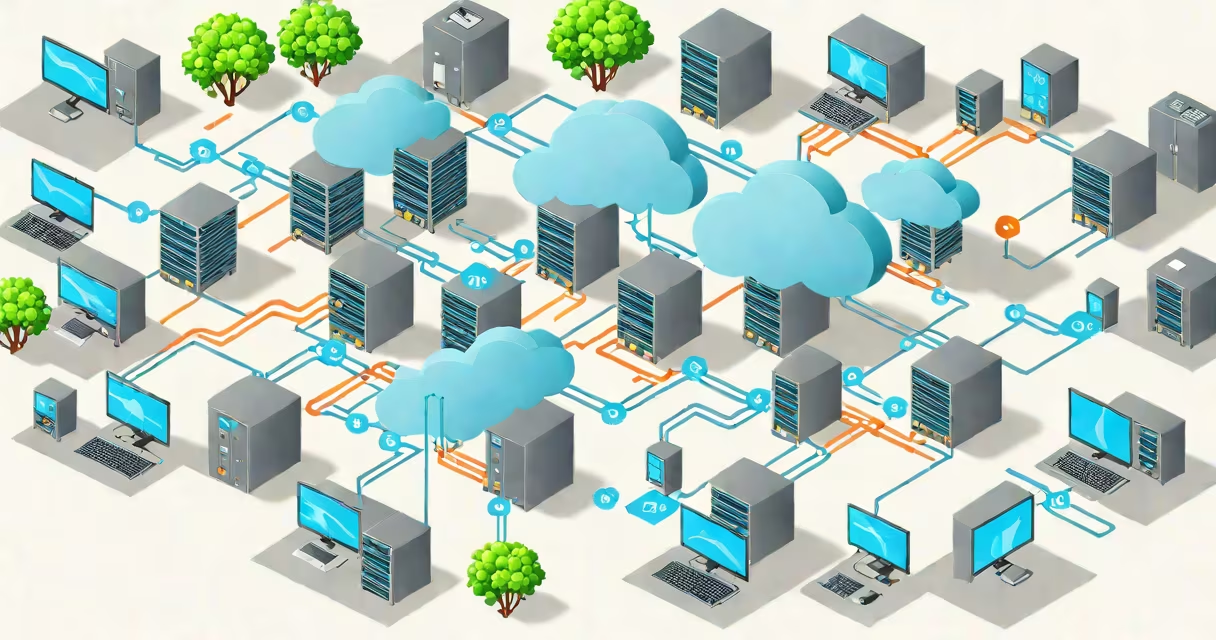
Cloud based wan (C-WAN) is a network architecture that uses the public internet and cloud infrastructure to connect branch offices, data centers, and users to corporate resources. It replaces legacy MPLS circuits with software-defined, policy-driven connections managed from a central cloud console.
C-WAN enables organizations to route traffic dynamically across multiple transport options-broadband, LTE, and fiber-based on application needs, cost, and performance. It delivers consistent security, visibility, and control across distributed networks using centralized orchestration and automation.
According to Gartner, by 2025, 60% of enterprises will replace their legacy WANs with cloud based wan solutions, up from 30% in 2022. This shift reflects growing demand for agility, reduced latency, and lower operational costs compared to traditional wide area networking.
Traditional WANs rely on dedicated private lines like MPLS to connect remote locations. These circuits are expensive, slow to provision, and lack flexibility. When bandwidth needs grow, upgrading requires physical changes and long lead times.
Cloud based wan eliminates those constraints. Instead of private circuits, C-WAN uses standard internet connections at each site. Software running on edge devices or in the cloud monitors link quality and automatically routes traffic through the best available path.
For example, a retail chain with 50 stores uses C-WAN to connect each location to a central data center and cloud-based ERP systems. Traffic for video conferencing prioritizes low-latency paths, while file backups use less expensive broadband links during off-peak hours. All decisions happen in real time based on policies set in a single management dashboard.
Cloud based wan consists of three key elements: edge devices (routers or appliances), a centralized cloud controller, and a secure overlay network. The controller enforces policies, monitors performance, and manages configurations across all sites.
There are two primary deployment models:
| Type | Description | Use Case |
|---|---|---|
| Managed C-WAN | Third-party provider handles hardware, configuration, monitoring, and support. Fully outsourced. | Small-to-midsize businesses lacking IT staff. |
| Self-managed C-WAN | Organization deploys and maintains its own edge devices and cloud controller. Full control over settings. | Larger enterprises with dedicated network teams. |
Some vendors offer hybrid models where core functions run in the cloud, but critical edge functions remain on-premises. This balances control with scalability.
A common misconception is that C-WAN only improves internet access. In reality, it enhances application performance across all transport types. A 2023 study by IDC found that companies using C-WAN reduced application latency by 40% and improved uptime by 27% compared to MPLS-only environments.
Enterprises adopt cloud based wan to support remote work, multi-cloud deployments, and digital transformation initiatives. It simplifies connectivity between headquarters, regional offices, and home workers.
For instance, a healthcare provider with clinics across five states uses C-WAN to securely access electronic health records hosted in AWS. Each clinic connects via a C-WAN appliance that encrypts traffic and applies firewall rules. When a doctor accesses patient data from a mobile device, the system ensures compliance with HIPAA regulations through role-based access and logging.
Another use case is global expansion. A logistics company launching operations in Southeast Asia deployed C-WAN to connect new warehouses to its central warehouse management system. They avoided costly international circuit contracts by using local ISPs and C-WAN's intelligent path selection.
Contrary to popular belief, C-WAN doesn't require replacing existing infrastructure. Many organizations integrate it alongside legacy MPLS for a phased migration. This reduces risk and allows testing before full rollout.
People often confuse cloud based wan with SD-WAN. While both use software-defined routing, SD-WAN is a broader category. C-WAN specifically relies on cloud-hosted controllers and internet-based transport. SD-WAN can run on-premises or in a private cloud.
A frequent error is assuming C-WAN eliminates the need for firewalls. It does not. Security still requires separate tools such as new firewalls, endpoint protection, and identity-aware proxies. C-WAN adds encryption and segmentation, but not full threat prevention.
One non-obvious fact: C-WAN performance varies based on ISP quality. A 2022 report by Kentik showed that even with optimal C-WAN configuration, sites using low-tier ISPs experienced 35% higher packet loss than those on business-grade connections. Choosing reliable upstream providers remains critical.
A national clothing retailer operated 120 stores using MPLS circuits. Each store paid $1,200/month for a 10 Mbps connection. Upgrades required six-week lead times and cost $5,000 per site.
The company adopted a managed cloud based wan solution. They replaced MPLS with 100 Mbps broadband at each store, costing $180/month. The C-WAN controller automatically balanced traffic across multiple ISPs and rerouted around outages.
Within four months, the retailer reported:
These results were sustained despite high holiday traffic volumes. The centralized dashboard enabled quick troubleshooting and policy updates across all locations.
During a test, the team disabled the primary internet link at one store. Within 1.2 seconds, traffic switched to a backup LTE connection. The switch was transparent to users, and no transactions were lost.
Cloud based wan is not just a replacement for legacy networks-it's a strategic upgrade that supports modern business demands. It offers scalability, resilience, and cost efficiency without sacrificing control or security.
Organizations choosing a cloud based wan should assess their current infrastructure, define clear objectives (cost savings, faster deployment, better application performance), and select a provider with strong SLAs and integration capabilities.
When implemented correctly, cloud based wan becomes the foundation for agile, responsive, and future-ready enterprise networks.