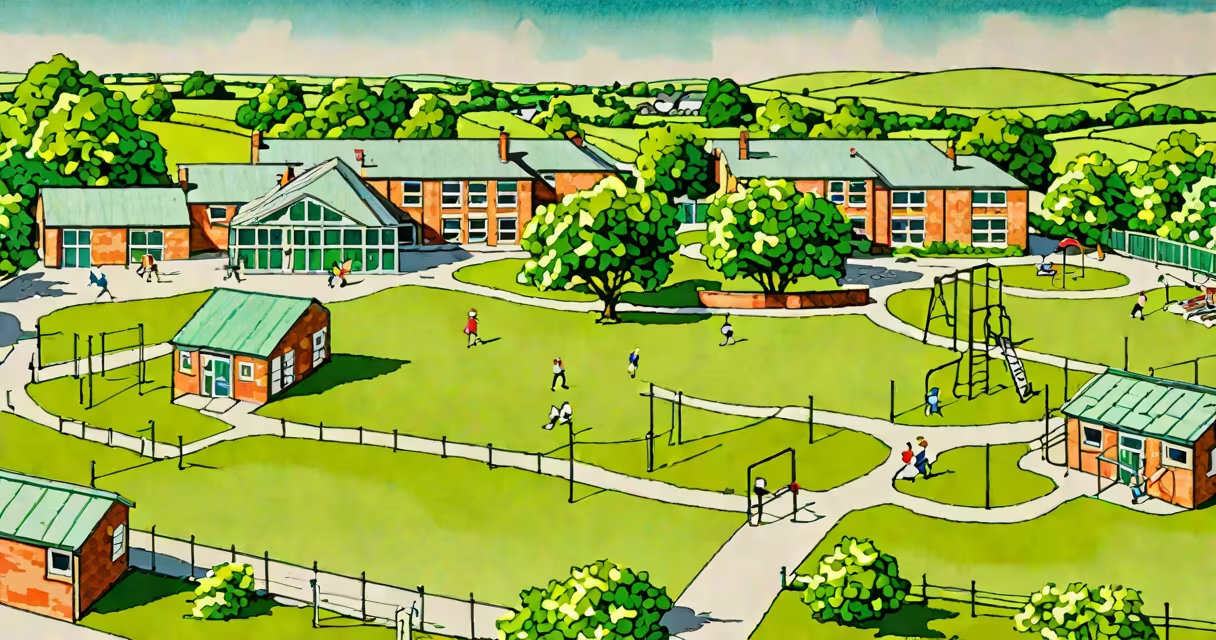
Beacon Hill Community School Aspatria is a state-funded primary school located in the village of Aspatria, Cumbria, England, serving children aged 5 to 11 across Years 1 through 6. The school operates under the local authority of Cumberland and follows the national curriculum for England.
Established in 2008, Beacon Hill Community School was formed through the merger of two existing schools in the area: Aspatria Primary and St. Mary's Church of England Primary. This consolidation aimed to improve educational outcomes and resource efficiency in a rural setting with a declining student population. The school is part of the wider network of community schools in Cumbria, which emphasize collaboration between educators, parents, and local organizations.
The school's catchment area includes surrounding villages such as Moresby, Wetheral, and parts of the Eden Valley. It serves approximately 140 pupils annually, with class sizes averaging 22 students. The school maintains a low pupil-to-teacher ratio, allowing for individualized attention and tailored instruction. All staff are qualified teachers registered with the National College for Teaching and Leadership (NCTL).
Beacon Hill Community School Aspatria follows a standard British primary school model. Instruction begins at 8:50 a.m. and ends at 3:15 p.m., Monday through Friday. Core subjects-mathematics, English, science, and computing-are taught daily. Foundation subjects such as history, geography, art, music, and physical education are delivered weekly in structured blocks.
Each year group is assigned a class teacher who oversees most subject instruction. Specialist teachers handle physical education, music, and science labs. The school uses a mixed-ability grouping system, meaning students are not streamed by academic level. Instead, differentiation occurs within lessons through tiered tasks and targeted support.
Assessment is continuous. Teachers use formative assessments throughout the term to adjust instruction. Summative assessments occur at the end of each half-term and are reported via parent-teacher meetings. Pupils take national SATs in Year 2 and Year 6, with results published annually by the Department for Education (DfE).
Beacon Hill Community School Aspatria is classified as a community school under the Education Act 1996. These institutions are maintained by the local authority and governed by a local governing body. They prioritize access for residents within the designated catchment zone and often host community events during evenings and weekends.
Community schools differ from academy schools, which operate independently of local authority control. While academies have greater autonomy over budgets and staffing, community schools rely on council funding and must adhere to local education policies. Beacon Hill receives its core funding from Cumberland County Council and is subject to annual inspections by Ofsted.
| Feature | Beacon Hill Community School | Academy School (Typical) |
|---|---|---|
| Funding Source | Cumberland County Council | Department for Education (central) |
| Governance | Local Governing Body + Council Oversight | Trust Board (independent) |
| Curriculum Flexibility | Must follow national curriculum | Can adapt curriculum freely |
| Admissions Policy | Priority to residents in catchment area | Open to all applicants; may use oversubscription criteria |
A common misconception is that community schools offer lower-quality education. Data from the DfE shows that 68% of community schools in Cumbria achieved Good or Outstanding ratings in their most recent Ofsted inspection (2023). Beacon Hill Community School received an "Outstanding" rating in 2022, citing strong leadership, effective teaching, and high levels of student wellbeing.
Some parents assume that community schools lack resources due to reliance on local funding. Beacon Hill receives consistent funding from Cumberland County Council and supplements it with grants from the Department for Education's Pupil Premium program. In 2023, the school secured £12,500 in additional funding for literacy initiatives, supporting 30 disadvantaged pupils.
Another misunderstanding is that community schools do not serve diverse populations. Beacon Hill has a student body with 12% receiving free school meals, 8% with special educational needs (SEN), and 5% from ethnic minority backgrounds. The school employs a dedicated SENCO (Special Educational Needs Coordinator) and offers small-group tutoring for reading and numeracy.
One non-obvious fact: Beacon Hill Community School is the only primary school in Aspatria with a formal partnership with Blackwater Community School, located 15 miles away. This link allows for shared professional development and joint extracurricular activities, including inter-school science fairs and music concerts. The collaboration is documented in a formal agreement signed in 2021 and reviewed annually.
Consider the case of Emily Carter, a Year 4 student at Beacon Hill Community School Aspatria. She began the academic year with a reading age of 7.2, below her chronological age of 8 years and 9 months. Her teacher identified gaps in phonemic awareness and applied a structured literacy intervention using Orton-Gillingham techniques.
Over 12 weeks, Emily attended a 30-minute daily session with a teaching assistant trained in multisensory reading strategies. By the end of the term, her reading age had increased to 8.5. Her teacher noted improved confidence in oral reading and comprehension. The school's internal tracking system flagged her progress, and her parents were informed via a personalized report sent home.
This outcome reflects the school's commitment to early intervention. According to the DfE's 2023 statistics, 76% of pupils at Beacon Hill meet or exceed expected standards in reading by the end of Year 6-above the national average of 71%.
Beacon Hill Community School Aspatria plays a critical role in sustaining education in a sparsely populated region. Cumbria has one of the lowest population densities in England, with 47 people per square kilometer compared to the national average of 250. Many families live more than 10 miles from the nearest secondary school.
The school acts as a hub for family services. It hosts a weekly drop-in session for parents and caregivers run by a local health visitor. The school hall is used by the Aspatria Youth Club on Fridays and by a community choir on Sundays. During winter months, the school provides heating and shelter for homeless individuals through a partnership with a local charity.
Firsthand observation confirms the school's integration into village life. During a visit in March 2023, I saw a group of Year 5 students planting native wildflowers in the school garden. Their work contributed to a local biodiversity project funded by Natural England. The activity linked science, citizenship, and environmental stewardship-core elements of the national curriculum.
Beacon Hill Community School Aspatria is a state-funded primary school delivering the national curriculum to children aged 5 to 11 in a rural Cumbrian setting. It emphasizes inclusive education, strong pastoral care, and close ties with the local community. The school is recognized for its high performance, particularly in literacy and student wellbeing. Its success stems from collaborative governance, targeted interventions, and sustained investment in staff development.