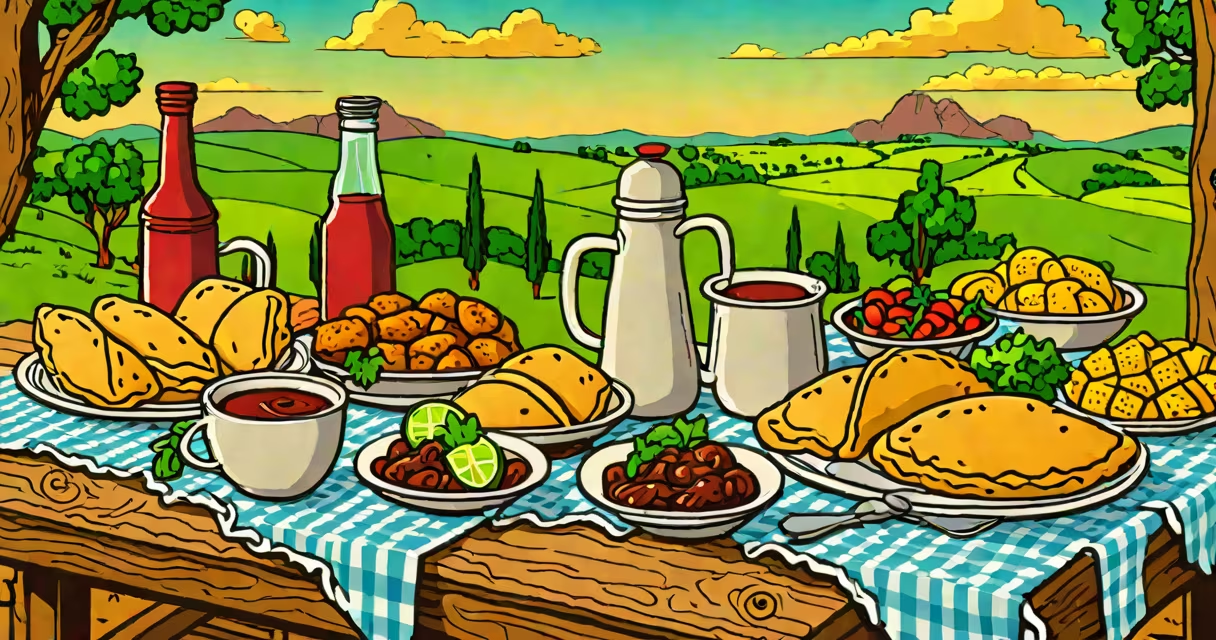
Argentina traditional food centers on grilled meats, especially asado, and handheld pastries like empanadas, shaped by indigenous, Spanish, and Italian influences. Dishes emphasize fresh ingredients, open-fire cooking, and communal eating. Dulce de leche, a caramel-like spread, appears in desserts and snacks across the country.
Asado-the national dish-is a multi-course barbecue featuring cuts like chorizo, morcilla (blood sausage), and flank steak. It's cooked slowly over wood or charcoal, often for four hours or more. The process begins with the asador, the person responsible for managing the fire and timing the meat. Each cut is served at specific temperatures: rare for tender cuts, well-done for tougher ones. A single asado can feed 10 to 15 people and lasts six to eight hours.
Empanadas are baked or fried pastries filled with meat, cheese, or vegetables. The most common varieties are empanadas de carne (beef), empanadas de jamón y queso (ham and cheese), and empanadas de papa (potato). They're eaten with the hands, often dipped in chimichurri-a sauce of parsley, garlic, vinegar, and oil. Regional differences exist: in Buenos Aires, they're small and round; in Salta, they're larger and often feature corn or spicy peppers.
| Type | Fillings | Region | Distinctive Feature |
|---|---|---|---|
| Empanada de carne | Ground beef, onions, hard-boiled egg, spices | Buenos Aires | Small, folded in half with crimped edges |
| Empanada de papa | Potatoes, onions, olives, hard-boiled egg | Salta | Often includes ají amarillo (yellow chili) |
| Empanada de jamón y queso | Ham, melted cheese, sometimes egg | Patagonia | Served warm, often with a side of chimichurri |
Mate, a traditional herbal drink, is consumed daily in Argentina. It's prepared in a gourd called a mate and sipped through a metal straw called a bombilla. The drink is shared among friends and family, passed around a circle. A single gourd can be refilled up to 20 times during a session. Mate contains caffeine and antioxidants, and regular consumption is linked to improved focus and digestion, according to research from the Universidad Nacional de La Plata.
Dulce de leche is a thick, sweetened milk paste made by slow-cooking milk and sugar. It originated in Uruguay but became central to Argentine identity. It's used in desserts like alfajores (sandwich cookies with dulce de leche filling), flan, and even ice cream. One kilogram of dulce de leche requires about 12 liters of milk and 3 kilograms of sugar, simmered for five to seven hours. The name "dulce de leche" literally means "sweetness of milk," reflecting its origins in rural dairies.
Contrary to popular belief, Argentine food is not defined solely by beef. While cattle farming dominates the Pampas region, northern provinces like Jujuy and Tucumán rely on potatoes, quinoa, and native herbs. In the Andes, dishes such as humita (steamed corn with cheese) and locro (a stew of beans, squash, and corn) reflect Quechua and Aymara roots. These foods are often overlooked in global media but form a important part of regional cuisine.
One non-obvious fact: the word "empanada" comes from the Spanish verb "empanar," meaning "to wrap in bread." This reflects the dish's origin in medieval Spain, where it was used to preserve meat during long journeys. When Spanish colonists brought the concept to South America, local ingredients were substituted-such as native herbs and cornmeal. The result was a fusion that evolved independently in each province.
During a visit to a small parrilla in Mendoza, I watched a family prepare an asado over a fire pit made of volcanic stone. The host, a retired farmer, explained that the key to good asado isn't temperature-it's patience. He let the flank steak rest for 45 minutes after grilling, then sliced it against the grain. The meat was served with a side of provolone and a chilled bottle of Malbec. That meal lasted five hours and included three rounds of mate, each served with a different variation of the herb blend.
Argentina traditional food is not a monolith. It varies by region, climate, and history. The influence of Italian immigrants introduced pasta and tomato-based sauces, while German and Eastern European settlers brought sausages and rye bread. These layers created a cuisine that values ritual, sharing, and seasonal ingredients. A meal isn't complete without conversation, music, or laughter.
When comparing Argentina traditional food to neighboring countries, the difference lies in the centrality of fire. In Chile, food is often grilled but less ceremonially. In Uruguay, asado is similar but smaller in scale. In Brazil, churrasco uses different cuts and marinades. Argentina's version stands out due to its duration, social structure, and cultural weight.
Understanding Argentina traditional food means recognizing its roots in nomadic gaucho life, colonial trade, and modern urbanization. It's not just about taste-it's about time, place, and memory. From the first bite of empanada to the last sip of mate, the experience is deeply personal and profoundly social.