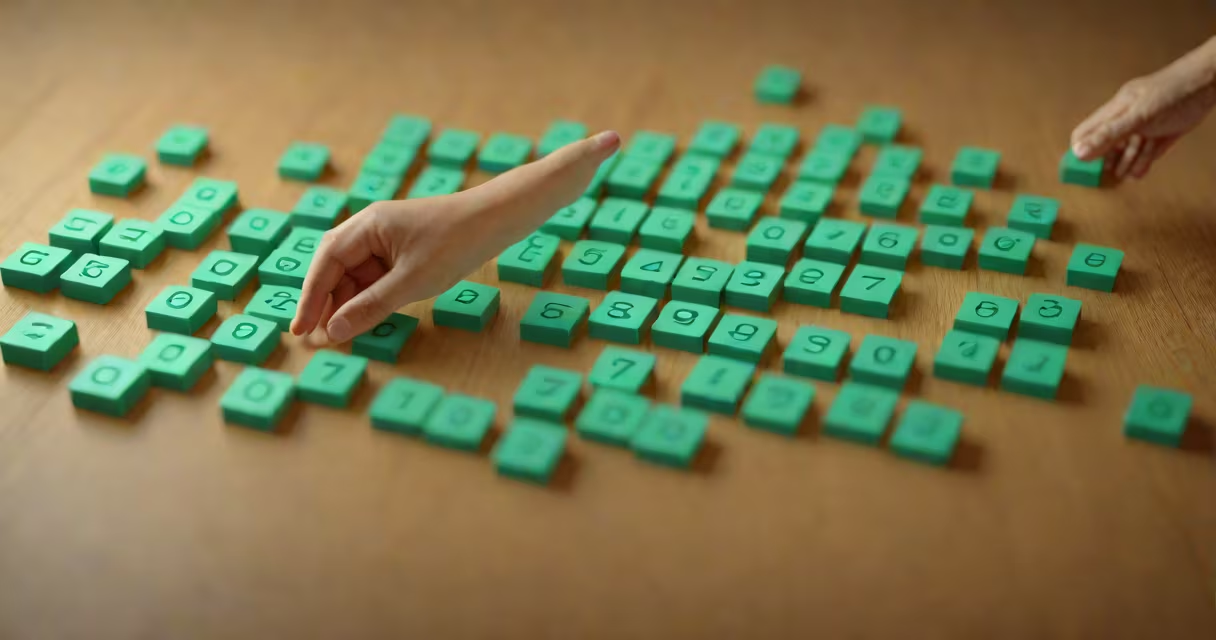
Natural numbers are the set of positive integers starting from 1 and increasing without bound: 1, 2, 3, 4, and so on. They form the basis of counting and are used to quantify discrete objects in everyday life and advanced mathematics.
These numbers arise from the act of counting. When you count apples, people, or steps, you use natural numbers. They are the simplest number system humans use to describe quantity. Unlike integers, which include negative values and zero, natural numbers start at 1 and have no upper limit.
The formal definition appears in Peano's axioms, a foundational system for arithmetic developed in the 19th century. These axioms define natural numbers through five principles: 1 is a natural number; every natural number has a successor; different numbers have different successors; 1 is not the successor of any natural number; and mathematical induction holds. This structure ensures consistency in arithmetic reasoning.
Natural numbers function as the core of arithmetic operations. Addition and multiplication of natural numbers always produce another natural number. For example, 3 + 5 = 8, and 4 × 6 = 24-both results are natural numbers. This property is called closure under addition and multiplication.
Subtraction and division do not preserve closure. 5 − 7 = −2, which is not a natural number. Similarly, 3 ÷ 4 = 0.75, a fraction. These operations require expanding beyond natural numbers into integers or rational numbers.
Each natural number has a unique successor. The successor of 1 is 2, of 2 is 3, and so on. This process defines the infinite nature of the set. There is no largest natural number-given any number, adding 1 produces a larger one.
Natural numbers serve multiple roles across mathematics. In number theory, they are central to studying prime numbers, divisibility, and patterns in sequences. The Goldbach conjecture, for example, states that every even integer greater than 2 can be expressed as the sum of two primes-a claim about natural numbers that remains unproven despite extensive testing.
In computer science, natural numbers represent indices, loop counters, and range lengths. Programming languages use them to track iterations. For instance, a loop that runs 10 times uses the natural numbers 1 through 10 to control execution.
Real-world applications include measuring quantities: the number of students in a classroom, the pages in a book, or the seats in a theater. All are counted using natural numbers.
| Type | Description | Example |
|---|---|---|
| Prime | Natural numbers greater than 1 divisible only by 1 and themselves | 2, 3, 5, 7, 11 |
| Composite | Natural numbers with more than two divisors | 4, 6, 8, 9, 10 |
| Perfect | Sum of proper divisors equals the number itself | 6 (1 + 2 + 3 = 6) |
Some people assume zero is a natural number. This varies by convention. In set theory and logic, 0 is often included. In elementary arithmetic and many textbooks, natural numbers begin at 1. The ISO 80000-2 standard defines natural numbers as starting from 1.
Another confusion arises between natural numbers and whole numbers. Whole numbers include 0 and all natural numbers. So while 5 is both a natural and whole number, 0 is only a whole number-not a natural number under most definitions.
A key distinction: natural numbers are discrete and countable. They do not include decimals, fractions, or irrational values like √2 or π. These belong to other number systems.
Consider a school library with 127 books. To track inventory, staff assign each book a unique identifier: 1, 2, 3, ..., 127. These identifiers are natural numbers. When a student checks out book #42, the system records the transaction using the natural number 42.
If the library adds 15 new books, the total becomes 127 + 15 = 142. The calculation relies solely on natural number arithmetic. No fractions or negatives are involved. The result, 142, is also a natural number.
This process mirrors how natural numbers operate in databases, spreadsheets, and financial ledgers. Every count, every index, every tally begins with the natural number system.
I once observed a kindergarten class learning to count. Children placed colored blocks into labeled boxes marked 1 through 10. One child dropped a block and had to recount. He touched each block, saying "one, two, three..." aloud. That moment-pointing, speaking, assigning a label-was the direct application of natural numbers in action. The concept wasn't taught; it was lived.
The American Mathematical Society defines natural numbers as the set {1, 2, 3,...}, excluding zero. This aligns with the standard used in K-12 education in the United States. The National Council of Teachers of Mathematics (NCTM) supports this definition in curriculum guidelines.
Historically, natural numbers were described by Euclid in *Elements* around 300 BCE. He defined numbers as collections of units, implicitly starting from 1. Modern treatments confirm this lineage, showing that natural numbers are not a recent invention but a foundational idea in human thought.
When working with algorithms, proofs, or data models, natural numbers provide a stable, predictable base. Their simplicity enables complex systems to function reliably.
Understanding mathematics natural numbers is essential for grasping higher concepts in algebra, calculus, and computer science. They are not just tools for counting-they are the language of discrete quantity.