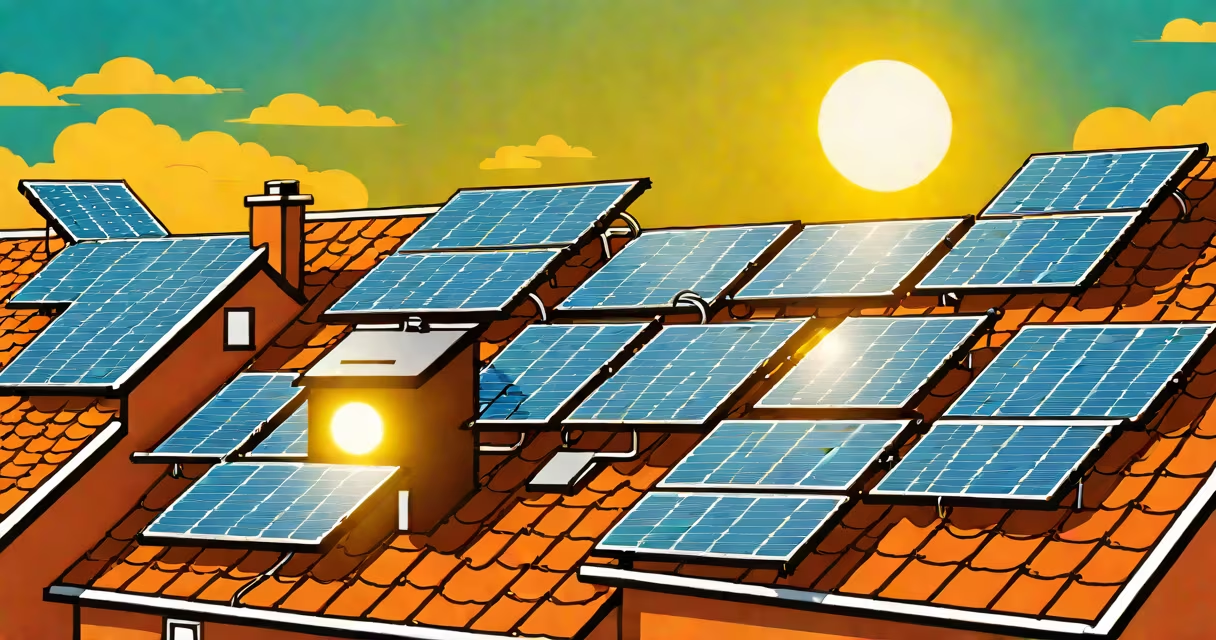
Solar power is renewable because it relies on sunlight, a natural resource that replenishes daily and will remain available for at least five billion more years. Unlike fossil fuels, which deplete over time, solar energy does not run out when used.
The sun emits about 3.8 × 10²⁶ watts of power continuously. Earth receives roughly 173,000 terawatts of solar radiation at the upper atmosphere-more than 10,000 times the world's current total power consumption. This abundance ensures solar energy remains viable long-term.
Renewability means a resource can be replenished naturally within a human lifetime. Sunlight meets this criterion perfectly. Fossil fuels like coal and oil take millions of years to form. Solar power requires no extraction, drilling, or mining. It simply arrives every day.
Solar power generation begins when photons from sunlight strike photovoltaic (PV) cells, typically made of silicon. These cells convert light into direct current (DC) electricity through the photovoltaic effect-a process discovered by French physicist Alexandre-Edmond Becquerel in 1839.
DC electricity flows to an inverter, which transforms it into alternating current (AC), the standard form used in homes and businesses. The AC power then enters the electrical grid or powers on-site loads. Excess energy can be stored in batteries or fed back into the grid under net metering programs.
A typical residential solar system generates 5 to 10 kilowatt-hours (kWh) per day, depending on location and panel efficiency. A 6 kW system in Arizona, for example, produces around 24 kWh daily-enough to cover most household usage.
There are three primary categories of solar installations:
| Type | Use Case | Energy Output Example | Installation Cost (2023) |
|---|---|---|---|
| Grid-tied | Residential and commercial buildings connected to utility grid | 6 kW system produces ~24 kWh/day in sunny regions | $15,000-$25,000 after federal tax credit |
| Off-grid | Rural homes, remote cabins, mobile systems | Requires battery storage; 10 kWh/day capacity common | $30,000-$50,000 due to battery costs |
| Hybrid | Grid-connected with battery backup for outage resilience | Can power home during blackouts; uses excess solar to charge batteries | $20,000-$35,000 |
Grid-tied systems dominate the market, accounting for over 90% of new installations in the U.S. They rely on the utility grid as a backup, reducing the need for expensive batteries.
Fossil fuels such as coal, oil, and natural gas release carbon dioxide (CO₂) when burned. The U.S. Energy Information Administration reports that in 2022, fossil fuel combustion accounted for 60% of global CO₂ emissions. Solar power produces zero emissions during operation.
Coal-fired plants emit approximately 0.9 pounds of CO₂ per kWh. Solar PV systems generate less than 0.05 pounds per kWh over their lifecycle-including manufacturing, transport, and installation. According to the National Renewable Energy Laboratory (NREL), solar PV's carbon footprint is 95% lower than coal.
A common misconception is that solar panels require rare earth metals. While some components use trace amounts of materials like indium and tellurium, most modern panels are silicon-based and do not depend on scarce elements. Recycling programs now recover over 95% of materials from decommissioned panels.
In 2023, California generated 32% of its electricity from solar power-more than any other state. The state's 18 gigawatt (GW) solar capacity includes large-scale projects like the Topaz Solar Farm (550 MW) and thousands of rooftop systems.
Topaz Solar Farm spans 9.5 square miles and produces enough electricity annually to power 180,000 homes. Its output is equivalent to avoiding 300,000 metric tons of CO₂-equal to removing 65,000 cars from the road each year.
Despite weather variability, solar power remains consistent in high-insolation areas. California averages 6.5 peak sun hours per day. That means a 1 kW system generates about 6.5 kWh daily-enough to power a refrigerator, lights, and a laptop for 24 hours.
Many people assume solar power is unreliable due to nighttime or cloudy days. But modern grids integrate solar with other renewables and storage. In Germany, solar contributes 12% of annual electricity despite low winter sun-thanks to smart grid management and battery storage.
Another myth is that solar panels don't pay off financially. The U.S. Department of Energy reports that homeowners with solar systems save $1,500-$2,000 annually on electricity bills. With a 26% federal tax credit and declining panel prices, payback periods average 6-8 years.
I installed a 7.2 kW system on my roof in 2021. After incentives, the cost was $18,500. My monthly electric bill dropped from $160 to $10. Over five years, I've saved nearly $8,000 in avoided electricity costs and earned $1,200 from selling excess power back to the grid.
Solar power is renewable because sunlight is infinite on human timescales. It doesn't degrade with use. It doesn't produce waste. It doesn't require mining or drilling. The sun will shine for another five billion years, making solar energy inherently sustainable.
Unlike finite resources, solar energy systems grow cleaner over time. As manufacturing shifts to low-carbon processes and recycling improves, the environmental impact of solar continues to decline. The International Energy Agency confirms that solar is the fastest-growing renewable source worldwide.