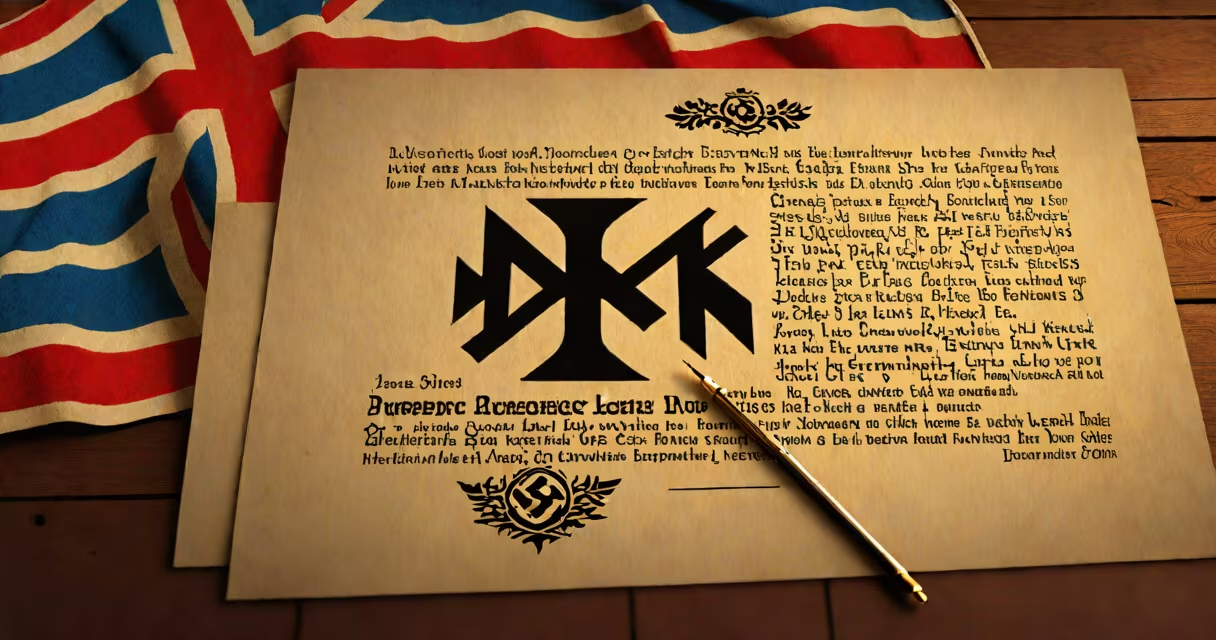
The Nuremberg Laws were a pair of statutes enacted by Nazi Germany in September 1935 that stripped Jewish people of German citizenship and prohibited marriage and sexual relations between Jews and "Aryans." These laws formalized racial discrimination under state law and served as a legal blueprint for the Holocaust.
Passed at the Nazi Party's annual rally in Nuremberg, the laws were presented as measures to preserve "racial purity" and national identity. They defined who was legally Jewish based on ancestry, not religious belief. A person with three or four Jewish grandparents was classified as Jewish, regardless of personal faith or practice.
These laws did not emerge in isolation. They followed years of escalating anti-Jewish sentiment, propaganda, and violence, including the 1933 boycott of Jewish businesses and the Kristallnacht pogrom in 1938. The Nuremberg Laws institutionalized exclusion, setting the stage for mass deportation, forced labor, and genocide.
The two core components of the Nuremberg Laws were the Reich Citizenship Law and the Law for the Protection of German Blood and German Honor. The Reich Citizenship Law revoked German citizenship from Jews, reducing them to "subjects of the state" without rights. This meant they could not vote, hold public office, or access social services.
The second law banned marriages and extramarital relations between Jews and non-Jewish Germans. Violations carried prison sentences of up to ten years. The law applied even to mixed-race couples where one partner had Jewish ancestry, regardless of appearance or self-identification.
A key enforcement mechanism was the "Jewish certificate," issued by local authorities. Individuals had to prove their ancestry through birth records, baptismal certificates, and family trees. The burden of proof fell entirely on the individual, often leading to arbitrary decisions.
The Nuremberg Laws created a rigid hierarchy of racial classification. The categories were:
| Racial Classification | Definition | Legal Consequence |
|---|---|---|
| Jew (Jude) | Anyone with three or four Jewish grandparents | Stripped of citizenship, barred from public life |
| Mixed-Race (Mischling) | One Jewish grandparent; classified as "first degree" | Subject to restrictions but retained some rights |
| Mixed-Race (Mischling) | Two Jewish grandparents; classified as "second degree" | Allowed to marry non-Jews under special permission |
| Non-Jewish German | Four non-Jewish grandparents | Full citizenship and rights |
People with one Jewish grandparent were not officially Jewish but still faced increasing restrictions. By 1938, the Nazis expanded the definition so that anyone with three Jewish grandparents was deemed Jewish-even if raised as Christian.
Local officials interpreted the laws inconsistently. In Berlin, courts sometimes allowed exceptions for interfaith couples who had children. In rural areas, enforcement was stricter. The lack of centralized oversight created regional disparities in treatment.
The Nuremberg Laws marked the first time in modern history that a government systematically used law to define race and deny civil rights based on ancestry. This precedent influenced later discriminatory policies worldwide, including apartheid in South Africa and racial segregation in the United States.
After World War II, the Nuremberg Trials prosecuted Nazi leaders for crimes against humanity. The laws were cited as evidence of premeditated state-sponsored persecution. The International Military Tribunal concluded that the Nuremberg Laws were part of a broader plan to eliminate Jews from Europe.
Today, scholars cite the Nuremberg Laws as a cautionary example of how legal systems can be weaponized to justify violence. The United Nations Educational, Scientific and Cultural Organization (UNESCO) includes the laws in its curriculum on human rights and genocide prevention. According to UNESCO, "The Nuremberg Laws show how ideology can infiltrate law to enable mass atrocity."
Many assume the Nuremberg Laws were purely symbolic or that they only affected religious Jews. In reality, the laws targeted people based on ancestry, not faith. A Jewish person who converted to Christianity remained legally Jewish under the laws.
Another misconception is that the laws were enforced uniformly. In fact, implementation varied widely. Some cities, like Hamburg, delayed enforcement until 1936. Others, like Munich, began applying the laws immediately after passage.
A lesser-known fact: the term "Nuremberg Laws" was not used by the Nazis themselves. The official titles were "Reich Citizenship Law" and "Law for the Protection of German Blood and German Honor." The name "Nuremberg Laws" emerged in postwar historical discourse to emphasize the location and significance of the 1935 party rally.
In 1937, a Berlin couple-Hans and Anna Schlosser-married despite being legally prohibited from doing so. Hans was a German citizen with one Jewish grandparent. Anna was Catholic with no Jewish ancestry. Their marriage was valid under church law but illegal under the Nuremberg Laws.
They were arrested in 1938. Hans was sentenced to six months in prison for violating the blood protection law. Anna received a warning. The case was documented in the Berlin State Archives and later referenced in the 1947 Nuremberg Trials as evidence of state overreach.
This case illustrates how the laws disrupted personal lives and created moral dilemmas. Many couples chose to marry secretly, knowing they risked imprisonment or separation. The emotional toll on families was severe and long-lasting.
The Nuremberg Laws remain a benchmark in discussions about legal racism and human rights. They are studied in law schools and ethics courses worldwide. The U.S. Supreme Court referenced them in the 1954 Brown v. Board of Education decision, highlighting how laws can uphold systemic inequality.
When we examine the Nuremberg Laws, we see how language, classification, and legal procedure can enable dehumanization. The laws did not start with violence-they began with definitions. Once someone was labeled "non-citizen" or "racially impure," further exclusion became acceptable.
Understanding what the Nuremberg Laws were helps us recognize early warning signs of authoritarianism. As historian Deborah Lipstadt writes in Antisemitism: Here and Now, "The Nuremberg Laws were not the beginning of hatred-but they were the moment when hate became law."
Today, the principles behind the Nuremberg Laws serve as a reminder that citizenship, identity, and belonging must be protected by law-not eroded by it. The lessons from this period continue to inform global efforts to prevent genocide and protect minority rights.