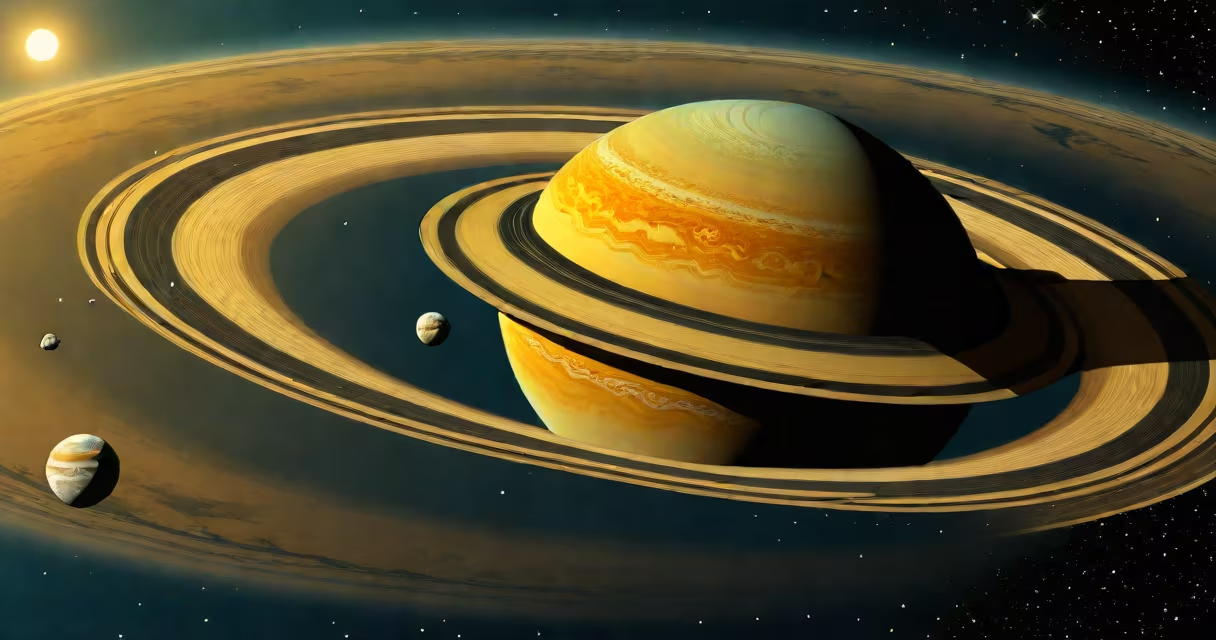
Saturn is a gas giant planet, one of the four outer planets in our solar system characterized by massive size, low density, and thick atmospheres composed mainly of hydrogen and helium.
Gas giants form far from the Sun, where temperatures allow volatile compounds like water, methane, and ammonia to condense into ice. Saturn formed in this cold region beyond the frost line, accumulating vast amounts of gas from the protoplanetary disk. Its core likely consists of rock and ice, surrounded by layers of metallic hydrogen under immense pressure. This structure gives Saturn its enormous volume and low average density-less than water's, meaning it would float if placed in a bathtub large enough.
The planet's most distinctive feature is its extensive ring system, made of billions of icy particles ranging from dust-sized grains to house-sized chunks. These rings orbit within Saturn's equatorial plane and are held in place by gravitational interactions with the planet and its many moons. The rings are not solid-they're a changing, constantly shifting collection of debris.
Scientists classify planets into four types: terrestrial, gas giants, ice giants, and dwarf planets. Saturn belongs to the gas giant category, alongside Jupiter. Both are primarily composed of hydrogen and helium, with no solid surface. Their atmospheres extend deep into the interior, where pressure transforms hydrogen into a conductive liquid state.
Ice giants-Uranus and Neptune-are distinct from gas giants. They contain more water, ammonia, and methane ices in their mantles and have lower hydrogen content. Saturn's atmospheric composition includes trace amounts of ammonia, water vapor, and hydrocarbons, which form colorful cloud bands and storms. The Great White Spot-a massive storm that appears roughly every 30 Earth years-has been observed since 1876 and last erupted in 2010.
| Planet Type | Examples | Key Traits |
|---|---|---|
| Terrestrial | Mars, Venus, Earth, Mercury | Rocky surfaces, thin or no atmospheres, small size |
| Gas Giant | Jupiter, Saturn | Massive, low density, thick hydrogen-helium atmospheres |
| Ice Giant | Uranus, Neptune | Higher proportions of water, ammonia, and methane ices |
| Dwarf Planet | Pluto, Ceres | Orbit the Sun but haven't cleared their orbital paths |
Many assume Saturn is a rocky planet due to its visibility through telescopes. But its appearance is due to reflected sunlight off high-altitude clouds, not a solid surface. The planet's diameter is 116,460 km-nearly ten times Earth's-but its mass is only 95 times greater, confirming its low density.
Another misconception is that Saturn's rings are ancient. Data from NASA's Cassini mission shows they are relatively young-possibly forming less than 100 million years ago from the breakup of a moon or comet. The rings' brightness and lack of contamination by micrometeorites suggest recent origin, contradicting earlier theories of formation during the solar system's early days.
Some believe Saturn's rings are made of metal or rock. They are actually composed mostly of water ice, with traces of dust and organic material. Ice particles reflect sunlight efficiently, giving the rings their brilliant shine. Spectroscopic analysis from Cassini confirmed the presence of crystalline water ice and silicate dust, indicating a mix of materials from different sources.
In 2017, NASA's Cassini spacecraft executed its Grand Finale-seven dives between Saturn and its innermost rings. During these passes, instruments measured the planet's gravity field and ring composition. Data revealed that the rings are losing mass at a rate of about 10,000 kilograms per second, falling into Saturn's atmosphere. This erosion process suggests the rings may disappear entirely in 100 million years.
Cassini also detected charged particles in the rings, indicating electrical activity. The spacecraft's magnetometer recorded magnetic field variations that helped refine models of Saturn's internal structure. These findings confirm that Saturn's core is not a single dense ball but likely a diffuse mixture of rock, ice, and metallic hydrogen extending over thousands of kilometers.
I watched Saturn through a 10-inch telescope during a clear night in 2019. The rings were sharply defined, and the planet's equatorial bulge was visible. When I zoomed in, I saw subtle banding near the equator-dark and light stripes caused by wind patterns. That moment confirmed what science had told me: Saturn is not a static ball of gas. It's a changing, spinning world shaped by useful internal forces and external influences.
Understanding what type of planet Saturn is requires knowing its physical makeup, formation history, and observational evidence. It is not a terrestrial planet, nor is it an ice giant. Saturn is a gas giant-defined by its composition, size, and behavior. Its classification helps explain why it differs from Earth, Mars, or even Uranus.
Knowing that Saturn is a gas giant clarifies its role in planetary science. It serves as a natural laboratory for studying atmospheric dynamics, ring systems, and internal structure under extreme conditions. Future missions like the proposed Dragonfly probe to Titan-Saturn's largest moon-will build on this understanding, using Saturn's environment to explore the chemistry of life's building blocks.
Recognizing Saturn as a gas giant allows accurate comparisons across the solar system. It is not a "giant Earth" or a "miniature star." It is a unique class of planet shaped by the laws of physics and the history of our cosmic neighborhood. This classification matters because it guides how we study, model, and interpret planetary behavior.
When asking what type of planet is Saturn, the answer is clear: it is a gas giant. This label reflects its composition, formation, and observable traits. Understanding this helps distinguish it from other planets and reveals its place in the broader context of planetary science.