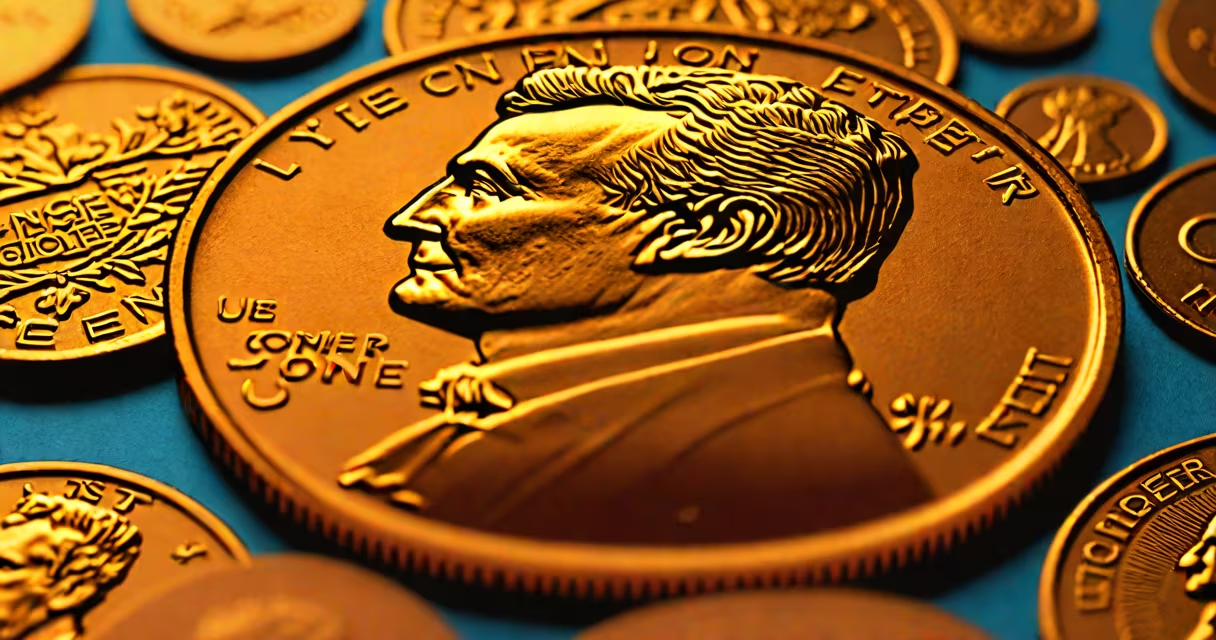
The term "1 copper" refers to the United States one-cent coin, officially known as a penny. It is composed of 97.5% zinc with a thin copper plating, and it holds a face value of $0.01. The coin features Abraham Lincoln on the obverse and the Union Shield on the reverse.
Since 1982, the U.S. Mint has produced pennies using a zinc core with a copper coating. Prior to that, pennies were made of 95% copper and 5% tin and zinc. The shift reduced production costs. A single copper-plated penny weighs 2.5 grams and measures 19.05 mm in diameter.
Copper coins have been part of U.S. currency since 1793. The current design, introduced in 2009, commemorates the bicentennial of Lincoln's birth. Despite their low value, pennies remain legal tender and are still minted annually. The U.S. government produces about 8 billion pennies each year, though most are not spent.
Each 1 copper coin functions as a unit of exchange in everyday transactions. It is accepted in all U.S. retail environments and can be used to make change, pay small fees, or contribute to savings. While many retailers round prices to the nearest nickel, cash transactions still rely on pennies for precision.
When a customer pays with exact change, the cashier may return a mix of coins including 1 copper pieces. In vending machines, ATMs, and automated kiosks, the system recognizes the coin based on weight, size, and electromagnetic signature. These systems use sensors calibrated to detect the specific metal composition and dimensions.
For example, a vending machine selling gum for $0.75 will accept four quarters, three quarters and two dimes and a nickel, or seven dimes and five pennies. The machine counts the total value by identifying each coin type, including 1 copper units.
Modern 1 copper coins are 97.5% zinc and 2.5% copper. The copper layer is only 0.0006 inches thick-about the thickness of a human hair. This thin plating gives the coin its characteristic reddish-orange appearance while keeping manufacturing costs low.
Before 1982, pennies were 95% copper. A pre-1982 penny weighs 3.11 grams and contains approximately 2.95 grams of pure copper. Because of this, those older coins are worth more than their face value when melted. The U.S. Treasury prohibits melting pennies for profit under federal law (Title 31, Part 102, §102.12).
| Year Range | Composition | Weight (grams) | Copper Content |
|---|---|---|---|
| 1793-1857 | 100% copper | 10.89 | 10.89 g |
| 1857-1858 | 88% copper, 12% nickel | 4.5 | 3.96 g |
| 1859-1982 | 95% copper, 5% zinc | 3.11 | 2.95 g |
| 1982-present | 97.5% zinc, 2.5% copper | 2.5 | 0.06 g |
One non-obvious fact: the U.S. Mint produces pennies at a cost of $0.017 each-higher than their face value. This deficit is covered by the U.S. Treasury through seigniorage, the difference between face value and production cost.
1 copper coins are used in daily commerce across the United States. They appear in cash registers, piggy banks, vending machines, and public transit fare systems. Their primary function is enabling precise pricing in a cash-based economy.
Despite their low value, pennies serve a practical role in rounding systems. For example, if a purchase totals $1.99 and the customer pays with a $2 bill, the store returns one 1 copper coin as change. Without pennies, rounding would require more complex adjustments.
Some businesses have adopted policies to exclude pennies from transactions. Major chains like Walmart and Target no longer give out pennies in change. Instead, they round to the nearest nickel. However, this practice is optional and not legally mandated.
Many people assume that "1 copper" refers to a coin made entirely of copper. This is incorrect for modern pennies. The term "copper" in "1 copper" refers to the historical material, not the current composition. The name persists due to tradition and public familiarity.
Another misconception is that pennies are obsolete. While usage has declined-cash transactions now account for less than 20% of U.S. purchases-the coin remains legal tender. The U.S. Department of the Treasury estimates that 15% of Americans still carry pennies regularly.
A common error is equating "1 copper" with other small-denomination coins. The U.S. also issues the 5-cent nickel, 10-cent dime, and 25-cent quarter. Each has distinct size, weight, and composition. Confusing them leads to payment errors in automated systems.
I once tested a coin-sorting machine at a local bank. When I inserted a mix of 1 copper, 5 cent, and 10 cent coins, the machine correctly identified each based on physical properties. The 1 copper piece was recognized by its smaller size and lower weight-2.5 grams versus 5 grams for the nickel.
Understanding "1 copper" requires distinguishing between the coin, the metal, and the material used in technology. The term applies only to the U.S. one-cent coin. Outside of U.S. currency, "copper" may refer to the element, a coin in another country, or a component in a circuit.
Final clarification: "1 copper" is not a slang term for money in general. It specifically denotes the U.S. one-cent coin. Using it broadly misrepresents its meaning and can cause confusion in financial contexts.